

#Short Answer
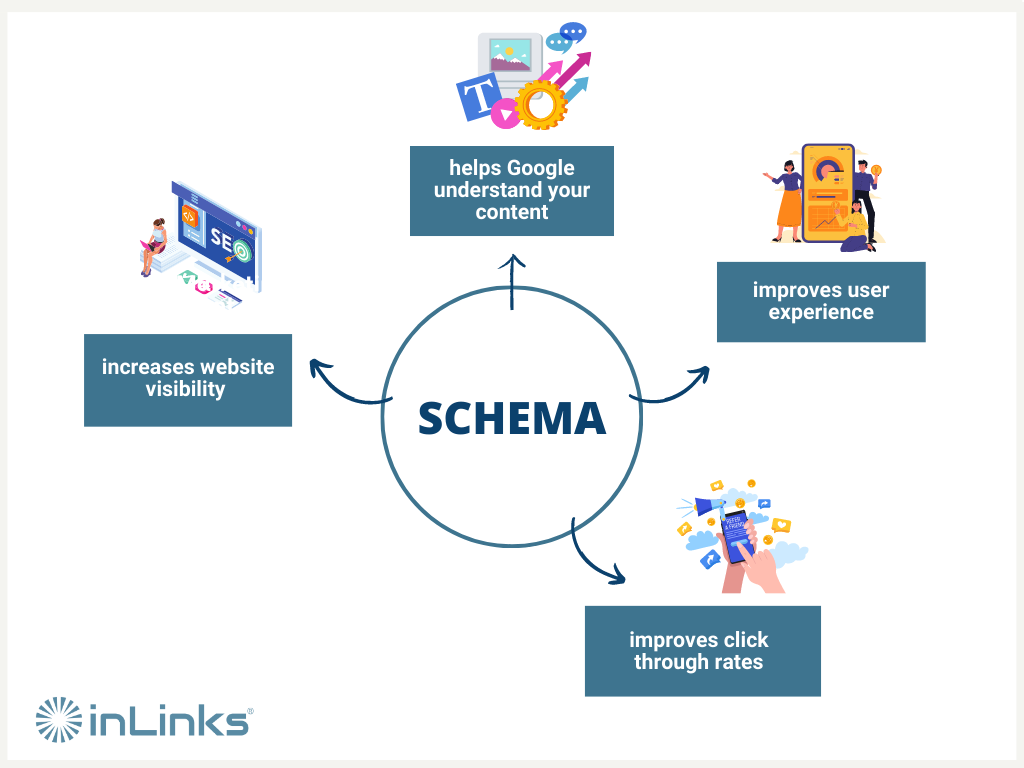
Schema markup, also known as structured data, is a semantic vocabulary that helps search engines better comprehend the content of web pages. Unlike traditional HTML, which primarily describes the structure and presentation of content, schema markup provides explicit clues about the meaning of data. This allows search engines to present more informative and visually appealing results to users, such as star ratings for reviews, event dates, product prices, and breadcrumb navigation.
#Infobox
#Overview
Schema markup, also known as structured data, is a semantic vocabulary that helps search engines better comprehend the content of web pages. Unlike traditional HTML, which primarily describes the structure and presentation of content, schema markup provides explicit clues about the meaning of data. This allows search engines to present more informative and visually appealing results to users, such as star ratings for reviews, event dates, product prices, and breadcrumb navigation.
The primary goal of schema markup is to bridge the gap between human-readable content and machine-readable data. By embedding structured data within a webpage, webmasters can influence how search engines interpret and display their content, potentially improving click-through rates (CTR) and user engagement. Schema markup is widely recognized as a critical component of modern SEO strategies due to its ability to enhance visibility in search engine results pages (SERPs).
#### Key Components Itemscope: Defines the scope of the item being described.
- Itemtype: Specifies the type of item (e.g.,
Product,Event,Person). - Itemprop: Describes properties of the item (e.g.,
name,price,datePublished). - Itemref: References properties defined outside the itemscope.
#History / Background
Schema markup was introduced in 2011 through a collaboration between major search engines—Google, Microsoft, Yahoo, and Yandex—under the umbrella of Schema.org. The initiative aimed to create a unified, open standard for structured data markup that could be universally adopted across the web. Before Schema.org, webmasters relied on disparate markup formats like Microformats, RDFa, and Microdata, which often led to inconsistencies and limited adoption.
The formation of Schema.org marked a significant shift in the SEO landscape, as it provided a single, authoritative source for structured data vocabulary. Over the years, the schema has expanded to include thousands of types and properties, covering a wide range of entities such as local businesses, creative works, medical conditions, and educational courses. This evolution has been driven by the growing demand for richer, more interactive search results and the rise of voice search and AI-powered assistants.
#How It Works
Schema markup works by embedding structured data into the HTML of a webpage using one of three primary syntaxes: JSON-LD, Microdata, or RDFa. Each syntax serves the same purpose but differs in implementation and readability.
#### Syntax Options JSON-LD (JavaScript Object Notation for Linked Data): The recommended syntax by Google, JSON-LD is a lightweight, script-based format that can be embedded directly into the or of a webpage. It is easier to implement and maintain compared to other formats.
- Microdata: An HTML5 specification that uses attributes like
itemscope,itemtype, anditempropto annotate content. While widely supported, it is considered less flexible than JSON-LD. - RDFa: A W3C standard that extends HTML with attributes to embed structured data. It is often used in conjunction with other markup languages like XHTML.
#Implementation Process
- Identify Relevant Schema Types: Choose the appropriate schema type (e.g.,
Article,LocalBusiness,BreadcrumbList) based on the content of the webpage. - Define Properties: Specify the properties of the schema type (e.g.,
name,description,image,url). - Embed Markup: Insert the structured data into the HTML using the chosen syntax.
- Validate Markup: Use tools like Google’s Structured Data Testing Tool or Schema Markup Validator to ensure correctness.
- Monitor Performance: Track the impact of schema markup on search rankings, CTR, and other SEO metrics using tools like Google Search Console.
#Important Facts
- Not a Ranking Factor: While schema markup does not directly influence search rankings, it can indirectly improve visibility by enabling rich snippets and enhanced search results.
- Supports Multiple Entities: Schema.org includes over 800 types and 1,400 properties, covering a vast array of entities such as events, recipes, FAQs, and job postings.
- Google’s Preference for JSON-LD: Google recommends using JSON-LD for schema markup due to its simplicity and ease of implementation.
- Dynamic Rendering: For JavaScript-heavy websites, dynamic rendering techniques can be used to serve structured data to search engine crawlers while maintaining a user-friendly interface.
- Local SEO Impact: Schema markup for local businesses (e.g.,
LocalBusiness,Restaurant) can significantly improve visibility in local search results and Google Maps. - Rich Results Testing Tool: Google provides a dedicated tool to validate and preview how structured data will appear in search results.
#Timeline
- Schema.org is launched by
Schema.org is launched by Google, Microsoft, Yahoo, and Yandex.
- Google introduces rich snippet
Google introduces rich snippets, leveraging schema markup for enhanced search results.
- Schema.org expands to include
Schema.org expands to include types for events, products, and creative works.
- Google updates its guidelines
Google updates its guidelines to emphasize JSON-LD as the preferred syntax for schema markup.
- Schema.org introduces vocabula
Schema.org introduces vocabulary for medical and health-related entities.
- Google launches the Rich
Google launches the Rich Results Test tool to help webmasters validate structured data.
- Schema.org adds support for
Schema.org adds support for FAQ and How-To markup, enabling interactive search results.
- Google introduces new schema
Google introduces new schema types for educational courses and Q&A pages.
#Related Terms
#FAQ
What does What Is Schema Markup? cover?
Explains what schema markup is, how it works, common examples, and why the concept matters for readers.
Why is What Is Schema Markup? important?
It helps readers understand key concepts, compare practical use cases, and evaluate how SEO decisions affect outcomes, risks, and implementation choices.
What should readers verify before applying this topic?
Readers should compare the benefits, limitations, data requirements, and related themes such as Explainer, Schema, Markup before using the ideas in real projects.
#References
- What Is Schema Markup? terminology and background research
- What Is Schema Markup? use cases, implementation examples, and limitations
- SEO best practices, standards, and risk guidance
- Explainer case studies, benchmarks, and current industry analysis




Comments
No comments yet. Start the discussion with a useful note.