

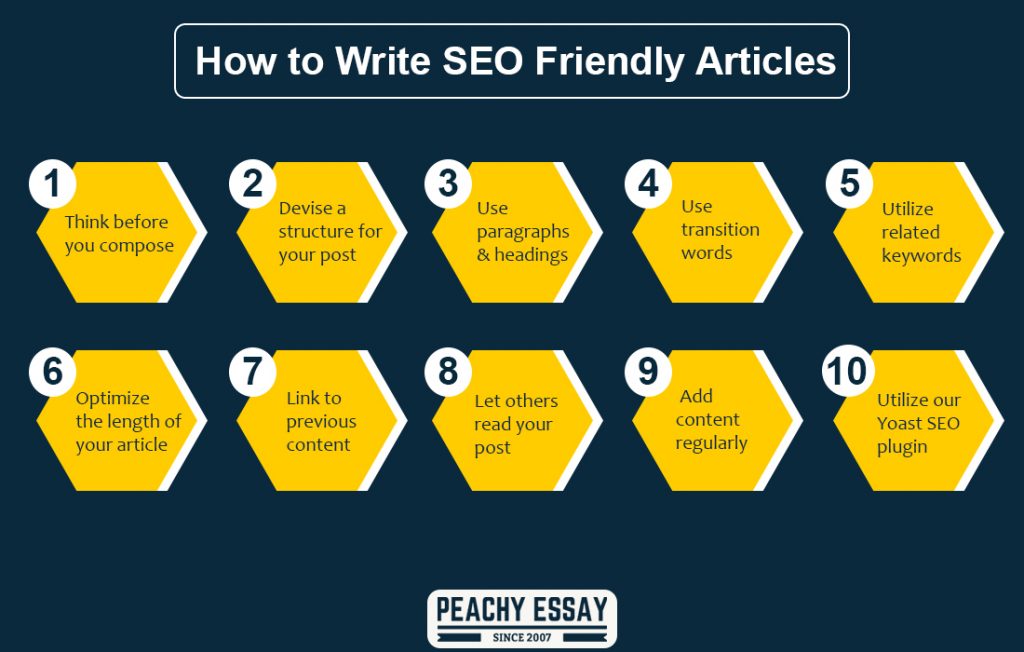
#Short Answer
SEO (Search Engine Optimization) article writing is a specialized form of content creation designed to improve a webpage's visibility on search engines like Google, Bing, and Yahoo. Unlike traditional writing, SEO articles prioritize both user experience and search engine algorithms to ensure content is discoverable and ranks well for relevant search queries.
#Infobox
#Overview
SEO (Search Engine Optimization) article writing is a specialized form of content creation designed to improve a webpage's visibility on search engines like Google, Bing, and Yahoo. Unlike traditional writing, SEO articles prioritize both user experience and search engine algorithms to ensure content is discoverable and ranks well for relevant search queries.
The process involves extensive research, strategic keyword integration, and adherence to SEO best practices such as proper heading hierarchy, internal linking, and mobile optimization. High-quality SEO articles not only attract more visitors but also establish authority and credibility in a given niche.
#History / Background
The concept of SEO article writing emerged in the late 1990s with the rise of search engines. Early search engines like AltaVista and Yahoo relied on simple keyword matching, leading to the creation of "keyword stuffing" content—articles filled with repetitive phrases to manipulate rankings. However, as search algorithms evolved, particularly with Google's PageRank update in 2000, the focus shifted toward relevance, quality, and user experience.
In 2011, Google introduced the Panda algorithm, which penalized low-quality content and rewarded well-researched, original articles. This marked a turning point, emphasizing the need for valuable, user-centric content over manipulative SEO tactics. Today, SEO writing aligns with Google’s Search Quality Evaluator Guidelines, which prioritize expertise, authoritativeness, and trustworthiness (E-A-T).
#How It Works
#Keyword Research
Keyword research is the foundation of SEO article writing. It involves identifying terms and phrases that users search for in relation to a specific topic. Tools like Google Keyword Planner, Ahrefs, and SEMrush help determine search volume, competition, and relevance. Long-tail keywords (e.g., "how to write an SEO article for beginners") are often preferred due to lower competition and higher conversion potential.
#Content Structure and Readability
An SEO article should be well-structured with clear headings (<h2>, <h3>) to improve readability and signal content hierarchy to search engines. Bullet points, numbered lists, and short paragraphs enhance user engagement. Tools like Hemingway Editor or Yoast SEO can assess readability scores.
#On-Page SEO
On-page SEO elements include:
- Title Tag: The clickable headline in SERPs, ideally under 60 characters.
- Meta Description: A concise summary (under 160 characters) that encourages clicks.
- URL Structure: Clean, keyword-rich URLs (e.g.,
/seo-article-writing-guide). - Internal Linking: Connecting to related articles to improve navigation and SEO.
- Image Optimization: Using descriptive
alttext and compressing file sizes for faster loading.
#User Intent and Content Quality
Search engines prioritize content that aligns with user intent—whether informational, navigational, commercial, or transactional. High-quality SEO articles answer user queries comprehensively, cite credible sources, and avoid thin or duplicate content. Google’s BERT algorithm further refines this by understanding natural language and context.
#Important Facts
- Google processes over 8.5 billion searches per day, making SEO a critical traffic source.
- The first result on Google’s SERP receives 31.7% of clicks, while the second gets 24.7%.
- Articles with 2,000+ words tend to rank higher, as they cover topics in depth.
- Mobile optimization: is essential, as over 60% of searches occur on mobile devices.
- Google’s Core Web Vitals (e.g., page speed, interactivity) impact rankings.
- Backlinks from authoritative sites remain a top ranking factor.
#Timeline
- Google is founded, introducing
Google is founded, introducing PageRank algorithm.
- Google launches AdWords, incre
Google launches AdWords, increasing demand for SEO.
- Google introduces Florida upda
Google introduces [Florida update](# 'Florida (algorithm)'), penalizing spammy SEO tactics.
- Google Panda update targets
Google Panda update targets low-quality content.
- Mobilegeddon update prioritize
Mobilegeddon update prioritizes mobile-friendly websites.
- BERT algorithm improves natura
BERT algorithm improves natural language processing.
- Google introduces Core Web
Google introduces Core Web Vitals as ranking factors.
#Related Terms
#FAQ
What does How To Write An SEO Article cover?
Outlines how to write an SEO article, with practical steps, key decisions, common mistakes, and tips for better results.
Why is How To Write An SEO Article important?
It helps readers understand key concepts, compare practical use cases, and evaluate how SEO decisions affect outcomes, risks, and implementation choices.
What should readers verify before applying this topic?
Readers should compare the benefits, limitations, data requirements, and related themes such as Tutorial, Write, Content Generation before using the ideas in real projects.
#References
- How To Write An SEO Article terminology and background research
- How To Write An SEO Article use cases, implementation examples, and limitations
- SEO best practices, standards, and risk guidance
- Tutorial case studies, benchmarks, and current industry analysis




Comments
No comments yet. Start the discussion with a useful note.