

#Short Answer
Explains What Is Dropout in Neural Networks, including the core definition, how it works, practical examples, and limitations.
#Infobox
#How It Works
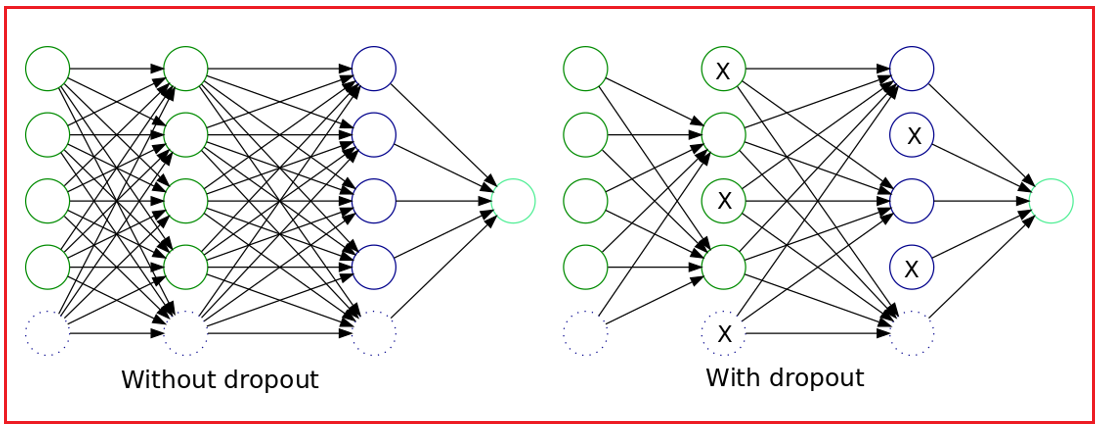
Mechanism Dropout operates by randomly setting a fraction of neuron outputs to zero during each training iteration. The probability of a neuron being dropped is controlled by a hyperparameter called the dropout rate (typically denoted as p), which ranges between 0.2 and 0.5. For example, if p = 0.5, each neuron has a 50% chance of being deactivated in a given iteration.
Training Phase During training: 1. A random subset of neurons is selected for dropout based on the dropout rate. 2. The selected neurons are temporarily deactivated, meaning their outputs are set to zero. 3. The remaining active neurons are scaled by a factor of 1/(1-p) to maintain the expected output magnitude. 4. The network's weights are updated via backpropagation as usual. 5. The process repeats for each training iteration.
Inference Phase During testing or inference: - Dropout is disabled, and all neurons are active. - The weights of the neurons are scaled by the dropout rate to account for the absence of dropout during training. This ensures that the expected output of the network remains consistent with the training phase.
Mathematical Formulation Let x be the input to a neuron, w be its weight, and b be its bias. During training, the neuron's output y is computed as: \[ y = \begincases 0 & \textwith probability p, \\ \fracx \cdot w + b1 - p & \textwith probability 1 - p. \endcases \] During inference, the output is simply: \[ y = x \cdot w + b. \]
Variants Several variants of dropout have been proposed to adapt the technique to different scenarios:
- Spatial Dropout: Used in CNNs, where entire feature maps (channels) are dropped instead of individual neurons.
- DropConnect: Instead of dropping neurons, individual weights are randomly set to zero.
- Alpha Dropout: Designed for self-normalizing neural networks (SNNs), where the dropout rate is adjusted to preserve the mean and variance of the activations.
- Gaussian Dropout: Neurons are scaled by a random value drawn from a Gaussian distribution instead of being set to zero.
#Important Facts
- Regularization Effect: Dropout acts as a form of ensemble learning, where multiple sub-networks are trained simultaneously. The final model can be seen as an average of these sub-networks, which improves generalization.
- Reduction of Co-adaptation: By randomly deactivating neurons, dropout prevents neurons from developing strong dependencies on specific features, forcing the network to learn more robust representations.
- Computational Efficiency: Dropout adds minimal computational overhead during training, as it only involves random number generation and masking operations.
- Hyperparameter Sensitivity: The dropout rate is a critical hyperparameter. A rate that is too low may not effectively prevent overfitting, while a rate that is too high may lead to underfitting.
- Compatibility: Dropout can be combined with other regularization techniques, such as L1/L2 regularization, batch normalization, and early stopping, to further enhance model performance.
- Architectural Considerations: Dropout is typically applied to fully connected layers in DNNs and to convolutional layers in CNNs. It is less commonly used in recurrent layers (e.g., LSTM, GRU) due to the sequential nature of the data.
#Timeline
- Foundational ideas
Core concepts and early methods shape What Is Dropout in Neural Networks?.
- Practical use
Tools, examples, and real-world deployments make the topic easier to evaluate.
- Responsible implementation
Current work focuses on reliability, governance, performance, and measurable impact.
#Related Terms
#FAQ
What does What Is Dropout in Neural Networks? cover?
Explains What Is Dropout in Neural Networks, including the core definition, how it works, practical examples, and limitations.
Why is What Is Dropout in Neural Networks? important?
It helps readers understand key concepts, compare practical use cases, and evaluate how Machine Learning decisions affect outcomes, risks, and implementation choices.
What should readers verify before applying this topic?
Readers should compare benefits, limitations, data requirements, and related themes such as Dropout, Neural, Networks before using the ideas in real projects.
#References
- What Is Dropout in Neural Networks? terminology and background research
- What Is Dropout in Neural Networks? use cases, implementation examples, and limitations
- Machine Learning best practices, standards, and risk guidance
- Dropout case studies, benchmarks, and current industry analysis

Comments
No comments yet. Start the discussion with a useful note.