

#Short Answer
Explains What Is AI in Gaming, including the core definition, how it works, practical examples, and limitations.
#Infobox
#Overview
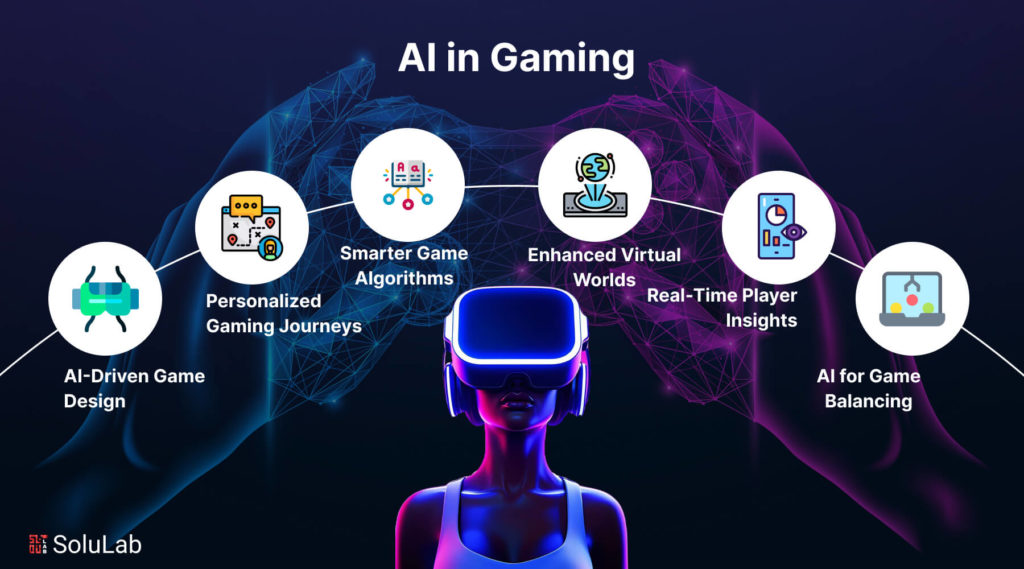
Artificial Intelligence in gaming (often referred to as Game AI) encompasses the application of AI technologies to enhance various aspects of video games, including non-player character (NPC) behavior, game world generation, adaptive difficulty, and player interaction. Unlike traditional software, AI in games focuses on creating systems that can simulate human-like decision-making, learn from player actions, and generate dynamic content in real time. Game AI is not a monolithic concept but a diverse field that integrates machine learning, pathfinding algorithms, natural language processing, and procedural generation. These technologies enable games to respond intelligently to player inputs, create vast and unique worlds, and offer personalized experiences. From classic arcade games like Pac-Man to modern open-world titles like The Witcher 3 and Red Dead Redemption 2, AI has become a cornerstone of modern game development. The integration of AI has transformed gaming from a static, scripted experience into a living, evolving environment where every playthrough can feel unique. This shift has not only improved player immersion but also expanded the creative possibilities for game designers and developers.
#History / Background
#Early Foundations (1950s–1970s)
The concept of AI in gaming traces its roots to the early days of computer science. In 1950, Alan Turing proposed the "Turing Test," which laid the groundwork for evaluating machine intelligence—a principle that would later influence game AI. The first notable application of AI in games came in 1951 with Nim, a mathematical game where an AI could defeat human players using basic algorithms. By the 1960s and 1970s, AI began appearing in arcade and early computer games. Spacewar! (1962), one of the first digital video games, featured AI-controlled opponents that could navigate and shoot at the player. Pong (1972) included simple AI to control the opponent’s paddle, responding to the ball’s movement with predefined logic.
#The Arcade and Console Era (1980s–1990s)
The 1980s marked a significant leap with the introduction of more sophisticated AI in arcade and console games. Pac-Man (1980) featured ghosts with distinct behaviors—each following a different algorithm to chase the player, creating a sense of unpredictability. Super Mario Bros. (1985) used simple AI to control enemies like Goombas and Koopas, which followed fixed paths or reacted to player proximity. This era also saw the rise of text-based adventure games like Zork (1977) and Colossal Cave Adventure (1976), which used natural language processing to interpret player commands and generate dynamic responses. These games demonstrated the potential of AI to create immersive, interactive narratives.
#The 3D Revolution and Modern AI (2000s–Present)
The transition to 3D graphics in the late 1990s and early 2000s brought new challenges and opportunities for AI in gaming. Games like Half-Life (1998) introduced AI-driven NPCs that could coordinate attacks, take cover, and react to environmental changes. Halo: Combat Evolved (2001) popularized the use of "flocking" algorithms, allowing groups of enemies to move realistically as a unit. The 2010s saw a surge in the use of machine learning and neural networks in gaming. Left 4 Dead (2008) introduced the "AI Director," a dynamic system that adjusted enemy spawns and item placements based on player performance, creating a personalized challenge. Middle-earth: Shadow of Mordor (2014) featured the Nemesis System, which tracked individual enemy behaviors and relationships, allowing for persistent, evolving rivalries between the player and NPCs. Today, AI is integral to nearly every aspect of game development, from procedural world generation in No Man’s Sky (2016) to real-time ray tracing and adaptive difficulty systems in Resident Evil 4 Remake (2023). The rise of generative AI and large language models (LLMs) is further expanding the possibilities, enabling NPCs with more natural dialogue and dynamic storytelling.
#How It Works
#Core AI Techniques in Gaming
- Rule-Based Systems The simplest form of game AI uses predefined rules to dictate NPC behavior. For example, an enemy might follow a scripted patrol route or attack when the player enters its line of sight. While effective for structured gameplay, rule-based systems lack adaptability and can feel predictable over time.
- Pathfinding Algorithms Pathfinding is essential for NPCs to navigate game environments intelligently. The A (A-Star) algorithm* is the most widely used method, balancing efficiency and accuracy to find the shortest path between two points while avoiding obstacles. Variations like Dijkstra’s algorithm and Jump Point Search are also employed in complex environments.
- Finite State Machines (FSMs) FSMs model NPC behavior as a series of states (e.g., "patrol," "attack," "flee") with transitions triggered by specific conditions. While simple to implement, FSMs can become unwieldy in large-scale games with numerous possible behaviors.
- Behavior Trees A more flexible alternative to FSMs, behavior trees organize AI logic into a hierarchical structure of nodes (e.g., "selector," "sequence," "decorator"). This allows for more complex and reactive decision-making, as seen in games like The Last of Us and Assassin’s Creed.
- Procedural Content Generation (PCG) AI-driven PCG uses algorithms to create game content dynamically, such as terrain, levels, quests, or even entire worlds. Techniques include Perlin noise for terrain generation, context-free grammars for dialogue, and neural networks for style transfer in asset creation.
- Machine Learning and Neural Networks Modern games increasingly use deep learning and reinforcement learning to train AI models. For instance:
- Supervised learning can teach NPCs to mimic human player strategies.
- Reinforcement learning enables AI to optimize actions based on rewards, as seen in AlphaStar (DeepMind’s AI that mastered StarCraft II).
- Generative Adversarial Networks (GANs) can create realistic textures, animations, or even entire game levels.
- Natural Language Processing (NLP) NLP allows NPCs to understand and respond to player speech or text inputs. Games like Detroit: Become Human (2018) use dialogue trees with NLP to enable branching conversations that adapt to player choices.
- Adaptive Difficulty Systems AI can adjust game difficulty in real time based on player performance. For example, Left 4 Dead’s AI Director monitors player health, ammo, and enemy encounters to dynamically spawn resources or threats, ensuring a balanced challenge.
#Important Facts
- AI is not always "intelligent": Much of game AI relies on pre-programmed rules or algorithms rather than true cognition. Modern AI techniques like neural networks are changing this, but many games still use simpler methods for performance and predictability.
- NPCs are not truly "alive": Despite appearances, most game AI operates within strict computational limits. Even advanced systems like The Sims or Creatures rely on simulated behaviors rather than genuine intelligence.
- AI can create entire worlds: Procedural generation powered by AI has enabled games like No Man’s Sky to generate over 18 quintillion unique planets, each with distinct ecosystems, creatures, and resources.
- AI enhances replayability: Dynamic systems like the Nemesis System in Middle-earth: Shadow of Mordor ensure that no two playthroughs are identical, as enemies remember past encounters and adapt their behavior.
- Voice AI is growing: Games like Hellblade: Senua’s Sacrifice (2017) and Cyberpunk 2077 (2020) use AI-driven voice synthesis to create realistic dialogue for NPCs, reducing the need for extensive voice acting.
- AI is used in game testing: Companies like Ubisoft and Electronic Arts employ AI to automate playtesting, identifying bugs, balance issues, and exploits more efficiently than human testers.
- Ethical concerns exist: The use of AI in games raises questions about job displacement (e.g., voice actors, animators) and the potential for biased or harmful NPC behaviors if not properly designed.
#Timeline
- Foundational ideas
Core concepts and early methods shape What Is AI in Gaming?.
- Practical use
Tools, examples, and real-world deployments make the topic easier to evaluate.
- Responsible implementation
Current work focuses on reliability, governance, performance, and measurable impact.
#Related Terms
#FAQ
What does What Is AI in Gaming? cover?
Explains What Is AI in Gaming, including the core definition, how it works, practical examples, and limitations.
Why is What Is AI in Gaming? important?
It helps readers understand key concepts, compare practical use cases, and evaluate how Artificial Intelligence decisions affect outcomes, risks, and implementation choices.
What should readers verify before applying this topic?
Readers should compare benefits, limitations, data requirements, and related themes such as AI, Gaming, Machine Learning before using the ideas in real projects.
#References
- What Is AI in Gaming? terminology and background research
- What Is AI in Gaming? use cases, implementation examples, and limitations
- Artificial Intelligence best practices, standards, and risk guidance
- AI case studies, benchmarks, and current industry analysis

Comments
No comments yet. Start the discussion with a useful note.