


#Short Answer
Covers the science behind generative ai, including core concepts, practical examples, benefits, limitations, and risks in Generative AI.
#Infobox
#Overview
Generative AI represents a transformative branch of artificial intelligence focused on creating novel, coherent, and contextually relevant outputs from learned data distributions. Unlike traditional AI, which primarily analyzes or classifies existing information, generative models synthesize new content that can be indistinguishable from human-made artifacts. This capability stems from advanced machine learning techniques that model complex patterns in high-dimensional data. The field has evolved rapidly due to breakthroughs in deep learning, particularly the advent of transformer architectures and scalable neural networks. These models leverage vast amounts of training data to generate outputs that align with human-like creativity and reasoning. Generative AI systems are now integral to industries seeking automation, personalization, and innovation, from drafting legal documents to designing virtual environments. Key distinctions within generative AI include:
- Text Generation: Models like large language models (LLMs) produce human-like text based on prompts.
- Image Synthesis: Systems such as DALL·E and Stable Diffusion generate photorealistic or artistic images from textual descriptions.
- Audio & Music: AI tools create synthetic speech, music compositions, and sound effects.
- Code Generation: Models like GitHub Copilot assist developers by writing functional code snippets.
- Multimodal Generation: Emerging systems combine multiple modalities (e.g., text-to-video) for richer outputs. The accessibility of generative AI tools—often via cloud-based APIs or open-source frameworks—has democratized its use, enabling creators, businesses, and researchers to integrate AI-driven content generation into workflows without requiring deep technical expertise.
#History / Background
#Early Foundations (1950s–2000s)
The conceptual roots of generative AI trace back to early AI research, including:
- 1950s–1960s: Early experiments in rule-based systems and symbolic AI, such as ELIZA (1966), which simulated conversation but lacked true generative capabilities.
- 1980s–1990s: Development of probabilistic models like Hidden Markov Models (HMMs) for sequence generation, and the emergence of neural networks, though limited by computational constraints.
#The Deep Learning Revolution (2010s)
The modern era of generative AI began with advancements in deep learning:
- 2014: Introduction of Generative Adversarial Networks (GANs) by Ian Goodfellow et al., which pit two neural networks against each other—one generating data and the other evaluating it—to improve output quality.
- 2015: Variational Autoencoders (VAEs) gained prominence for their ability to generate diverse outputs by learning latent representations of data.
- 2017: The Transformer architecture (Vaswani et al.) revolutionized sequence modeling, enabling models to handle long-range dependencies in text and other data types. This laid the groundwork for large language models.
#Breakthroughs in Large-Scale Models (2018–Present)
- 2018: BERT (Bidirectional Encoder Representations from Transformers) demonstrated the power of pre-trained language models, though its primary use was discriminative tasks.
- 2019: GPT-2 (Generative Pre-trained Transformer 2) by OpenAI showcased the potential of generative models for text, generating coherent paragraphs from minimal prompts.
- 2020: DALL·E introduced text-to-image generation, combining transformers with image synthesis techniques.
- 2021: Stable Diffusion and Imagen improved image generation quality and accessibility, leveraging diffusion models for photorealistic outputs.
- 2022: ChatGPT (based on GPT-3.5) popularized conversational AI, demonstrating the versatility of generative models in real-world applications.
- 2023–2024: Rapid advancements in multimodal models (e.g., text-to-video, text-to-3D) and open-source alternatives (e.g., Llama, Stable Diffusion XL) expanded accessibility and customization.
#Key Milestones
| Year | Milestone | |----------|-------------------------------------------------------------------------------| | 1950 | Alan Turing proposes the "Imitation Game," a precursor to generative AI. | | 1966 | ELIZA simulates human conversation using pattern matching. | | 2014 | GANs are introduced, enabling high-quality image generation. | | 2017 | Transformers are proposed, revolutionizing sequence modeling. | | 2018 | BERT demonstrates the power of pre-trained language models. | | 2019 | GPT-2 showcases text generation capabilities. | | 2020 | DALL·E generates images from text descriptions. | | 2022 | ChatGPT popularizes conversational generative AI. | | 2023 | Multimodal models (e.g., text-to-video) and open-source alternatives emerge. |
#How It Works
Generative AI systems rely on deep learning models trained on large datasets to learn the statistical patterns of the input data. The core mechanisms vary by modality but generally involve the following steps:
#1. Data Collection and Preprocessing
- Datasets: Models are trained on vast, curated datasets (e.g., Common Crawl for text, LAION-5B for images). Quality and diversity of data are critical to avoid bias and ensure generalization.
- Preprocessing: Data is cleaned, normalized, and tokenized (for text) or transformed (for images/sound) to suit the model’s input requirements.
#2. Model Architecture Generative models employ different architectures depending on the output type:
Text Generation (Language Models)
- Transformers: The dominant architecture for text generation, using self-attention mechanisms to weigh the importance of each word in a sequence.
- Encoder-Decoder: Used for tasks like translation, where an input sequence is encoded into a latent representation and decoded into an output sequence.
- Decoder-Only: Models like GPT generate text autoregressively, predicting the next token based on previous tokens.
- Training Objective: Models are trained to predict the next token in a sequence (autoregressive training) or to reconstruct input data (denoising autoencoders).
Image Generation
- GANs (Generative Adversarial Networks):
- Generator: Creates images from random noise or latent vectors.
- Discriminator: Evaluates whether generated images are real or fake, providing feedback to improve the generator.
- Training: The two networks compete in a minimax game, leading to increasingly realistic outputs.
- VAEs (Variational Autoencoders):
- Encoder: Maps input images to a latent space distribution.
- Decoder: Samples from the latent space to generate new images.
- Training: Optimized to maximize the likelihood of the input data under the learned distribution.
- Diffusion Models:
- Forward Process: Gradually adds noise to an image over many steps.
- Reverse Process: A neural network learns to denoise the image, generating it from pure noise.
- Advantages: High-quality, diverse outputs with better control over the generation process.
Audio and Music Generation
- Autoregressive Models: Predict the next audio sample based on previous samples (e.g., WaveNet).
- Diffusion Models: Applied to audio synthesis for high-fidelity generation.
- Transformer-Based Models: Used for symbolic music generation (e.g., MIDI sequences).
Code Generation
- Transformer Models: Trained on large code repositories (e.g., GitHub) to predict the next token in a programming language.
- Fine-Tuning: Models are fine-tuned on specific languages or frameworks (e.g., Python, JavaScript).
#3. Training and Optimization
- Loss Functions: Models are trained to minimize a loss function that measures the difference between generated outputs and real data (e.g., cross-entropy for text, adversarial loss for GANs).
- Optimization: Techniques like stochastic gradient descent (SGD), Adam, and learning rate scheduling are used to refine model weights.
- Regularization: Methods like dropout, weight decay, and early stopping prevent overfitting.
#4. Inference (Generation)
Once trained, the model generates new content by:
- Autoregressive Sampling: For text or audio, the model predicts the next token/sample iteratively.
- Latent Space Sampling: For VAEs or diffusion models, the model samples from the learned latent distribution.
- Conditioning: Models can be guided by additional inputs (e.g., text prompts for image generation, class labels for controlled synthesis).
#5. Post-Processing Generated outputs may undergo refinement, such as:
- Upscaling: Increasing image resolution (e.g., using ESRGAN).
- Editing: Manual or automated adjustments to improve coherence or aesthetics.
- Filtering: Removing inappropriate or low-quality outputs.
#Important Facts
#Capabilities and Limitations
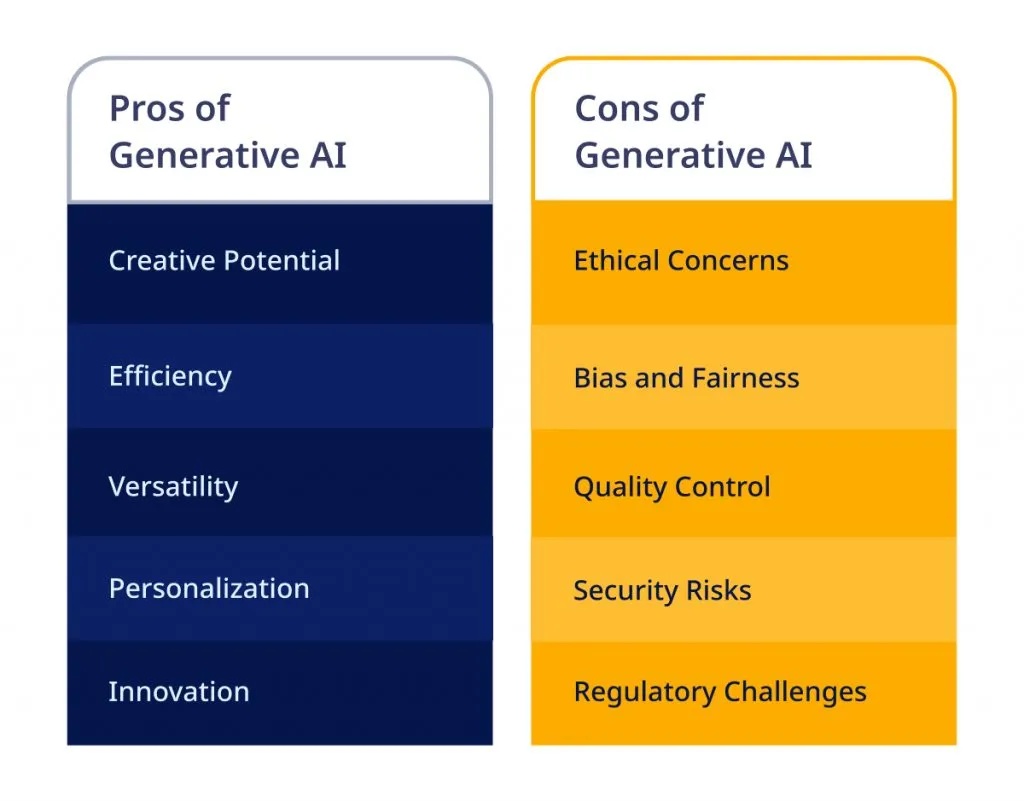
- Strengths:
- Creativity: Generates novel content, including art, music, and text.
- Automation: Accelerates repetitive tasks (e.g., drafting emails, generating reports).
- Personalization: Enables tailored content for users (e.g., chatbots, recommendation systems).
- Scalability: Can produce large volumes of content quickly.
- Limitations:
- Hallucinations: Models may generate plausible but incorrect or nonsensical outputs (e.g., fake facts in text).
- Bias: Training data often reflects societal biases, leading to biased outputs.
- Computational Cost: Training large models requires significant resources (e.g., thousands of GPUs).
- Ethical Risks: Misuse for deepfakes, misinformation, or plagiarism.
- Lack of Common Sense: Models struggle with logical reasoning and contextual understanding beyond training data.
#Performance Metrics
- Text Generation:
- Perplexity: Measures how well a model predicts a sample (lower is better).
- BLEU/ROUGE: Evaluate text similarity to reference outputs.
- Image Generation:
- Fréchet Inception Distance (FID): Compares the distribution of generated images to real images.
- Inception Score (IS): Assesses image quality and diversity.
- Audio Generation:
- Mean Opinion Score (MOS): Human evaluation of audio quality.
- Spectral Distortion: Measures differences in audio frequency content.
#Notable Models and Tools
| Model/Tool | Type | Developer | Key Features | |----------------------|------------------------|---------------------|---------------------------------------------------| | GPT-4 | Text Generation | OpenAI | Multimodal capabilities, high coherence. | | DALL·E 3 | Text-to-Image | OpenAI | Photorealistic images, improved text alignment. | | Stable Diffusion XL | Text-to-Image | Stability AI | Open-source, customizable, high-quality outputs. | | PaLM 2 | Text Generation | Google | Multilingual, reasoning-focused. | | MidJourney | Text-to-Image | MidJourney Inc. | Artistic and stylized image generation. | | GitHub Copilot | Code Generation | GitHub + OpenAI | Autocompletes code in multiple languages. | | MusicLM | Text-to-Music | Google | Generates music from text descriptions. |
#Timeline
- Foundational ideas
Core concepts and early methods shape The Science Behind Generative AI.
- Practical use
Tools, examples, and real-world deployments make the topic easier to evaluate.
- Responsible implementation
Current work focuses on reliability, governance, performance, and measurable impact.
#Related Terms
#FAQ
What does The Science Behind Generative AI cover?
Covers the science behind generative ai, including core concepts, practical examples, benefits, limitations, and risks in Generative AI.
Why is The Science Behind Generative AI important?
It helps readers understand key concepts, compare practical use cases, and evaluate how Generative AI decisions affect outcomes, risks, and implementation choices.
What should readers verify before applying this topic?
Readers should compare benefits, limitations, data requirements, and related themes such as Science, Behind, Generative before using the ideas in real projects.
#References
- The Science Behind Generative AI terminology and background research
- The Science Behind Generative AI use cases, implementation examples, and limitations
- Generative AI best practices, standards, and risk guidance
- Science case studies, benchmarks, and current industry analysis


Comments
No comments yet. Start the discussion with a useful note.