

#Short Answer
Explains how generative ai is changing the world, including the main process, tools, examples, risks, and practical implementation steps.
#Infobox
#Overview
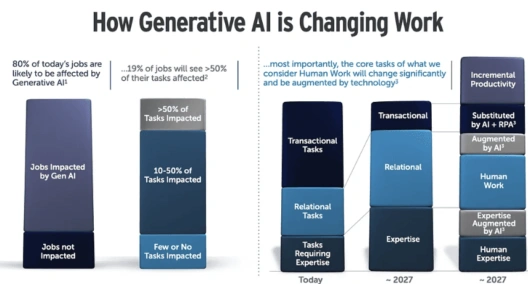
Generative AI represents a paradigm shift in artificial intelligence, moving beyond analytical tasks to actively produce novel, human-like content. By leveraging deep learning models trained on massive datasets, these systems can generate coherent text, realistic images, synthetic voices, and even functional code. The technology has rapidly evolved from experimental prototypes to mainstream tools, influencing sectors as diverse as healthcare, where it accelerates drug discovery, to entertainment, where it powers virtual influencers and AI-generated music. The core innovation lies in the ability of generative models to understand context, mimic stylistic nuances, and produce outputs indistinguishable from human-created content in many cases. This has democratized creativity, allowing non-experts to generate professional-grade materials while also raising ethical concerns about authenticity, ownership, and misuse.
#History / Background
#Early Foundations (Pre-2010s)
The conceptual roots of generative AI trace back to early neural networks and probabilistic models. In the 1950s, Alan Turing’s Imitation Game (later the Turing Test) posed fundamental questions about machine-generated content. Early experiments in generative systems included Markov chains for text generation and rule-based systems for simple image synthesis.
#Breakthroughs in Deep Learning (2010s)
The modern era of generative AI began with advances in deep learning, particularly:
- 2014: Introduction of Generative Adversarial Networks (GANs) by Ian Goodfellow et al., which pit two neural networks against each other—one generating data and the other evaluating it—to improve realism.
- 2017: The Transformer architecture (Vaswani et al.) revolutionized natural language processing (NLP) by enabling models to process sequences in parallel, leading to more efficient and scalable text generation.
- 2018: OpenAI’s GPT (Generative Pre-trained Transformer) demonstrated the potential of large-scale language models, though early versions lacked coherence for long-form content.
#Explosive Growth (2020–Present)
The field accelerated dramatically with:
- 2020: GPT-3 (OpenAI) showcased unprecedented text generation capabilities, handling tasks like translation, summarization, and creative writing with minimal prompts.
- 2021: DALL·E (OpenAI) and Stable Diffusion introduced high-quality image generation from text descriptions, making generative AI accessible to non-technical users.
- 2022: ChatGPT (OpenAI) and Bard (Google) brought conversational AI to the masses, enabling interactive, context-aware dialogue.
- 2023–2024: Multimodal models like Gemini (Google) and Sora (OpenAI) expanded generative AI to video, audio, and 3D environments. Open-source alternatives (e.g., Stable Diffusion XL, Llama 2) further democratized access.
#Key Milestones
| Year | Event | |----------|---------------------------------------------------------------------------| | 2014 | GANs introduced by Goodfellow et al. | | 2017 | Transformer architecture published | | 2018 | GPT-1 released by OpenAI | | 2020 | GPT-3 launched, demonstrating few-shot learning | | 2021 | DALL·E and Stable Diffusion released | | 2022 | ChatGPT launched, sparking global adoption | | 2023 | Multimodal models (e.g., Gemini) and AI-generated video (e.g., Sora) | | 2024 | Open-source models (e.g., Llama 3) and enterprise adoption surges |
#How It Works
Generative AI relies on deep learning models trained on vast datasets to identify patterns and generate new content. The process typically involves:
#
- Data Collection and Preprocessing - Models are trained on large, diverse datasets (e.g., books, images, code repositories). - Data is cleaned, normalized, and tokenized (for text) or transformed (for images/audio).
#
- Model Architecture Generative AI employs several key architectures:
- Transformers: Used in language models (e.g., GPT, BERT) to process sequential data via self-attention mechanisms.
- GANs (Generative Adversarial Networks): Consist of a generator (creates data) and a discriminator (evaluates authenticity), trained adversarially.
- Diffusion Models: Gradually add noise to data and then reverse the process to generate high-quality samples (e.g., Stable Diffusion).
- Variational Autoencoders (VAEs): Encode data into a latent space and decode it to generate new variations.
#
- Training Process
- Supervised Learning: Models learn from labeled data (e.g., paired text-image datasets).
- Unsupervised Learning: Models identify patterns in unlabeled data (e.g., training on raw text corpora).
- Reinforcement Learning from Human Feedback (RLHF): Fine-tunes models based on human preferences (e.g., used in ChatGPT).
#
- Inference and Generation
- Prompt Engineering: Users provide input (e.g., "a cat wearing a hat") to guide generation.
- Sampling Techniques: Models use probabilistic methods (e.g., beam search, top-k sampling) to select the most likely outputs.
- Post-Processing: Outputs may be refined (e.g., upscaled images, edited text) for quality.
#
- Deployment - Models are deployed via APIs (e.g., OpenAI’s API), cloud platforms (e.g., AWS SageMaker), or local applications. - Edge devices (e.g., smartphones) now support lightweight generative models for real-time use.
#Important Facts
#Capabilities
- Text Generation: Can write essays, poetry, code, and emails with human-like fluency.
- Image Synthesis: Creates photorealistic images from text prompts (e.g., "a cyberpunk city at night").
- Audio Generation: Produces synthetic voices (e.g., ElevenLabs) and music (e.g., Suno AI).
- Video Generation: Generates short videos from text (e.g., Runway ML, Pika Labs).
- 3D Modeling: Creates 3D assets for games and virtual worlds (e.g., NVIDIA’s Omniverse).
#Limitations
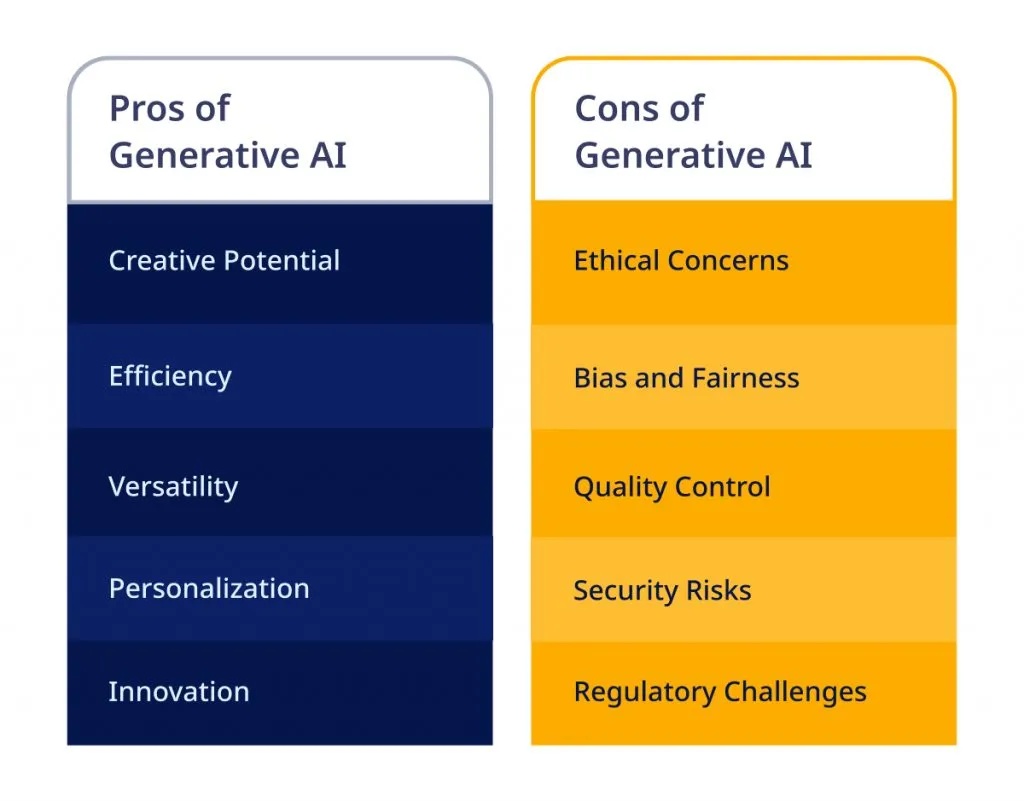
- Hallucinations: Models may generate plausible but false information (e.g., incorrect facts in text).
- Bias: Training data often reflects societal biases, leading to skewed outputs (e.g., gender or racial stereotypes).
- Ethical Risks: Deepfakes, misinformation, and copyright infringement are growing concerns.
- Computational Cost: Training large models requires significant energy and resources (e.g., GPT-3’s training consumed ~1,287 MWh of electricity).
#Performance Metrics
- BLEU Score: Measures text similarity (higher = better for translation tasks).
- FID (Fréchet Inception Distance): Evaluates image quality (lower = more realistic).
- Perplexity: Assesses language model performance (lower = better).
#Timeline
- Foundational ideas
Core concepts and early methods shape How Generative AI Is Changing the World.
- Practical use
Tools, examples, and real-world deployments make the topic easier to evaluate.
- Responsible implementation
Current work focuses on reliability, governance, performance, and measurable impact.
#Related Terms
#FAQ
What does How Generative AI Is Changing the World cover?
Explains how generative ai is changing the world, including the main process, tools, examples, risks, and practical implementation steps.
Why is How Generative AI Is Changing the World important?
It helps readers understand key concepts, compare practical use cases, and evaluate how Generative AI decisions affect outcomes, risks, and implementation choices.
What should readers verify before applying this topic?
Readers should compare benefits, limitations, data requirements, and related themes such as Generative, AI, Changing before using the ideas in real projects.
#References
- How Generative AI Is Changing the World terminology and background research
- How Generative AI Is Changing the World use cases, implementation examples, and limitations
- Generative AI best practices, standards, and risk guidance
- Generative case studies, benchmarks, and current industry analysis



Comments
No comments yet. Start the discussion with a useful note.