

#Short Answer
Traces the rise of computer vision: a historical perspective, highlighting major milestones, context, examples, and future implications.
#Infobox
#Overview
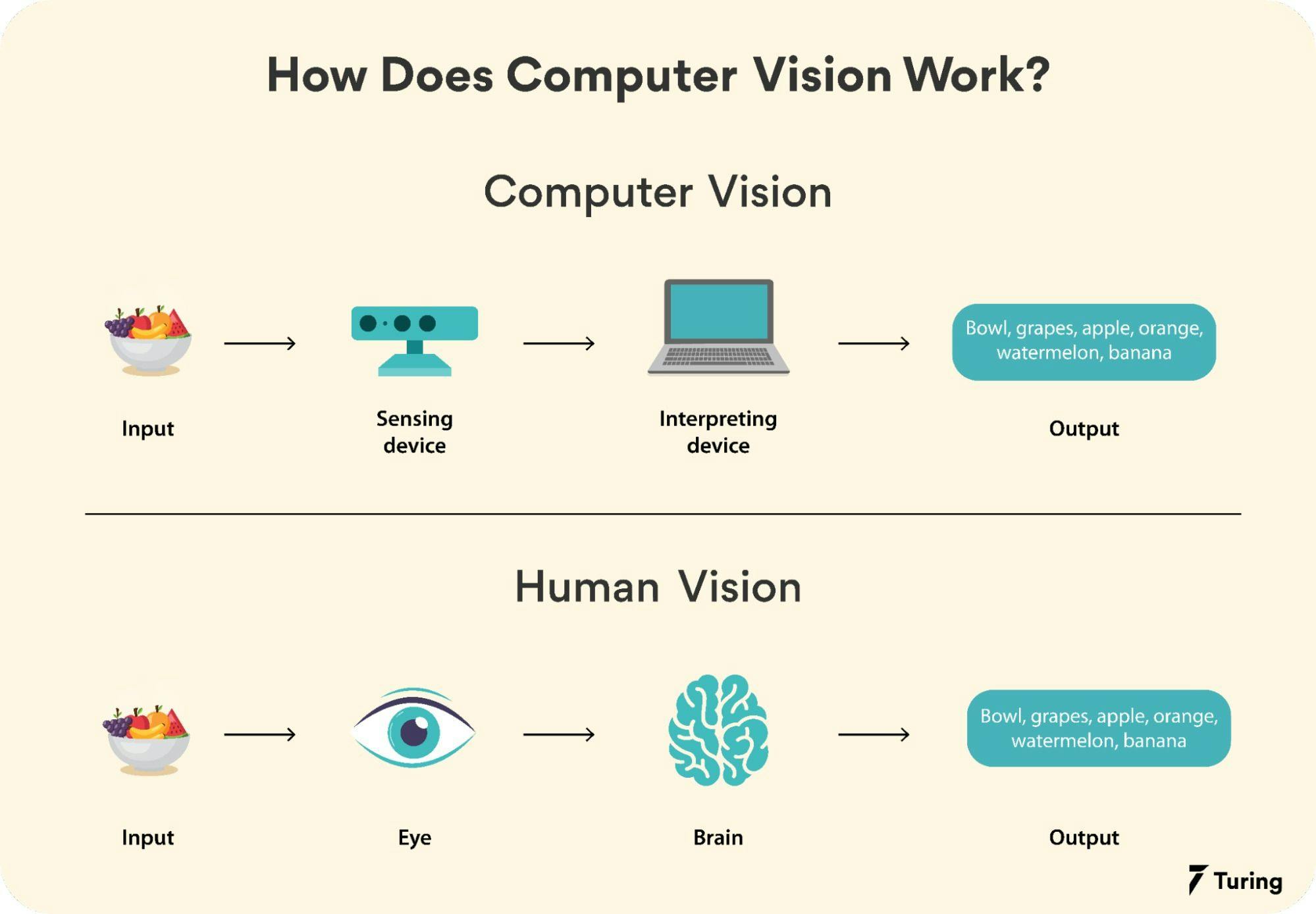
Computer vision is a multidisciplinary field that combines artificial intelligence (AI), machine learning, and image processing to enable computers to derive meaningful information from digital images or videos. It mimics the human visual system by allowing machines to recognize objects, detect patterns, and make decisions based on visual input. The technology has become a cornerstone of modern automation, enabling advancements in robotics, autonomous systems, medical diagnostics, and surveillance. The field has seen exponential growth due to improvements in computational power, the availability of large datasets, and breakthroughs in deep learning algorithms. Today, computer vision powers applications ranging from facial recognition in smartphones to real-time object detection in self-driving cars.
#History / Background
#Early Foundations (1950s–1960s)
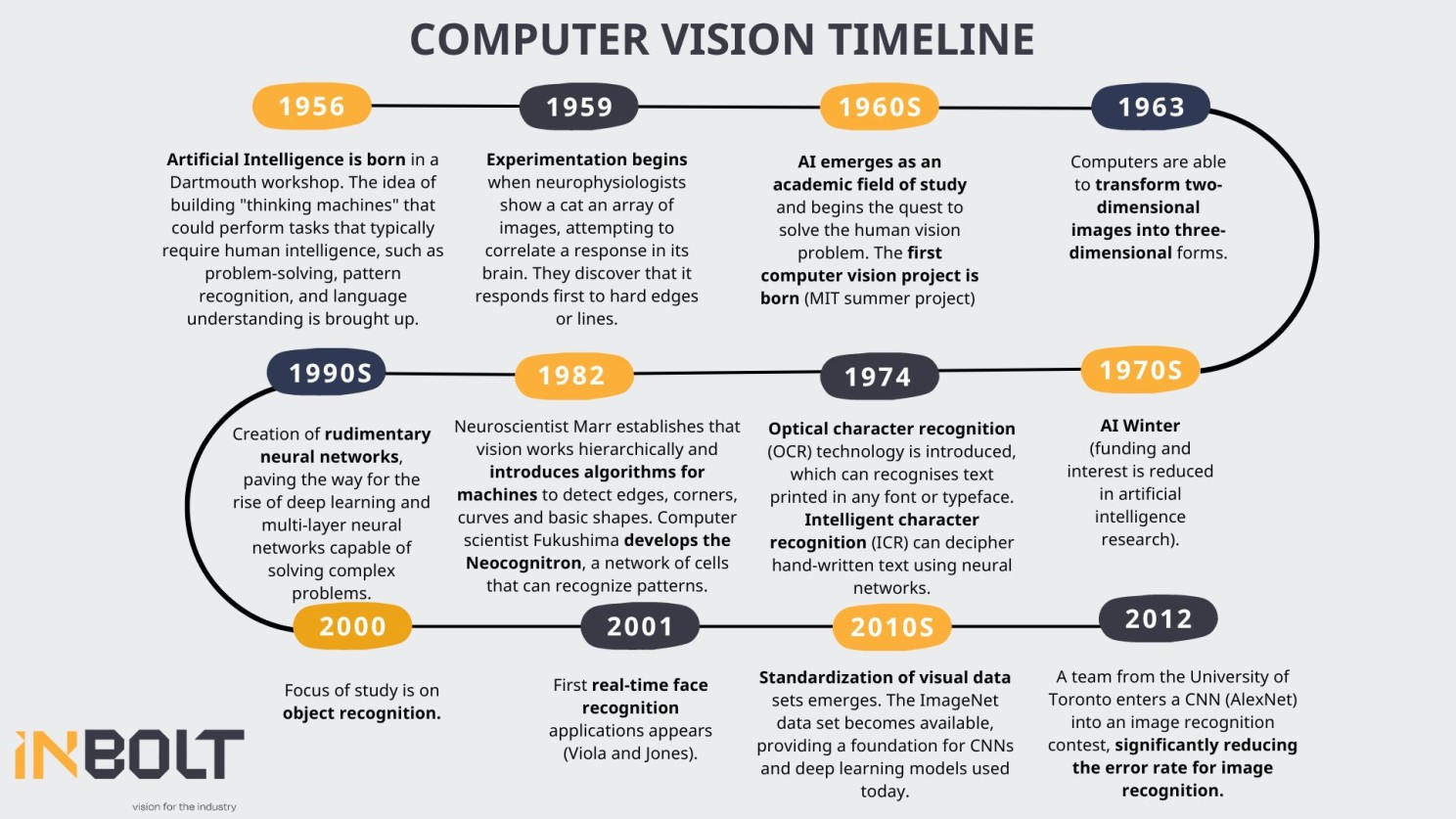
The origins of computer vision trace back to the 1950s, when early researchers began exploring ways to automate visual perception. In 1959, researchers at the Massachusetts Institute of Technology (MIT) developed the first computer program capable of recognizing simple shapes, laying the groundwork for the field. The term "computer vision" was formally introduced in the 1960s, with Marvin Minsky and Seymour Papert pioneering early work at MIT. During this period, the focus was on basic pattern recognition and edge detection. The limited computational power of early computers restricted progress, but theoretical frameworks for image processing began to emerge.
#The 1970s–1980s: Theoretical Advancements The 1970s marked a shift toward more sophisticated algorithms. David Marr, a neuroscientist and computer scientist, proposed a computational theory of vision in his seminal work Vision: A Computational Investigation into the Human Representation and Processing of Visual Information (1982). Marr’s framework emphasized the importance of understanding the computational processes underlying human vision, influencing subsequent research. Meanwhile, industrial applications of computer vision began to take shape. Automated inspection systems were deployed in manufacturing to detect defects in products, marking the first commercial use of the technology.
#The 1990s–2000s: Machine Learning Integration The 1990s saw the integration of machine learning techniques into computer vision. Researchers developed algorithms for feature extraction and classification, enabling more accurate object recognition. The introduction of support vector machines (SVMs) and other statistical methods improved performance in tasks such as handwriting recognition and facial detection. The early 2000s witnessed the rise of large-scale image datasets, such as ImageNet, which provided the foundation for training deep learning models. This era also saw the emergence of key computer vision conferences, including the IEEE Conference on Computer Vision and Pattern Recognition (CVPR), which became a hub for innovation.
#The 2010s–Present: Deep Learning Revolution The breakthrough in deep learning, particularly convolutional neural networks (CNNs), revolutionized computer vision. In 2012, AlexNet—a deep CNN developed by Alex Krizhevsky, Ilya Sutskever, and Geoffrey Hinton—won the ImageNet Large Scale Visual Recognition Challenge (ILSVRC) by a significant margin, demonstrating the superiority of deep learning over traditional methods. Since then, advancements in neural networks, such as ResNet, YOLO (You Only Look Once), and Vision Transformers (ViT), have pushed the boundaries of what computer vision can achieve. Today, the field continues to evolve with applications in augmented reality (AR), virtual reality (VR), and robotics.
#How It Works
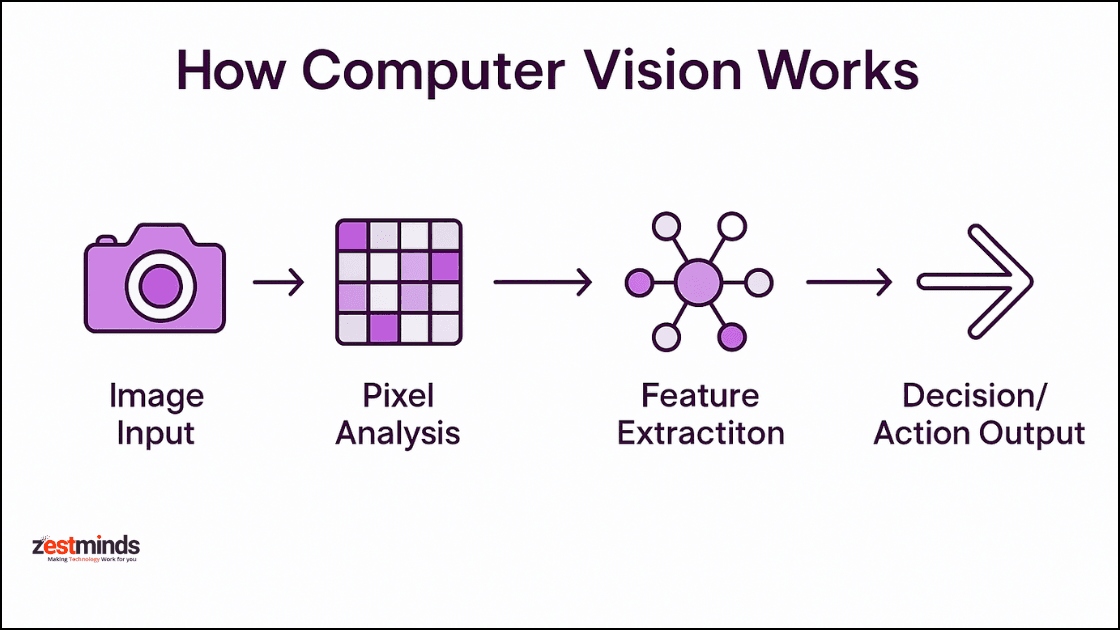
Computer vision systems process visual data through a series of stages, from raw image acquisition to high-level interpretation. The process can be broken down into the following key components:
#
- Image Acquisition The first step involves capturing visual data using cameras, sensors, or other imaging devices. The quality of the input directly impacts the system’s performance, so high-resolution sensors and proper lighting conditions are often required.
#
- Preprocessing Raw images often contain noise, distortions, or irrelevant information. Preprocessing techniques such as noise reduction, contrast enhancement, and normalization are applied to improve image quality. Common methods include:
- Filtering (e.g., Gaussian blur, median filtering)
- Edge Detection (e.g., Sobel, Canny edge detectors)
- Color Space Conversion (e.g., RGB to grayscale)
#
- Feature Extraction Features are distinctive patterns or characteristics in an image that help in object recognition. Traditional methods relied on handcrafted features like SIFT (Scale-Invariant Feature Transform) and HOG (Histogram of Oriented Gradients). Modern deep learning approaches, however, automatically learn features through convolutional layers in neural networks.
#
- Object Detection and Recognition This stage involves identifying and classifying objects within an image. Techniques include:
- Object Detection: Locating objects and drawing bounding boxes around them (e.g., YOLO, Faster R-CNN).
- Image Segmentation: Dividing an image into meaningful regions (e.g., U-Net, Mask R-CNN).
- Classification: Assigning a label to an entire image (e.g., ResNet, EfficientNet).
#
- Decision Making and Action The final step involves using the extracted information to make decisions or trigger actions. For example: - In robotics, a computer vision system may guide a robotic arm to pick up an object. - In autonomous vehicles, it enables real-time obstacle detection and path planning.
#Key Algorithms and Models
- Convolutional Neural Networks (CNNs): The backbone of modern computer vision, used for tasks like image classification and object detection.
- Generative Adversarial Networks (GANs): Used for image synthesis and enhancement.
- Transformer-based Models: Vision Transformers (ViT) and Swin Transformers have gained popularity for their ability to handle large-scale image data.
#Important Facts
- Human vs. Machine Vision: While humans can recognize objects effortlessly, computer vision systems require massive datasets and computational power to achieve similar accuracy.
- Real-Time Processing: Modern computer vision systems can process images in real time, enabling applications like facial recognition and autonomous driving.
- Ethical Concerns: The use of computer vision in surveillance and facial recognition has raised privacy and ethical concerns, leading to debates on regulation.
- Industry Impact: The global computer vision market is projected to reach $48.6 billion by 2026, driven by demand in healthcare, automotive, and retail sectors.
- Open-Source Tools: Frameworks like OpenCV, TensorFlow, and PyTorch have democratized access to computer vision, accelerating research and development.
#Timeline
- Foundational ideas
Core concepts and early methods shape The Rise of Computer Vision: a Historical Perspective.
- Practical use
Tools, examples, and real-world deployments make the topic easier to evaluate.
- Responsible implementation
Current work focuses on reliability, governance, performance, and measurable impact.
#Related Terms
#FAQ
What does The Rise of Computer Vision: a Historical Perspective cover?
Traces the rise of computer vision: a historical perspective, highlighting major milestones, context, examples, and future implications.
Why is The Rise of Computer Vision: a Historical Perspective important?
It helps readers understand key concepts, compare practical use cases, and evaluate how Computer Vision decisions affect outcomes, risks, and implementation choices.
What should readers verify before applying this topic?
Readers should compare benefits, limitations, data requirements, and related themes such as Rise, Computer, Vision before using the ideas in real projects.
#References
- The Rise of Computer Vision: a Historical Perspective terminology and background research
- The Rise of Computer Vision: a Historical Perspective use cases, implementation examples, and limitations
- Computer Vision best practices, standards, and risk guidance
- Rise case studies, benchmarks, and current industry analysis

Comments
No comments yet. Start the discussion with a useful note.