

#Short Answer
Covers the impact of ai in finance on society, including core concepts, practical examples, benefits, limitations, and risks in Business & Marketing.
#Infobox
#Overview
Artificial Intelligence has revolutionized the financial sector by introducing automation, predictive analytics, and data-driven decision-making. AI systems analyze vast datasets to identify patterns, predict market trends, and optimize financial operations. From retail banking to investment management, AI enhances accuracy, reduces costs, and improves customer experiences. However, its rapid adoption also raises concerns about data privacy, algorithmic bias, and the displacement of traditional financial roles. The integration of AI in finance spans multiple domains, including:
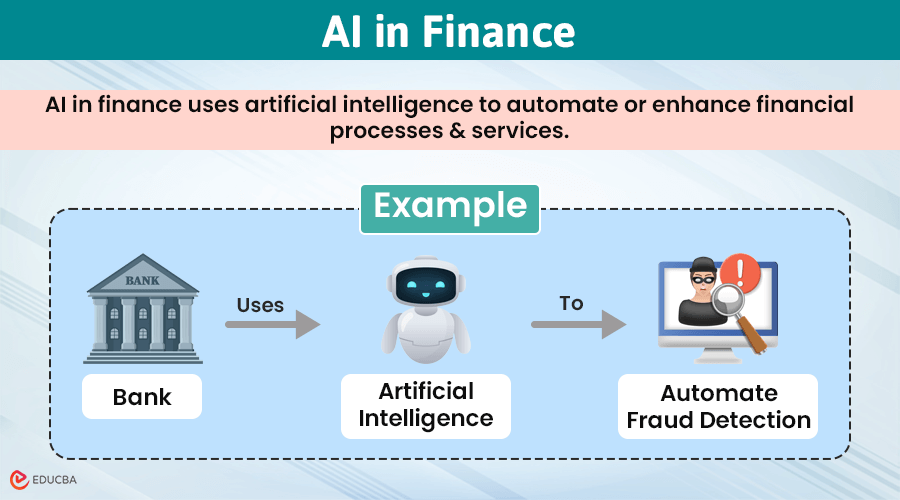
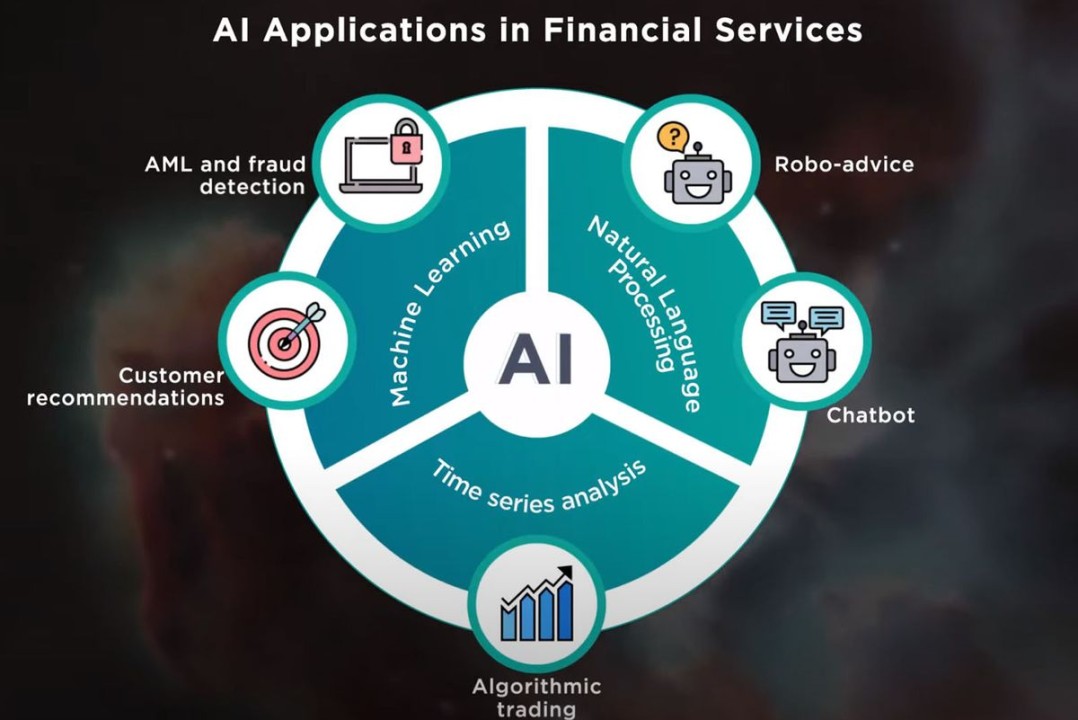
- Retail Banking: Personalized financial advice, chatbots, and fraud detection.
- Investment Management: Algorithmic trading, portfolio optimization, and risk assessment.
- Insurance: Underwriting automation and claims processing.
- Regulatory Compliance: Automated reporting and anomaly detection. As AI continues to evolve, its influence on financial markets and societal structures grows, necessitating robust frameworks for ethical use and regulation.
#History / Background
#Early Developments
(1950s–1980s)
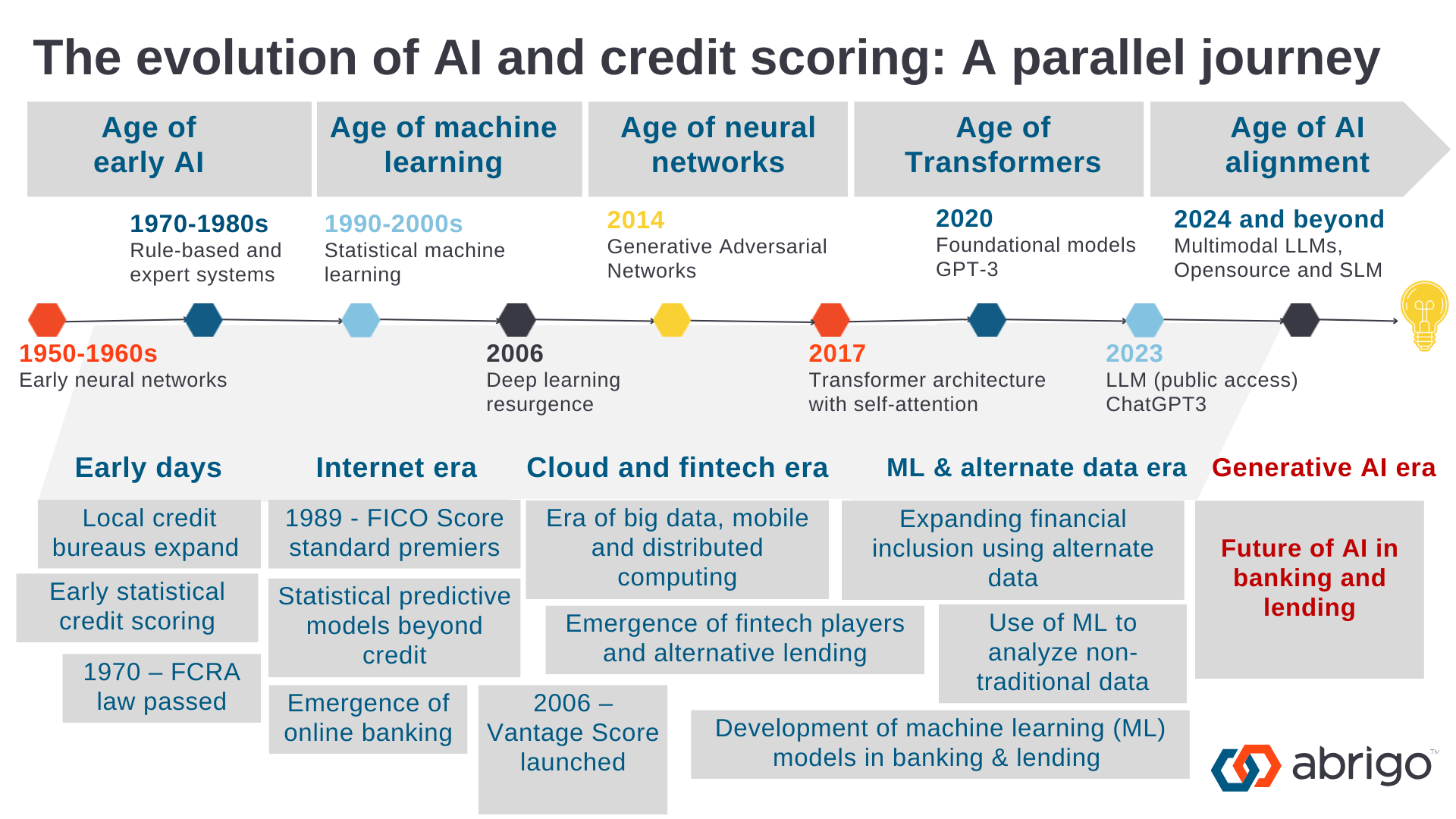
The concept of AI in finance traces back to the 1950s with the advent of early computer systems. In 1956, the Dartmouth Conference marked the formal birth of AI, though its financial applications were limited. By the 1960s, financial institutions began using mainframe computers for basic data processing, such as account management and transaction recording. The 1970s and 1980s saw the emergence of algorithmic trading, with early models relying on statistical methods rather than AI. The Black-Scholes model (1973) for option pricing, though not AI-based, laid the groundwork for quantitative finance. Meanwhile, expert systems—rule-based AI programs—were deployed in banking for credit scoring and loan approvals.
#The AI Revolution (1990s–2010s)
The 1990s brought significant advancements with the rise of machine learning (ML) and neural networks. Financial institutions started using ML for fraud detection, risk assessment, and market prediction. The dot-com bubble (late 1990s) accelerated the adoption of digital financial services, further driving AI integration. In the 2000s, the proliferation of big data and cloud computing enabled AI systems to process larger datasets with greater speed. High-frequency trading (HFT) became prevalent, leveraging AI to execute trades in milliseconds. The 2008 financial crisis highlighted the need for robust risk management tools, prompting banks to invest heavily in AI-driven analytics.
#Modern Era
(2010s–Present)
The 2010s marked a turning point with the rise of deep learning, natural language processing (NLP), and generative AI. Companies like JPMorgan Chase and Goldman Sachs deployed AI for fraud detection, customer service (e.g., chatbots), and algorithmic trading. The introduction of Open Banking regulations (e.g., PSD2 in Europe) further democratized financial data, enabling AI-driven personalized services. Today, AI in finance is characterized by:
- Hyper-personalization: AI tailors financial products to individual needs using behavioral data.
- RegTech: AI automates compliance tasks, reducing human error and operational costs.
- Decentralized Finance (DeFi): Blockchain-based AI systems enable peer-to-peer financial transactions without intermediaries.
#How It Works
#Core Technologies
- Machine Learning (ML):
- Supervised Learning: Used for credit scoring, fraud detection, and price prediction. Models are trained on labeled datasets to classify or regress outcomes.
- Unsupervised Learning: Identifies patterns in unlabeled data, such as customer segmentation or anomaly detection in transactions.
- Reinforcement Learning: Optimizes trading strategies by learning from market feedback (e.g., Q-learning algorithms).
- Natural Language Processing (NLP): - Analyzes text data from news articles, earnings reports, and social media to gauge market sentiment. - Powers chatbots and virtual assistants (e.g., Bank of America’s Erica) for customer interactions.
- Computer Vision: - Processes visual data, such as check deposits via mobile apps or facial recognition for secure authentication.
- Predictive Analytics: - Uses historical data to forecast market trends, loan defaults, or investment risks.
#Key Applications
| Application | AI Technique | Example | |--------------------------|--------------------------------|--------------------------------------------------| | Fraud Detection | Anomaly Detection (ML) | Real-time transaction monitoring by PayPal | | Algorithmic Trading | Reinforcement Learning (RL) | Renaissance Technologies’ Medallion Fund | | Credit Scoring | Supervised Learning (ML) | FICO Score 10 using alternative data sources | | Customer Service | NLP & Chatbots | HSBC’s Amy, a virtual financial assistant | | Risk Management | Predictive Analytics | JPMorgan’s COIN for legal document analysis | | Portfolio Management | Deep Learning | BlackRock’s Aladdin for asset allocation |
#Data Sources AI systems in finance rely on diverse data inputs:
- Structured Data: Transaction records, market prices, accounting data.
- Unstructured Data: Emails, news articles, social media posts.
- Alternative Data: Satellite imagery, credit card transactions, IoT device data.
#Important Facts
- Efficiency Gains: - AI reduces operational costs by up to 30% in financial services (McKinsey, 2023). - Automated fraud detection can process millions of transactions per second.
- Market Impact: - AI-driven trading accounts for 60–73% of U.S. equity trading volume (Aite Group). - Hedge funds using AI outperform traditional funds by 2–5% annually (Eurekahedge).
- Job Displacement vs. Creation: - The World Economic Forum estimates that 85 million jobs may be displaced by AI by 2025, but 97 million new roles will emerge. - Roles in data science, cybersecurity, and AI ethics are in high demand.
- Ethical Concerns:
- Algorithmic Bias: AI models trained on biased data may discriminate in lending or insurance (e.g., Apple Card controversy).
- Explainability: "Black box" AI systems (e.g., deep learning models) lack transparency, complicating regulatory compliance.
- Data Privacy: Financial AI systems handle sensitive data, raising concerns about breaches (e.g., Equifax hack, 2017).
- Regulatory Landscape: - The EU AI Act (2024) classifies AI in finance as "high-risk," mandating strict oversight. - The U.S. SEC requires disclosures on AI use in investment strategies.
- GDPR imposes limits on data usage for AI training.
- Emerging Trends:
- Quantum AI: Leveraging quantum computing for portfolio optimization and risk modeling.
- Decentralized AI: Blockchain-based AI systems (e.g., Fetch.ai) enable secure, peer-to-peer financial interactions.
- Generative AI: Used for synthetic financial data generation and automated report writing.
#Timeline
- Foundational ideas
Core concepts and early methods shape The Impact of AI in Finance on Society.
- Practical use
Tools, examples, and real-world deployments make the topic easier to evaluate.
- Responsible implementation
Current work focuses on reliability, governance, performance, and measurable impact.
#Related Terms
#FAQ
What does The Impact of AI in Finance on Society cover?
Covers the impact of ai in finance on society, including core concepts, practical examples, benefits, limitations, and risks in Business & Marketing.
Why is The Impact of AI in Finance on Society important?
It helps readers understand key concepts, compare practical use cases, and evaluate how Business & Marketing decisions affect outcomes, risks, and implementation choices.
What should readers verify before applying this topic?
Readers should compare benefits, limitations, data requirements, and related themes such as Impact, AI, Finance before using the ideas in real projects.
#References
- The Impact of AI in Finance on Society terminology and background research
- The Impact of AI in Finance on Society use cases, implementation examples, and limitations
- Business & Marketing best practices, standards, and risk guidance
- Impact case studies, benchmarks, and current industry analysis

Comments
No comments yet. Start the discussion with a useful note.