

#Short Answer
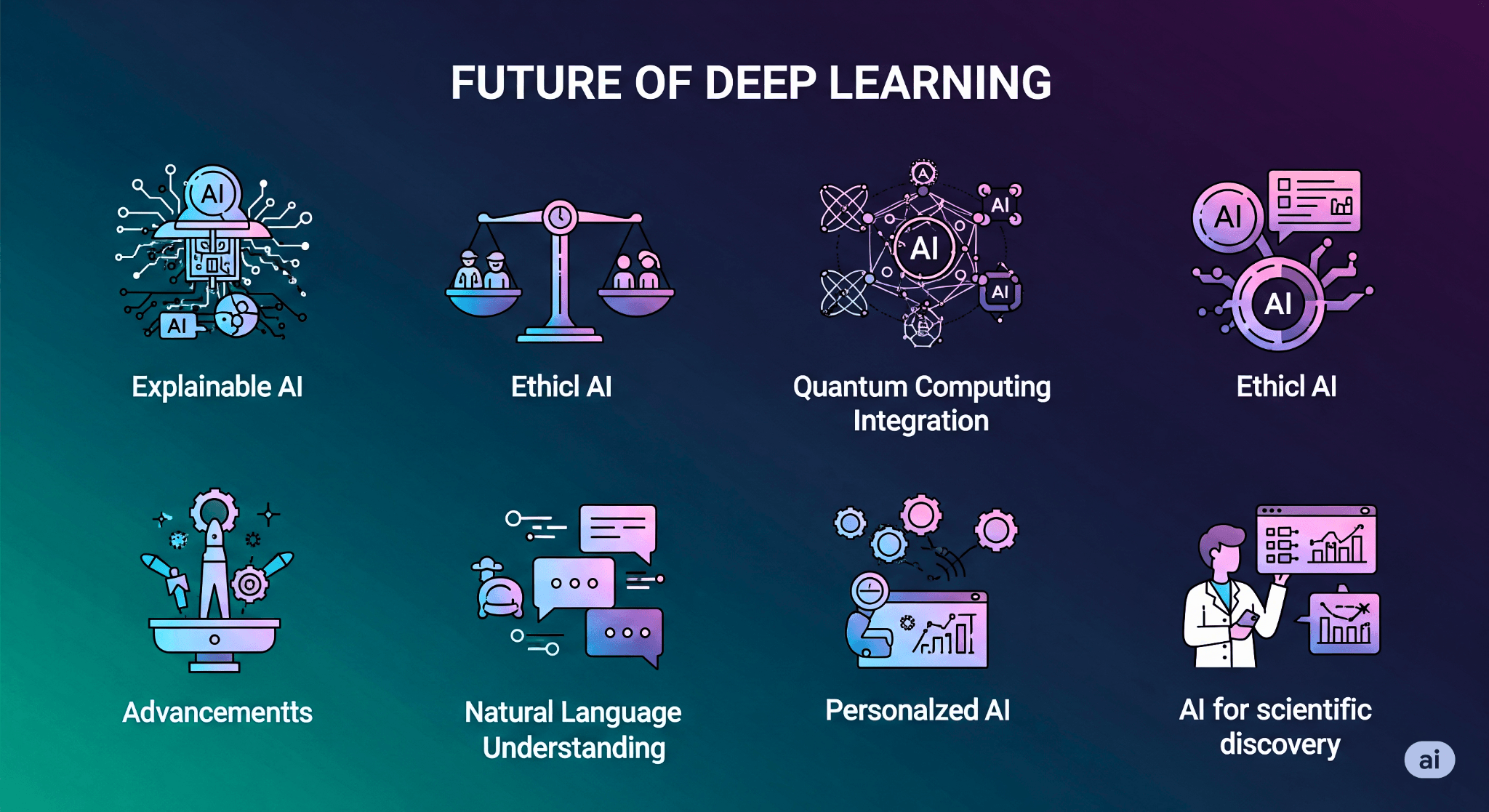
Explores the future of deep learning, including emerging trends, practical impacts, risks, and important signals to watch.
#Infobox
#Overview
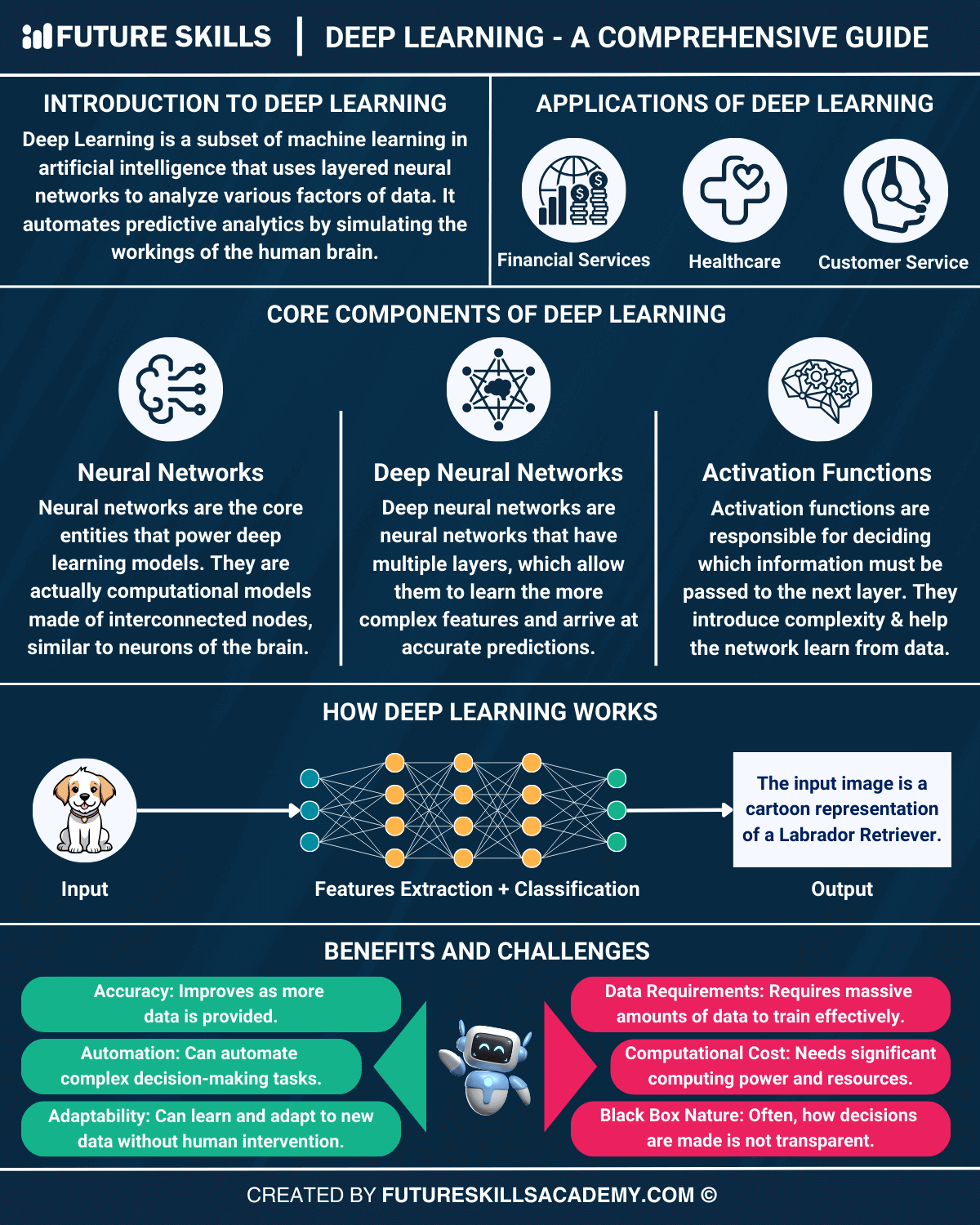
Deep learning, a subset of machine learning, leverages artificial neural networks with multiple layers to model and solve complex problems. Unlike traditional machine learning, which relies on handcrafted features, deep learning automatically extracts hierarchical representations from raw data. Its ability to process vast amounts of unstructured data—such as images, text, and audio—has revolutionized industries, from autonomous vehicles to personalized medicine. The future of deep learning is poised for exponential growth, driven by breakthroughs in hardware acceleration (e.g., GPUs, TPUs), algorithm efficiency, and data availability. Emerging paradigms like foundation models (e.g., large language models) and AI agents are expanding its scope beyond static predictions to interactive, adaptive systems. However, challenges such as scalability, energy consumption, and regulatory compliance remain critical hurdles.
#History / Background
#Early Foundations (1940s–1980s)
- 1943: Warren McCulloch and Walter Pitts proposed the first mathematical model of a neuron, laying the groundwork for artificial neural networks.
- 1958: Frank Rosenblatt developed the Perceptron, an early neural network model capable of simple pattern recognition.
- 1969: Marvin Minsky and Seymour Papert’s critique of the Perceptron’s limitations led to a decline in neural network research, known as the "AI Winter."
#Revival and Breakthroughs (1980s–2010s)
- 1986: Geoffrey Hinton, David Rumelhart, and Ronald Williams popularized backpropagation, enabling efficient training of multi-layer networks.
- 1997: The Long Short-Term Memory (LSTM) network was introduced by Sepp Hochreiter and Jürgen Schmidhuber, revolutionizing sequential data processing.
- 2012: AlexNet, a deep convolutional neural network (CNN), won the ImageNet Large Scale Visual Recognition Challenge (ILSVRC), marking the beginning of the deep learning era.
#Modern Era
(2010s–Present)
- 2014: The Generative Adversarial Network (GAN) was introduced by Ian Goodfellow, enabling high-fidelity synthetic data generation.
- 2017: The Transformer architecture was proposed in the paper "Attention Is All You Need", replacing recurrent networks in natural language processing (NLP).
- 2020s: The rise of large language models (LLMs) like GPT-3 and diffusion models for image generation (e.g., DALL·E) has pushed deep learning into mainstream applications.
#How It Works
#Core Principles Deep learning systems are built on neural networks composed of interconnected nodes (neurons) organized in layers:
- Input Layer: Receives raw data (e.g., pixels, words).
- Hidden Layers: Perform transformations through weighted connections and activation functions (e.g., ReLU, sigmoid).
- Output Layer: Produces predictions or classifications.
#Key Architectures
- Convolutional Neural Networks (CNNs): Optimized for grid-like data (e.g., images), using convolutional layers to detect spatial hierarchies.
- Recurrent Neural Networks (RNNs): Designed for sequential data (e.g., time series), with memory cells (e.g., LSTMs) to retain context.
- Transformers: Rely on self-attention mechanisms to weigh the importance of different input elements, enabling parallel processing of sequences.
- Generative Models: Include Variational Autoencoders (VAEs) and GANs, which learn data distributions to generate new samples.
#Training Process
- Forward Propagation: Data passes through the network, generating predictions.
- Loss Calculation: A loss function (e.g., cross-entropy, mean squared error) measures prediction error.
- Backpropagation: Gradients are computed and propagated backward to adjust weights via optimization algorithms (e.g., Adam, SGD).
- Iteration: The process repeats until the model achieves desired performance.
#Key Innovations
- Attention Mechanisms: Allow models to focus on relevant parts of input data dynamically.
- Transfer Learning: Pre-trained models (e.g., BERT, ResNet) are fine-tuned for specific tasks, reducing training time.
- Few-Shot Learning: Enables models to generalize from limited examples, mimicking human-like adaptability.
#Important Facts
#Performance Milestones
- Image Recognition: CNNs now surpass human accuracy in tasks like ImageNet classification (top-5 error < 2%).
- Natural Language Processing: LLMs achieve near-human performance in language understanding and generation (e.g., human-level scores on MMLU benchmark).
- Game AI: Deep learning agents (e.g., AlphaGo, AlphaZero) have defeated world champions in Go and chess.
#Computational Requirements - Training a single large model (e.g., GPT-3) can require thousands of GPU hours and millions of dollars in cloud costs.
- Carbon footprint: The training of some models emits hundreds of tons of CO₂, comparable to multiple cars’ lifetime emissions.
#Ethical and Societal Impact
- Bias and Fairness: Deep learning models can inherit biases from training data, leading to discriminatory outcomes (e.g., facial recognition disparities).
- Privacy Concerns: Techniques like federated learning and differential privacy aim to mitigate data exposure risks.
- Job Displacement: Automation via deep learning may disrupt industries, necessitating reskilling initiatives.
#Timeline
- Foundational ideas
Core concepts and early methods shape The Future of Deep Learning.
- Practical use
Tools, examples, and real-world deployments make the topic easier to evaluate.
- Responsible implementation
Current work focuses on reliability, governance, performance, and measurable impact.
#Related Terms
#FAQ
What does The Future of Deep Learning cover?
Explores the future of deep learning, including emerging trends, practical impacts, risks, and important signals to watch.
Why is The Future of Deep Learning important?
It helps readers understand key concepts, compare practical use cases, and evaluate how Machine Learning decisions affect outcomes, risks, and implementation choices.
What should readers verify before applying this topic?
Readers should compare benefits, limitations, data requirements, and related themes such as Future, Deep, Learning before using the ideas in real projects.
#References
- The Future of Deep Learning terminology and background research
- The Future of Deep Learning use cases, implementation examples, and limitations
- Machine Learning best practices, standards, and risk guidance
- Future case studies, benchmarks, and current industry analysis

Comments
No comments yet. Start the discussion with a useful note.