

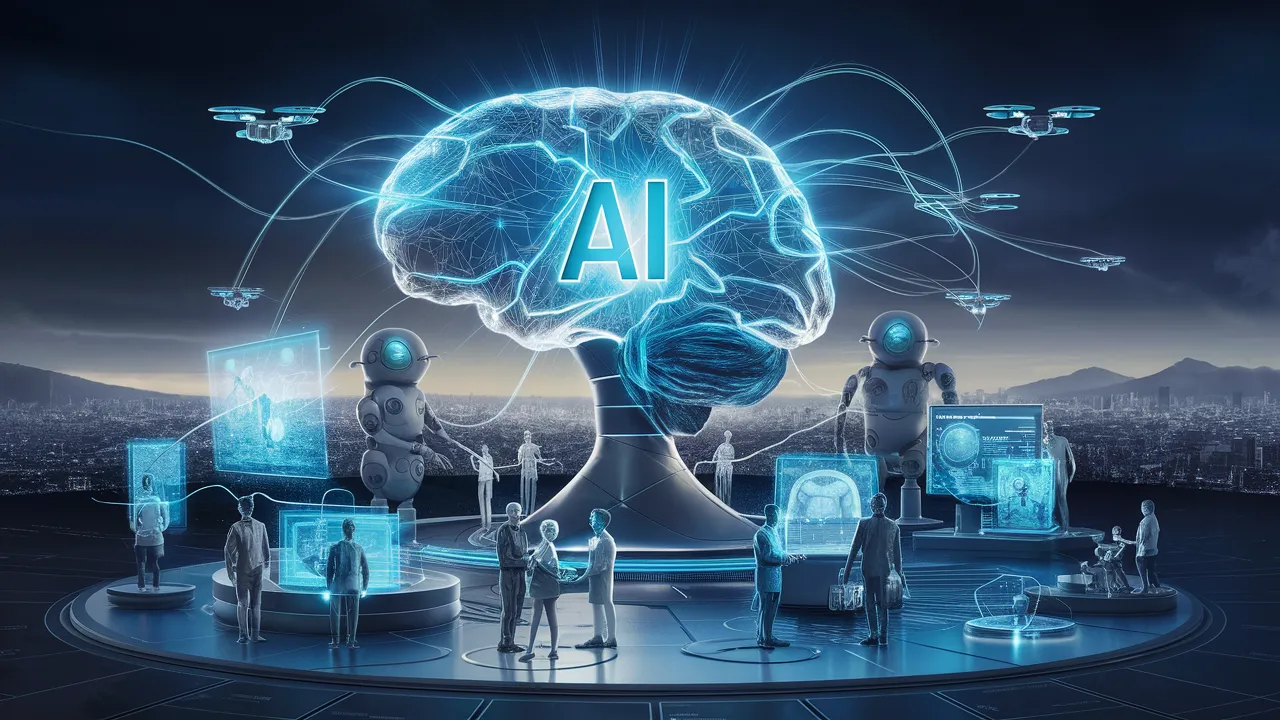
#Short Answer
Explores the future of ai: predictions for 2030, including emerging trends, practical impacts, risks, and important signals to watch.
#Infobox
#Overview
Artificial Intelligence (AI) is poised to undergo transformative changes by 2030, reshaping industries, economies, and daily life. The next decade will likely witness the maturation of generative AI, the rise of autonomous systems, and deeper integration of AI into critical infrastructure. Predictions indicate that AI will not only augment human capabilities but also introduce new paradigms in decision-making, creativity, and problem-solving. By 2030, AI systems are expected to achieve near-human levels of reasoning in specialized domains, while also becoming more explainable and aligned with ethical standards. The convergence of AI with other emerging technologies—such as quantum computing, biotechnology, and the Internet of Things (IoT)—will further accelerate innovation. However, this progress will be accompanied by significant challenges, including data privacy concerns, algorithmic bias, and the need for robust regulatory frameworks to ensure responsible development.
#History / Background
#Early Foundations (1950s–2000s)
The concept of AI dates back to the 1950s, when pioneers like Alan Turing and John McCarthy laid the groundwork for machine intelligence. Early AI systems were rule-based and limited in scope, relying on symbolic reasoning rather than learning from data. The 1980s and 1990s saw the rise of expert systems and machine learning techniques, though progress was constrained by computational limitations and data scarcity.
#The Machine Learning Revolution (2000s–2010s)
The 2000s marked a turning point with the advent of deep learning, fueled by advances in neural networks and increased computational power. Breakthroughs such as convolutional neural networks (CNNs) and recurrent neural networks (RNNs) enabled significant progress in image recognition, natural language processing (NLP), and reinforcement learning. The 2010s witnessed the emergence of large-scale AI models, including Google’s AlphaGo, which defeated human champions in complex games, demonstrating AI’s potential beyond narrow tasks.
#The AI Boom (2020s–Present)
The 2020s have been defined by the rapid proliferation of generative AI, driven by transformer architectures like those powering models such as GPT-4 and DALL·E. These systems can generate human-like text, images, and even code, revolutionizing industries from healthcare to entertainment. Concurrently, AI has become a cornerstone of digital transformation, with applications in autonomous vehicles, personalized medicine, and smart cities. The current era is characterized by a focus on scalability, accessibility, and ethical considerations, setting the stage for the advancements anticipated by 2030.
#How It Works
#Core Technologies
Driving AI Advancements
- Generative AI Generative AI models, such as large language models (LLMs) and diffusion models, are trained on vast datasets to produce new content. These models leverage transformer architectures, which use self-attention mechanisms to understand context and generate coherent outputs. By 2030, generative AI is expected to become more efficient, requiring less data and computational power while producing higher-quality results.
- Autonomous Systems Autonomous systems, including self-driving cars, drones, and robotic process automation (RPA), rely on a combination of AI, sensors, and real-time data processing. These systems use reinforcement learning to adapt to dynamic environments, improving safety and efficiency. By 2030, autonomous vehicles may achieve Level 5 autonomy, operating without human intervention in most scenarios.
- Edge AI Edge AI refers to the deployment of AI models on local devices (e.g., smartphones, IoT sensors) rather than centralized cloud servers. This approach reduces latency, enhances privacy, and enables real-time decision-making. Advances in model compression and federated learning will make edge AI more prevalent by 2030.
- Quantum Computing Quantum computing has the potential to revolutionize AI by solving complex optimization problems that are intractable for classical computers. While still in its infancy, quantum AI could enable breakthroughs in drug discovery, materials science, and cryptography by 2030.
- Explainable AI (XAI) As AI systems become more complex, the need for transparency and interpretability grows. Explainable AI techniques aim to make AI decisions understandable to humans, fostering trust and accountability. By 2030, XAI may become a standard requirement for high-stakes applications like healthcare and finance.
#AI Integration into Workflows AI is increasingly embedded into workflows through APIs, low-code platforms, and AI-as-a-service (AIaaS) models. Businesses leverage AI for tasks such as customer service automation, predictive maintenance, and supply chain optimization. By 2030, AI-driven decision support systems will likely become ubiquitous, augmenting human expertise in fields ranging from law to engineering.
#Important Facts
- Economic Impact: AI is projected to contribute up to $15.7 trillion to the global economy by 2030, according to PwC. This includes productivity gains and innovation-driven growth.
- Job Market: While AI will automate repetitive tasks, it is also expected to create 97 million new jobs by 2025, particularly in AI ethics, data science, and human-AI collaboration roles (World Economic Forum).
- Data Growth: By 2030, the global datasphere is projected to reach 175 zettabytes, necessitating advanced AI systems to process and analyze this information efficiently.
- Ethical Concerns: A 2023 survey by Pew Research found that 68% of Americans are concerned about AI’s impact on privacy, while 63% worry about job displacement.
- Regulation: The European Union’s AI Act, passed in 2024, is the first comprehensive legal framework for AI, setting precedents for global regulation. Other regions are expected to follow suit.
- Energy Consumption: Training large AI models consumes significant energy. By 2030, the AI industry may account for 4.5% of global electricity consumption, prompting a shift toward greener computing solutions.
#Timeline
- Foundational ideas
Core concepts and early methods shape The Future of AI: Predictions for 2030.
- Practical use
Tools, examples, and real-world deployments make the topic easier to evaluate.
- Responsible implementation
Current work focuses on reliability, governance, performance, and measurable impact.
#Related Terms
#FAQ
What does The Future of AI: Predictions for 2030 cover?
Explores the future of ai: predictions for 2030, including emerging trends, practical impacts, risks, and important signals to watch.
Why is The Future of AI: Predictions for 2030 important?
It helps readers understand key concepts, compare practical use cases, and evaluate how AI Trends decisions affect outcomes, risks, and implementation choices.
What should readers verify before applying this topic?
Readers should compare benefits, limitations, data requirements, and related themes such as Future, AI, Predictions before using the ideas in real projects.
#References
- The Future of AI: Predictions for 2030 terminology and background research
- The Future of AI: Predictions for 2030 use cases, implementation examples, and limitations
- AI Trends best practices, standards, and risk guidance
- Future case studies, benchmarks, and current industry analysis



Comments
No comments yet. Start the discussion with a useful note.