

#Short Answer
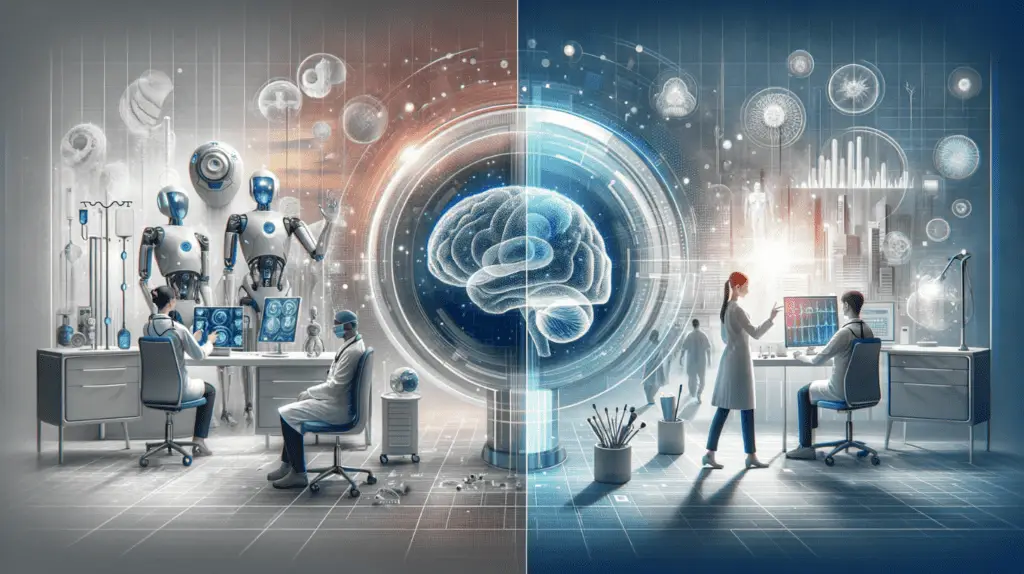
Explores the future of ai in healthcare, including emerging trends, practical impacts, risks, and important signals to watch.
#Infobox
#Overview
Artificial Intelligence (AI) is reshaping the healthcare industry by introducing intelligent systems capable of analyzing vast datasets, identifying patterns, and making data-driven decisions. In the realm of medical product design, AI is revolutionizing how devices, software, and digital health solutions are conceptualized, developed, and deployed. From AI-assisted diagnostic tools to autonomous surgical robots, the integration of AI is enhancing precision, reducing human error, and improving patient outcomes. The convergence of AI with healthcare is not merely a technological advancement but a paradigm shift. It enables healthcare providers to move from reactive to proactive care, leveraging predictive models to anticipate diseases before symptoms manifest. Additionally, AI-driven product design accelerates innovation cycles, allowing for rapid prototyping and testing of medical devices tailored to individual patient needs. This transformation is particularly evident in areas such as personalized medicine, where AI algorithms analyze genetic, lifestyle, and clinical data to recommend customized treatment plans. In medical imaging, AI enhances the interpretation of X-rays, MRIs, and CT scans, detecting anomalies with higher accuracy than traditional methods. Furthermore, AI-powered wearable devices and remote monitoring systems enable continuous health tracking, empowering patients and clinicians alike. The healthcare AI market is projected to grow exponentially, driven by increasing investments in digital health, rising demand for precision medicine, and the need to address global healthcare challenges such as aging populations and chronic disease management. As AI continues to evolve, its role in healthcare product design will expand, fostering a new era of intelligent, adaptive, and patient-centric medical solutions.
#History / Background
#Early Foundations (1950s–1980s)
The concept of AI in healthcare dates back to the mid-20th century, with early experiments in rule-based expert systems. In 1959, researchers at Stanford developed DENDRAL, an AI program designed to analyze chemical compounds, laying the groundwork for future medical applications. By the 1970s, MYCIN, an expert system for diagnosing bacterial infections, demonstrated the potential of AI in clinical decision-making, though its adoption was limited by computational constraints.
#The Rise of Machine Learning (1990s–2000s)
The advent of machine learning (ML) algorithms in the 1990s marked a turning point. Researchers began exploring neural networks for medical image analysis, with early successes in radiology and pathology. In 1997, IBM’s Deep Blue defeated world chess champion Garry Kasparov, showcasing the power of AI in complex decision-making—a principle later applied to medical diagnostics. The 2000s saw the emergence of big data in healthcare, with electronic health records (EHRs) becoming ubiquitous. This data deluge enabled the development of predictive models for disease risk assessment, such as those used in diabetes and cardiovascular risk prediction.
#The AI Revolution (2010s–Present)
The 2010s witnessed a surge in AI applications, fueled by advancements in deep learning and computer vision. Key milestones include:
- 2012: Google’s AlexNet won the ImageNet competition, demonstrating the superiority of deep learning in image recognition—a breakthrough later applied to medical imaging.
- 2015: IBM Watson Health partnered with healthcare providers to deploy AI for oncology diagnostics and treatment recommendations.
- 2016: DeepMind Health (acquired by Google) developed AI models to detect eye diseases from retinal scans, achieving accuracy comparable to human experts.
- 2018: The FDA approved the first AI-powered diagnostic tool (IDx-DR) for detecting diabetic retinopathy without human oversight.
- 2020s: The COVID-19 pandemic accelerated AI adoption, with applications ranging from vaccine development to pandemic forecasting and AI-driven telemedicine.
#AI in Medical Product Design Parallel to clinical applications, AI began transforming medical product design in the 2010s. Designers leveraged AI for:
- Generative design: Using algorithms to optimize the structure of prosthetics, implants, and surgical instruments.
- Virtual prototyping: Simulating device performance under various conditions to reduce physical testing.
- User-centered design: Analyzing patient and clinician feedback to refine product usability.
- Regulatory compliance: Automating documentation and ensuring adherence to standards like ISO 13485 and FDA guidelines. Today, AI is an integral part of the medical device innovation pipeline, enabling faster, more cost-effective, and patient-specific solutions.
#How It Works
#Core AI Technologies in Healthcare
- Machine Learning (ML)
- Supervised Learning: Trained on labeled datasets to classify data (e.g., identifying tumors in medical images).
- Unsupervised Learning: Detects patterns in unlabeled data (e.g., clustering patient symptoms to identify disease subtypes).
- Reinforcement Learning: Optimizes decision-making through trial and error (e.g., robotic surgery path planning).
- Deep Learning (DL) - Uses neural networks with multiple layers to process complex data, such as:
- Convolutional Neural Networks (CNNs): Analyze medical images (X-rays, MRIs).
- Recurrent Neural Networks (RNNs): Process sequential data (e.g., patient vital signs over time).
- Transformers: Enable natural language understanding for clinical text analysis (e.g., extracting insights from EHRs).
- Natural Language Processing (NLP) - Extracts and interprets information from unstructured clinical notes, research papers, and patient records. - Powers chatbots and virtual assistants for patient triage and administrative tasks.
- Computer Vision - Analyzes visual data from endoscopies, ultrasounds, and pathology slides to detect abnormalities. - Used in radiology for detecting fractures, tumors, and other pathologies.
- Robotics & Automation
- Surgical robots (e.g., da Vinci System) use AI for precision in minimally invasive procedures.
- Autonomous robots assist in drug dispensing, lab automation, and patient care in hospitals.
#AI in Medical Product Design
- Generative Design - AI algorithms generate multiple design iterations based on performance criteria (e.g., weight, strength, biocompatibility). - Used in designing custom prosthetics, orthotics, and implants tailored to individual anatomy.
- Predictive Modeling - Forecasts device failure rates, patient outcomes, and market demand to guide product development. - Helps in clinical trial design by identifying optimal patient cohorts.
- Digital Twins - Virtual replicas of organs, tissues, or medical devices simulate real-world conditions for testing. - Enables personalized treatment planning (e.g., simulating heart valve replacements).
- Automated Testing & Quality Control - AI-driven inspection systems detect defects in surgical tools, pacemakers, and diagnostic equipment. - Reduces human error in manufacturing processes.
- Regulatory & Compliance Automation - AI tools automate documentation for FDA 510(k) submissions and CE marking. - Ensures adherence to GMP (Good Manufacturing Practices) and ISO standards.
#Data Integration & Interoperability AI systems rely on high-quality, interoperable data from:
- Electronic Health Records (EHRs)
- Medical imaging databases
- Genomic sequencing data
- Wearable device data (e.g., Fitbit, Apple Watch)
- Clinical trial datasets Challenges in Data Integration:
- Data silos: Fragmented healthcare systems hinder seamless data sharing.
- Bias in datasets: Underrepresentation of certain demographics can lead to biased AI models.
- Privacy concerns: Compliance with HIPAA and GDPR is critical when handling patient data.
#Important Facts
- Market Growth - The global AI in healthcare market was valued at $11.06 billion in 2021 and is projected to reach $187.95 billion by 2030, growing at a CAGR of 37.5%. - North America dominates the market, followed by Europe and Asia-Pacific.
- Clinical Impact - AI-powered tools can reduce diagnostic errors by up to 30% (source: Stanford Medicine).
- IBM Watson for Oncology has assisted in cancer treatment recommendations for over 100,000 patients.
- Google’s DeepMind AI achieved 94.5% accuracy in detecting breast cancer from mammograms, surpassing human radiologists.
- Regulatory Approvals - The FDA has approved over 200 AI/ML-based medical devices as of 2023.
- CE marking in the EU allows AI tools to be marketed across Europe with regulatory oversight.
- Cost Savings - AI can reduce healthcare costs by up to $150 billion annually in the U.S. by 2026 (McKinsey).
- Predictive maintenance of medical equipment using AI reduces downtime by 20–30%.
- Ethical & Social Considerations
- Bias in AI: Studies show skin cancer detection algorithms perform poorly on darker skin tones due to biased training data.
- Transparency: The "black box" nature of deep learning raises concerns about accountability in clinical decisions.
- Job Displacement: While AI automates routine tasks, it also creates new roles in AI ethics, data governance, and clinical AI oversight.
- Emerging Innovations
- Federated Learning: Enables AI training across multiple hospitals without sharing raw patient data.
- AI-powered Drug Discovery: Companies like BenevolentAI and Recursion Pharmaceuticals use AI to identify new drug candidates in weeks instead of years.
- Neuro-symbolic AI: Combines deep learning with symbolic reasoning for explainable medical AI.
#Timeline
- Foundational ideas
Core concepts and early methods shape The Future of AI in Healthcare.
- Practical use
Tools, examples, and real-world deployments make the topic easier to evaluate.
- Responsible implementation
Current work focuses on reliability, governance, performance, and measurable impact.
#Related Terms
#FAQ
What does The Future of AI in Healthcare cover?
Explores the future of ai in healthcare, including emerging trends, practical impacts, risks, and important signals to watch.
Why is The Future of AI in Healthcare important?
It helps readers understand key concepts, compare practical use cases, and evaluate how AI in Healthcare decisions affect outcomes, risks, and implementation choices.
What should readers verify before applying this topic?
Readers should compare benefits, limitations, data requirements, and related themes such as Future, AI, Healthcare before using the ideas in real projects.
#References
- The Future of AI in Healthcare terminology and background research
- The Future of AI in Healthcare use cases, implementation examples, and limitations
- AI in Healthcare best practices, standards, and risk guidance
- Future case studies, benchmarks, and current industry analysis


Comments
No comments yet. Start the discussion with a useful note.