

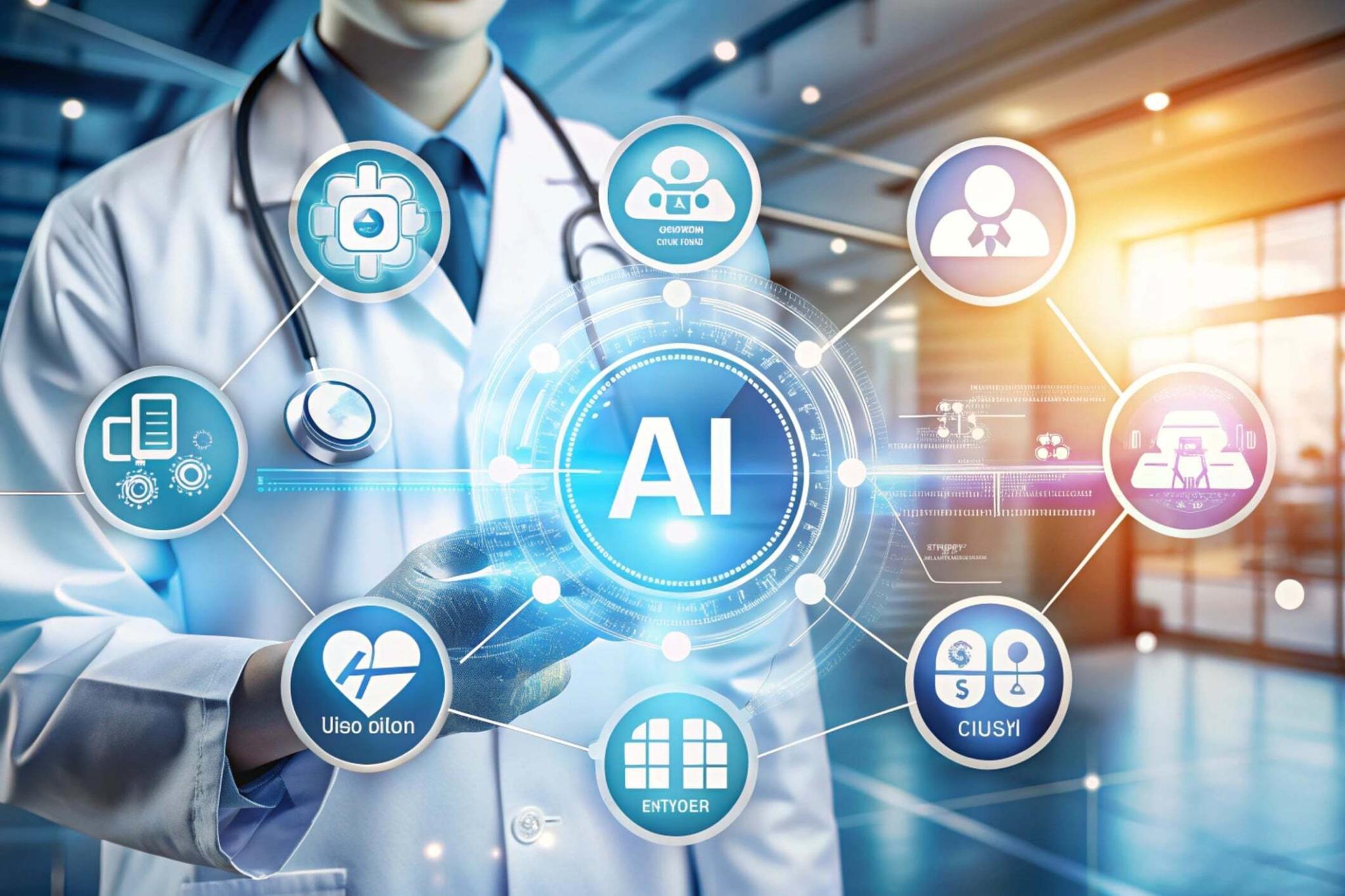
#Short Answer
Covers meaning of ai in healthcare, including core concepts, practical examples, benefits, limitations, and risks in AI in Healthcare.
#Infobox
#Overview
Artificial Intelligence (AI) is transforming healthcare by leveraging advanced computational techniques to analyze complex medical data, automate routine tasks, and support clinical decision-making. Unlike traditional software, AI systems improve over time through exposure to larger datasets, enabling them to recognize subtle patterns in patient symptoms, imaging scans, and laboratory results. The integration of AI into healthcare spans multiple domains, including diagnostics, treatment planning, drug development, and administrative operations. AI’s role in healthcare is categorized into two primary types:
- Narrow AI (Weak AI): Designed for specific tasks, such as detecting tumors in radiology images or predicting patient readmission risks.
- General AI (Strong AI): Hypothetical systems with human-like cognitive abilities, though currently nonexistent in practical healthcare applications. The adoption of AI in healthcare is driven by the exponential growth of medical data, the need for precision medicine, and the global shortage of healthcare professionals. By augmenting human capabilities, AI aims to reduce diagnostic errors, streamline workflows, and improve patient outcomes while lowering healthcare costs.
#History / Background
#Early Foundations (1950s–1970s)
The conceptual roots of AI in healthcare trace back to the 1950s, when early computer scientists explored the potential of machines to mimic human reasoning. In 1956, the term "artificial intelligence" was coined at the Dartmouth Conference, marking the beginning of AI as a formal discipline. During this period, researchers developed rudimentary expert systems—rule-based programs designed to replicate human decision-making. One of the first notable applications was MYCIN, developed in the 1970s at Stanford University. MYCIN was an expert system capable of diagnosing bacterial infections and recommending antibiotics, achieving accuracy comparable to human specialists. However, its reliance on rigid rules and limited computational power restricted its widespread adoption.
#The AI Winter and Revival (1980s–1990s)
The 1980s saw a decline in AI research funding due to unmet expectations, a period known as the "AI Winter." Despite this, advancements in machine learning and neural networks reignited interest in the 1990s. The introduction of backpropagation algorithms enabled neural networks to learn from data, paving the way for more sophisticated applications. During this era, AI began to play a role in medical imaging. Researchers developed systems to analyze X-rays, MRIs, and CT scans, though computational limitations constrained their practical use.
#The Modern Era (2000s–Present)
The 21st century marked a renaissance for AI in healthcare, fueled by:
- Big Data: The digitization of health records and the proliferation of wearable devices generated vast datasets.
- Computational Power: Advances in graphics processing units (GPUs) and cloud computing accelerated AI training.
- Deep Learning: Convolutional neural networks (CNNs) and recurrent neural networks (RNNs) revolutionized image recognition and natural language processing. Key milestones include:
- 2012: Google’s AI system, trained on 1.2 million images, outperformed human experts in detecting breast cancer in mammograms.
- 2016: IBM Watson Health partnered with Memorial Sloan Kettering Cancer Center to assist in oncology treatment planning.
- 2018: DeepMind’s AI achieved superhuman performance in diagnosing eye diseases from retinal scans.
- 2020s: The COVID-19 pandemic accelerated AI applications in drug discovery, contact tracing, and predictive modeling. Regulatory bodies like the U.S. Food and Drug Administration (FDA) and the European Medicines Agency (EMA) began establishing frameworks for AI-driven medical devices, ensuring safety and efficacy.
#How It Works
#Core Technologies
AI in healthcare relies on several foundational technologies:
- Machine Learning (ML)
- Supervised Learning: Algorithms trained on labeled datasets to predict outcomes (e.g., classifying tumors as benign or malignant).
- Unsupervised Learning: Identifies patterns in unlabeled data (e.g., clustering patients with similar genetic profiles).
- Reinforcement Learning: Optimizes decision-making through trial-and-error (e.g., dynamic treatment adjustment in chronic diseases).
- Deep Learning - Uses multi-layered neural networks to process complex data structures.
- Convolutional Neural Networks (CNNs): Excel in image analysis (e.g., detecting lung nodules in CT scans).
- Recurrent Neural Networks (RNNs): Analyze sequential data (e.g., predicting patient deterioration from time-series vitals).
- Natural Language Processing (NLP) - Extracts insights from unstructured text (e.g., EHRs, clinical notes). - Enables chatbots for patient triage and voice assistants for documentation.
- Computer Vision - Analyzes visual data from medical imaging (e.g., X-rays, MRIs, pathology slides). - Applications include detecting fractures, identifying cancerous tissues, and assessing retinal damage.
#Data Sources AI systems ingest diverse data types:
- Structured Data: Lab results, vital signs, ICD-10 codes.
- Unstructured Data: Physician notes, discharge summaries, medical journals.
- Medical Imaging: Radiology scans, ultrasound images, endoscopic footage.
- Genomic Data: DNA sequences for personalized medicine.
- Wearable Data: Heart rate, glucose levels, activity metrics from smart devices.
#Workflow Integration AI tools are integrated into healthcare workflows through:
- Clinical Decision Support Systems (CDSS): Provide evidence-based recommendations (e.g., drug interaction alerts).
- Predictive Analytics: Forecast patient risks (e.g., sepsis, readmission).
- Robotic Process Automation (RPA): Automate administrative tasks (e.g., billing, scheduling).
- Telemedicine Platforms: Enable remote diagnostics and monitoring.
#Challenges in Implementation
- Data Quality: Incomplete or biased datasets can lead to inaccurate models.
- Interoperability: Integrating AI with disparate EHR systems remains a hurdle.
- Explainability: "Black box" models (e.g., deep learning) lack transparency, raising trust issues.
- Regulatory Compliance: Ensuring AI tools meet safety and privacy standards (e.g., HIPAA, GDPR).
#Important Facts
- Accuracy: AI systems can match or exceed human performance in specific tasks. For example, a 2020 study found that an AI model detected breast cancer in mammograms with 94% accuracy, compared to 88% for radiologists.
- Cost Savings: AI-driven diagnostics and predictive analytics can reduce healthcare costs by up to $150 billion annually in the U.S. by 2026, according to McKinsey.
- Drug Discovery: AI accelerates drug development by analyzing molecular structures and predicting drug interactions. For instance, AI identified halicin, a novel antibiotic, in 2020.
- Personalized Medicine: AI tailors treatments based on genetic, lifestyle, and environmental factors. Companies like Tempus and Foundation Medicine use AI to match cancer patients with targeted therapies.
- Robotics: AI-powered robotic surgery systems, such as da Vinci, enhance precision in minimally invasive procedures.
- Mental Health: AI chatbots like Woebot and Wool provide cognitive behavioral therapy (CBT) and monitor mental health trends.
- Global Impact: AI is projected to contribute $15.7 trillion to the global economy by 2030, with healthcare being a major driver.
#Timeline
- Foundational ideas
Core concepts and early methods shape Meaning of AI in Healthcare.
- Practical use
Tools, examples, and real-world deployments make the topic easier to evaluate.
- Responsible implementation
Current work focuses on reliability, governance, performance, and measurable impact.
#Related Terms
#FAQ
What does Meaning of AI in Healthcare cover?
Covers meaning of ai in healthcare, including core concepts, practical examples, benefits, limitations, and risks in AI in Healthcare.
Why is Meaning of AI in Healthcare important?
It helps readers understand key concepts, compare practical use cases, and evaluate how AI in Healthcare decisions affect outcomes, risks, and implementation choices.
What should readers verify before applying this topic?
Readers should compare benefits, limitations, data requirements, and related themes such as Meaning, AI, Healthcare before using the ideas in real projects.
#References
- Meaning of AI in Healthcare terminology and background research
- Meaning of AI in Healthcare use cases, implementation examples, and limitations
- AI in Healthcare best practices, standards, and risk guidance
- Meaning case studies, benchmarks, and current industry analysis


Comments
No comments yet. Start the discussion with a useful note.