

#Short Answer
Covers natural language processing explained: a simple guide, including core concepts, practical examples, benefits, limitations, and risks in Language AI.
#Infobox
#History / Background
Early Foundations (1950s–1970s) The origins of NLP trace back to the 1950s, when researchers began exploring the possibility of machines understanding human language. Key milestones include:
- 1950: Alan Turing proposed the "Turing Test," a benchmark for machine intelligence, including language comprehension.
- 1954: The Georgetown-IBM experiment demonstrated the first automated translation of Russian to English, using a limited vocabulary.
- 1960s–1970s: Early rule-based systems, such as ELIZA (1966), simulated conversation by pattern matching, laying the groundwork for chatbots.
The AI Winter and Rule-Based Systems (1980s–1990s) During the "AI Winter" of the 1980s and 1990s, interest in NLP waned due to limited computational power and overly simplistic approaches. However, rule-based systems like SHRDLU (1970s) and CHAT-80 (1980s) demonstrated that structured grammar could enable basic language understanding.
Statistical and Machine Learning Era (2000s–2010s) The rise of machine learning revolutionized NLP by enabling systems to learn patterns from data rather than relying solely on predefined rules. Key developments included:
- 2001: Introduction of Latent Dirichlet Allocation (LDA), a topic modeling technique.
- 2006: Google’s Statistical Machine Translation improved translation accuracy.
- 2010s: Deep learning models, such as Recurrent Neural Networks (RNNs) and Long Short-Term Memory (LSTM) networks, enhanced sequence modeling for tasks like text generation and sentiment analysis.
The Deep Learning Revolution (2010s–Present) The advent of transformer models in 2017, particularly BERT (Bidirectional Encoder Representations from Transformers) by Google, marked a turning point. Transformers enabled:
- Contextual understanding of words based on surrounding text.
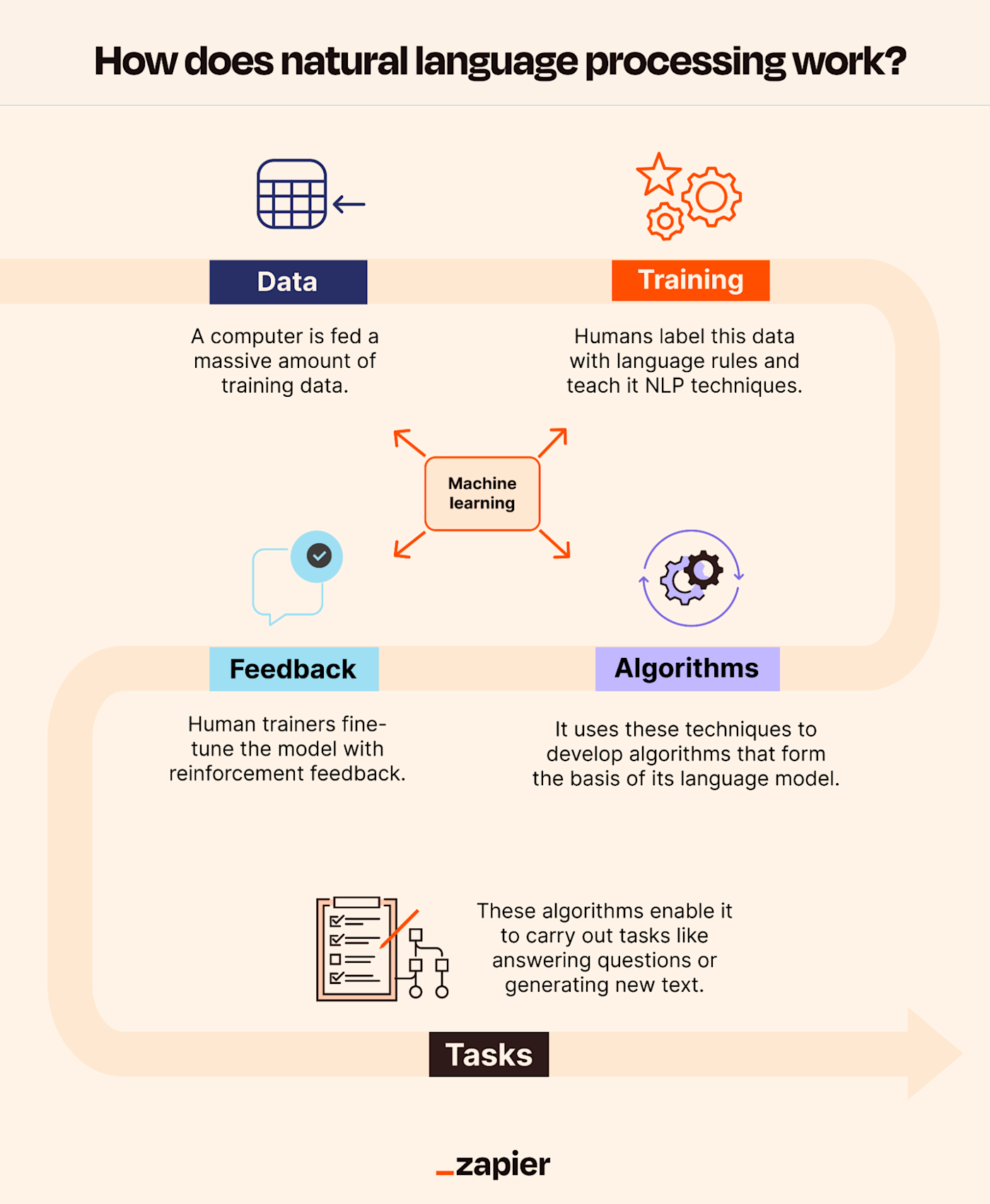
- Pre-trained language models that could be fine-tuned for specific tasks.
- State-of-the-art performance in tasks like question answering, summarization, and language translation. Today, NLP powers applications ranging from voice assistants to legal document analysis, with ongoing research focusing on multilingual models, low-resource language support, and ethical AI.
#How It Works
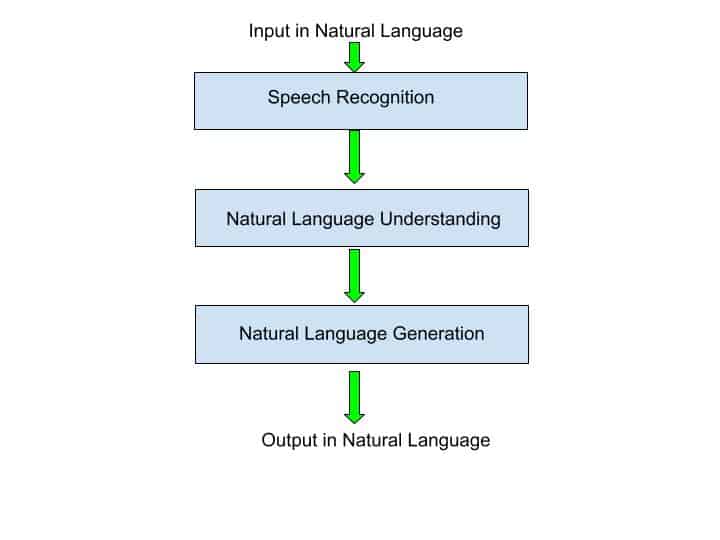
Core Components of NLP NLP systems typically involve several stages:
- Text Preprocessing
- Tokenization: Splitting text into words, phrases, or sentences (e.g., "Hello world" → ["Hello", "world"]).
- Normalization: Converting text to a standard format (e.g., lowercase conversion, removing punctuation).
- Stopword Removal: Filtering out common words (e.g., "the", "is") that add little meaning.
- Stemming/Lemmatization: Reducing words to their base form (e.g., "running" → "run").
- Feature Extraction
- Bag-of-Words (BoW): Represents text as a frequency distribution of words.
- TF-IDF (Term Frequency-Inverse Document Frequency): Weighs words by their importance in a document relative to a corpus.
- Word Embeddings: Dense vector representations of words (e.g., Word2Vec, GloVe) that capture semantic relationships.
- Modeling and Training
- Rule-Based Models: Use predefined linguistic rules (e.g., regular expressions).
- Machine Learning Models: Train on labeled data (e.g., Naive Bayes, Support Vector Machines).
- Deep Learning Models: Leverage neural networks for complex tasks (e.g., CNNs for text classification, RNNs/LSTMs for sequence modeling).
- Transformer Models: Use self-attention mechanisms to process entire sequences simultaneously (e.g., BERT, GPT-3).
- Post-Processing
- Named Entity Recognition (NER): Identifying entities like names, dates, or locations.
- Part-of-Speech (POS) Tagging: Labeling words by their grammatical role.
- Sentiment Analysis: Determining the emotional tone of text (positive, negative, neutral).
Example Workflow: Sentiment Analysis
- Input: "I love this product! It’s amazing."
- Preprocessing: Tokenization → ["I", "love", "this", "product", "!", "It", "’s", "amazing", "."]
- Feature Extraction: Convert to numerical vectors using word embeddings.
- Model Prediction: A trained classifier (e.g., LSTM) predicts the sentiment as positive.
- Output: "Sentiment: Positive (Confidence: 95%)"
#Important Facts
- NLP is Everywhere: From search engines (Google) to social media (Twitter sentiment analysis), NLP is embedded in modern technology.
- Multilingual NLP: Models like mBERT and XLM-R support over 100 languages, enabling cross-lingual applications.
- Bias in NLP: Language models can inherit biases from training data, leading to unfair or discriminatory outputs.
- Computational Cost: Training large models (e.g., GPT-3) requires significant GPU/TPU resources, often limiting accessibility.
- Ethical Concerns: NLP applications like deepfake text and automated misinformation pose societal challenges.
- Human-in-the-Loop: Many NLP systems require human oversight to correct errors and improve accuracy.
#Timeline
- Foundational ideas
Core concepts and early methods shape Natural Language Processing Explained: a Simple Guide.
- Practical use
Tools, examples, and real-world deployments make the topic easier to evaluate.
- Responsible implementation
Current work focuses on reliability, governance, performance, and measurable impact.
#Related Terms
#FAQ
What does Natural Language Processing Explained: a Simple Guide cover?
Covers natural language processing explained: a simple guide, including core concepts, practical examples, benefits, limitations, and risks in Language AI.
Why is Natural Language Processing Explained: a Simple Guide important?
It helps readers understand key concepts, compare practical use cases, and evaluate how Language AI decisions affect outcomes, risks, and implementation choices.
What should readers verify before applying this topic?
Readers should compare benefits, limitations, data requirements, and related themes such as Natural, Language, Processing before using the ideas in real projects.
#References
- Natural Language Processing Explained: a Simple Guide terminology and background research
- Natural Language Processing Explained: a Simple Guide use cases, implementation examples, and limitations
- Language AI best practices, standards, and risk guidance
- Natural case studies, benchmarks, and current industry analysis


Comments
No comments yet. Start the discussion with a useful note.