

#Short Answer
Traces microsoft ai: company profile and history, highlighting major milestones, context, examples, and future implications.
#Infobox
#Overview
Microsoft AI represents the company’s strategic initiative to embed artificial intelligence across its ecosystem of products and services. It leverages cutting-edge AI research and development to enhance productivity, automation, and decision-making for enterprises and individuals. The division operates under Microsoft’s broader cloud computing and software strategy, with a strong emphasis on Azure AI, a cloud-based platform offering AI services like machine learning, speech recognition, and predictive analytics. The AI division aligns with Microsoft’s mission to "empower every person and every organization on the planet to achieve more" by democratizing AI through accessible tools and platforms. Microsoft AI’s solutions are designed to be scalable, secure, and compliant with ethical AI principles, ensuring responsible deployment in enterprise environments.
#History / Background
#Early Foundations (1990s–2010s)
Microsoft’s involvement in AI dates back to the 1990s, with early research in machine learning and natural language processing. Key milestones include:
- 1997: Microsoft Research was founded, laying the groundwork for AI advancements.
- 2011: Introduction of Microsoft Kinect, a motion-sensing input device for Xbox that utilized computer vision and speech recognition.
- 2014: Acquisition of SwiftKey, a predictive text keyboard company, enhancing AI-driven typing experiences.
#The AI Division (2016–Present)
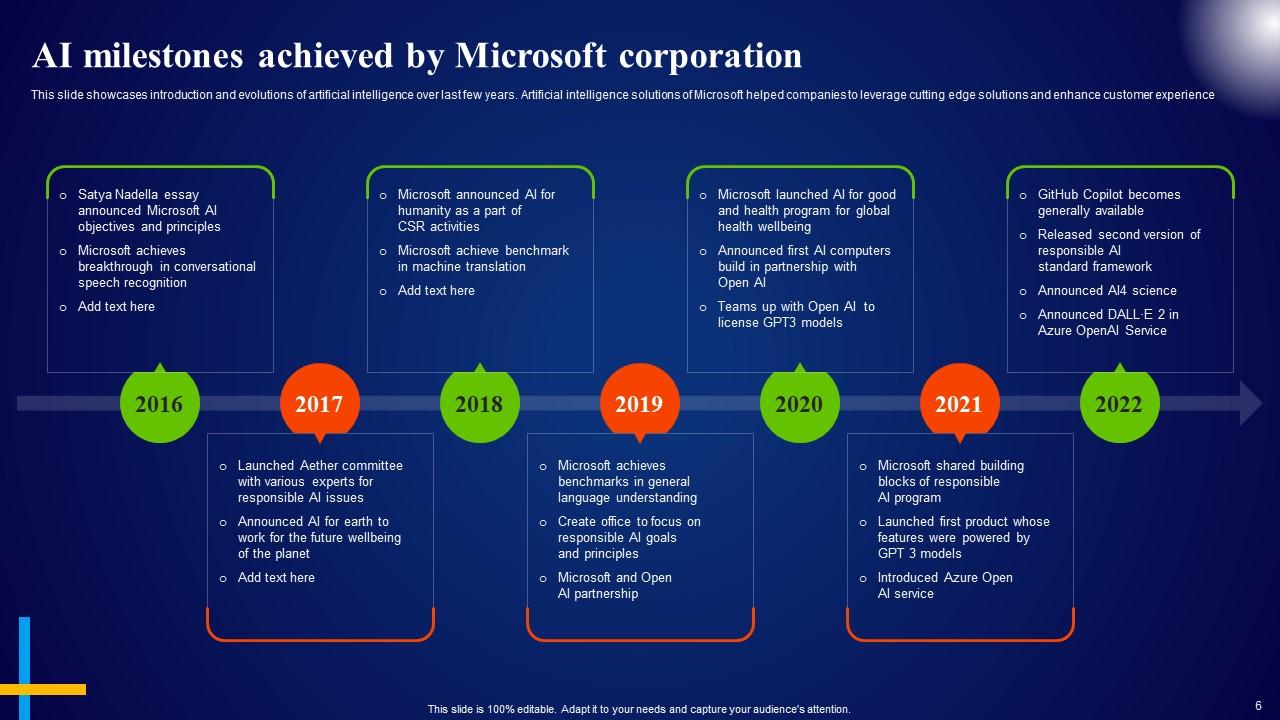
Microsoft formally established its AI division in 2016, consolidating AI efforts across the company. Critical developments include:
- 2016: Launch of Microsoft Cognitive Services, a suite of pre-built AI APIs for vision, speech, language, and decision-making.
- 2018: Introduction of Azure AI, integrating AI capabilities into Microsoft’s cloud platform.
- 2019: Microsoft AI for Earth program launched to address environmental challenges using AI.
- 2020: Azure AI Fundamentals certification introduced to train developers in AI and machine learning.
- 2021: Microsoft Viva introduced, incorporating AI-driven insights for employee engagement and productivity.
- 2023: Microsoft Copilot (formerly Bing Chat) launched, integrating generative AI into Bing, Edge, and Microsoft 365.
#Strategic Acquisitions Microsoft has bolstered its AI capabilities through strategic acquisitions:
- 2014: SwiftKey (AI-powered typing)
- 2016: Maluuba (deep learning research)
- 2018: GitHub (AI-driven developer tools)
- 2020: Nuance Communications (AI for healthcare and speech recognition)
#How It Works
Microsoft AI operates through a multi-layered approach, combining cloud infrastructure, AI services, and end-user applications. The core components include:
#
- Azure AI Azure AI is the backbone of Microsoft’s AI offerings, providing a cloud-based platform for building, training, and deploying AI models. Key services include:
- Azure Machine Learning: A managed service for developing and deploying machine learning models.
- Azure Cognitive Services: Pre-built APIs for vision, speech, language, and decision-making (e.g., Computer Vision, Speech-to-Text, Text Analytics).
- Azure Bot Service: Enables the creation of AI-powered chatbots.
- Azure Applied AI Services: Industry-specific AI solutions (e.g., Form Recognizer for document processing).
#
- Microsoft Copilot Copilot is an AI assistant integrated into Microsoft 365, Bing, and Edge, leveraging large language models (LLMs) to assist with tasks such as:
- Writing and editing documents in Word.
- Data analysis in Excel.
- Code generation in GitHub Copilot.
- Summarizing emails in Outlook.
#
- AI in Microsoft 365 Microsoft 365 incorporates AI to enhance productivity:
- Microsoft Teams: AI-driven meeting summaries and transcription.
- Power Platform: Low-code tools with AI capabilities (e.g., Power Automate for workflow automation).
- Dynamics 365: AI-powered customer insights and sales forecasting.
#
- AI Research and Ethics Microsoft AI prioritizes responsible AI through:
- Fairlearn: A toolkit for assessing and mitigating bias in AI models.
- AI Ethics and Society: Guidelines for ethical AI development.
- AI for Accessibility: Tools to assist people with disabilities (e.g., Seeing AI app).
#Important Facts
- Market Leader: Microsoft is a top player in the AI cloud services market, competing with Amazon Web Services (AWS) and Google Cloud.
- Generative AI: Microsoft invested $10 billion in OpenAI (2019–2023), integrating its GPT models into Copilot and Azure AI.
- Enterprise Adoption: Over 50% of Fortune 500 companies use Azure AI for AI-driven solutions.
- AI in Healthcare: Microsoft’s Nuance Communications acquisition strengthened its AI capabilities in healthcare, particularly in clinical documentation.
- Sustainability: Microsoft aims to be carbon-negative by 2030, with AI playing a role in optimizing energy use and reducing emissions.
- Security: Azure AI includes AI-driven cybersecurity tools like Microsoft Defender for Cloud.
#Timeline
- Foundational ideas
Core concepts and early methods shape Microsoft AI: Company Profile and History.
- Practical use
Tools, examples, and real-world deployments make the topic easier to evaluate.
- Responsible implementation
Current work focuses on reliability, governance, performance, and measurable impact.
#Related Terms
#FAQ
What does Microsoft AI: Company Profile and History cover?
Traces microsoft ai: company profile and history, highlighting major milestones, context, examples, and future implications.
Why is Microsoft AI: Company Profile and History important?
It helps readers understand key concepts, compare practical use cases, and evaluate how Business & Marketing decisions affect outcomes, risks, and implementation choices.
What should readers verify before applying this topic?
Readers should compare benefits, limitations, data requirements, and related themes such as Microsoft, AI, Company before using the ideas in real projects.
#References
- Microsoft AI: Company Profile and History terminology and background research
- Microsoft AI: Company Profile and History use cases, implementation examples, and limitations
- Business & Marketing best practices, standards, and risk guidance
- Microsoft case studies, benchmarks, and current industry analysis



Comments
No comments yet. Start the discussion with a useful note.