

#Short Answer
Covers facts about ai, including core concepts, practical examples, benefits, limitations, and risks in Artificial Intelligence.
#Infobox
#Overview
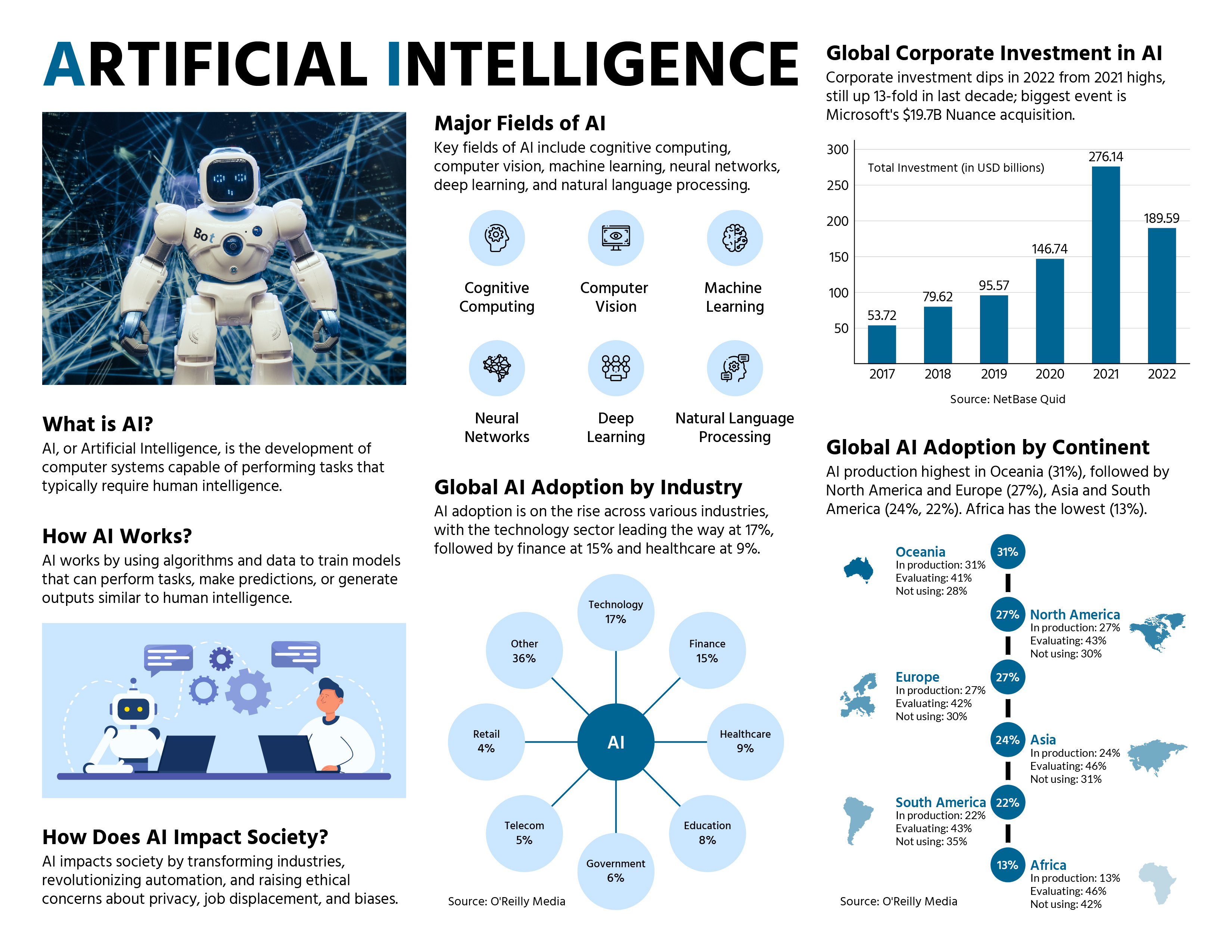
Artificial Intelligence (AI) is a branch of computer science focused on creating systems capable of performing tasks that typically require human intelligence. These tasks include reasoning, learning, perception, problem-solving, and language understanding. AI systems are designed to analyze vast amounts of data, identify patterns, and make decisions with minimal human intervention. The field of AI is broadly categorized into two types: Narrow AI (or Weak AI), which is designed for specific tasks (e.g., facial recognition, chatbots), and General AI (or Strong AI), which aims to replicate human-like cognitive abilities across all domains. While Narrow AI is already prevalent in modern applications, General AI remains a theoretical goal. AI technologies are powered by algorithms, statistical models, and large datasets. Machine learning (ML), a subset of AI, enables systems to improve their performance over time by learning from data. Deep learning, a further subset of ML, uses neural networks with multiple layers to process complex data such as images, speech, and text.
#History / Background
#Early Foundations (1950s–1970s)
The concept of AI dates back to the mid-20th century. In 1950, Alan Turing published "Computing Machinery and Intelligence," introducing the Turing Test as a criterion for machine intelligence. The term "Artificial Intelligence" was coined in 1956 at the Dartmouth Conference, where researchers like John McCarthy, Marvin Minsky, and others laid the groundwork for the field. Early AI research focused on symbolic reasoning and problem-solving. Programs like the Logic Theorist (1956) and ELIZA (1966), an early natural language processing program, demonstrated the potential of AI. However, limitations in computational power and data availability slowed progress during this period, leading to the first "AI winter" in the 1970s.
#Revival and Expansion (1980s–2000s)
The 1980s saw a resurgence in AI with the development of expert systems, which mimicked human decision-making in specific domains. Japan’s Fifth Generation Computer Systems project (1982) and the revival of neural networks (e.g., backpropagation algorithm) marked significant milestones. The 1990s and 2000s witnessed the integration of AI into mainstream applications, such as spam filters, recommendation systems (e.g., Amazon, Netflix), and speech recognition (e.g., IBM’s ViaVoice). The rise of the internet provided vast datasets, fueling advancements in machine learning.
#Modern Era
(2010s–Present)
The 2010s marked a turning point for AI, driven by breakthroughs in deep learning and the availability of big data. Key developments include:
- 2012: AlexNet, a deep convolutional neural network, achieved record-breaking performance in image recognition, sparking the deep learning revolution.
- 2016: AlphaGo, developed by DeepMind, defeated a world champion Go player, demonstrating AI’s ability to master complex strategy games.
- 2018: The release of BERT (Bidirectional Encoder Representations from Transformers) revolutionized natural language processing (NLP), enabling more accurate language understanding.
- 2020s: The emergence of generative AI models like DALL·E, Stable Diffusion, and ChatGPT has brought AI into the public consciousness, enabling the creation of text, images, and even music. Today, AI is a cornerstone of technological innovation, with applications spanning healthcare (e.g., diagnostic tools), finance (e.g., fraud detection), transportation (e.g., autonomous vehicles), and entertainment (e.g., personalized recommendations).
#How It Works
#Core Principles AI systems operate based on algorithms and data. The process typically involves:
- Data Collection: Gathering relevant datasets (e.g., images, text, sensor data).
- Preprocessing: Cleaning and normalizing data to remove noise and inconsistencies.
- Model Training: Using algorithms to learn patterns from the data. This step often involves:
- Supervised Learning: Training on labeled data (e.g., classifying spam emails).
- Unsupervised Learning: Identifying patterns in unlabeled data (e.g., customer segmentation).
- Reinforcement Learning: Learning through trial and error (e.g., robotics, game-playing AI).
- Inference: Applying the trained model to new data to make predictions or decisions.
- Evaluation: Assessing the model’s performance using metrics like accuracy, precision, and recall.
#Key Technologies
- Machine Learning (ML): Enables systems to learn from data without explicit programming. Subsets include:
- Supervised Learning: Uses labeled data to train models (e.g., regression, classification).
- Unsupervised Learning: Finds hidden patterns in unlabeled data (e.g., clustering, dimensionality reduction).
- Reinforcement Learning: Trains models to make sequences of decisions (e.g., AlphaGo, robotics).
- Deep Learning: A subset of ML that uses neural networks with multiple layers to process complex data. Types include:
- Convolutional Neural Networks (CNNs): Used for image and video recognition.
- Recurrent Neural Networks (RNNs): Used for sequential data like time series or text.
- Transformers: Used for NLP tasks (e.g., BERT, GPT).
- Natural Language Processing (NLP): Enables machines to understand, interpret, and generate human language. Applications include chatbots, translation, and sentiment analysis.
- Computer Vision: Allows machines to interpret and analyze visual data (e.g., facial recognition, object detection).
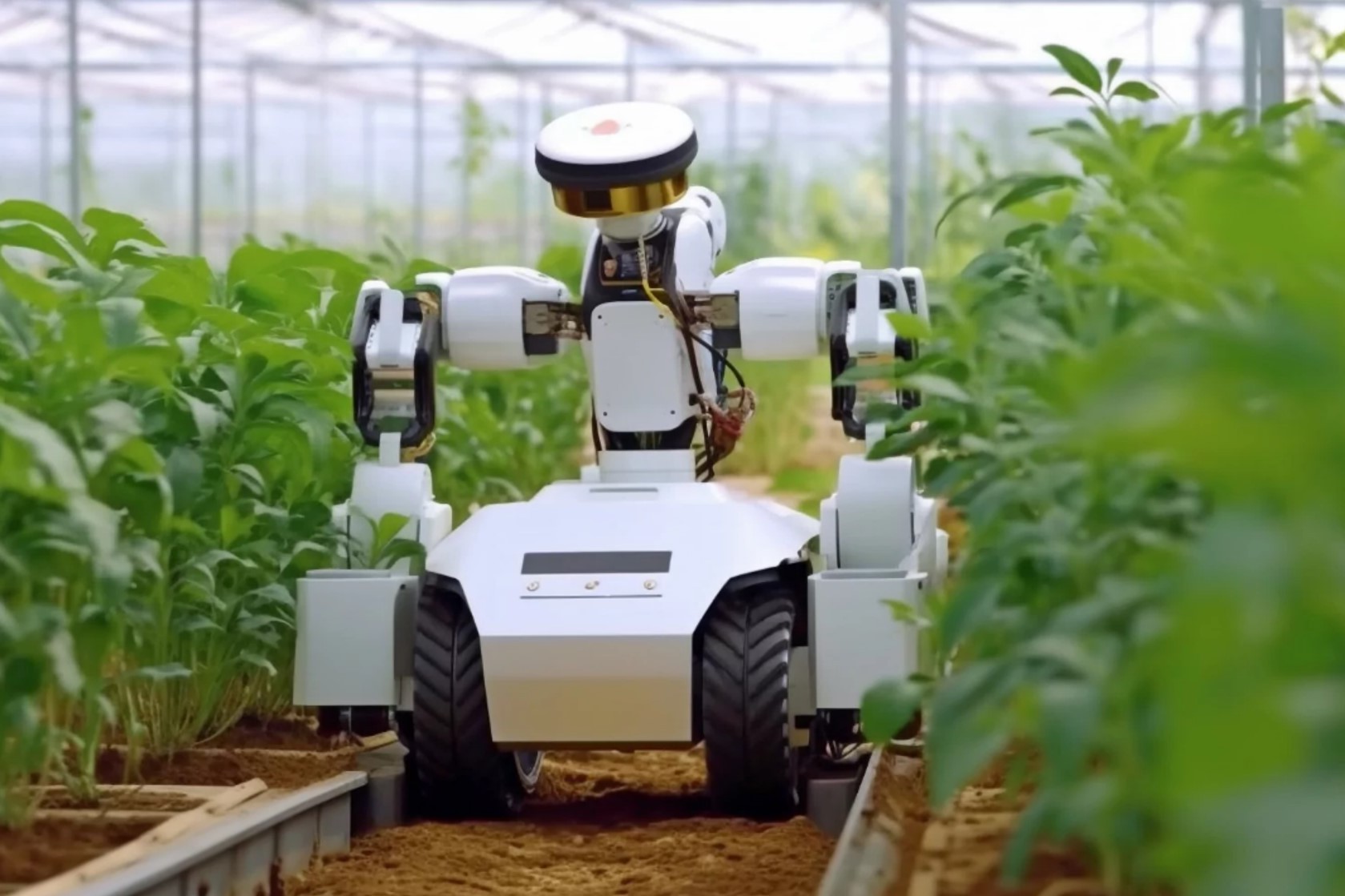
- Robotics: Combines AI with physical systems to perform tasks in the real world (e.g., autonomous drones, robotic arms).
#Hardware and Infrastructure AI systems require significant computational power, often provided by:
- Graphics Processing Units (GPUs): Accelerate parallel processing tasks (e.g., training deep learning models).
- Tensor Processing Units (TPUs): Specialized hardware designed by Google for AI workloads.
- Cloud Computing: Platforms like AWS, Google Cloud, and Azure provide scalable AI infrastructure.
- Edge Computing: Deploys AI models on local devices (e.g., smartphones, IoT devices) to reduce latency and improve privacy.
#Important Facts
- AI is Ubiquitous: AI is integrated into everyday technologies, from smartphone assistants (e.g., Siri, Google Assistant) to recommendation systems (e.g., Netflix, Spotify).
- AI Outperforms Humans in Specific Tasks: AI systems have surpassed human capabilities in areas like chess (Deep Blue), Go (AlphaGo), and image recognition (ImageNet benchmarks).
- AI is Data-Driven: The performance of AI models depends heavily on the quality and quantity of data. Poor data can lead to biased or inaccurate results.
- AI Ethics and Bias: AI systems can perpetuate biases present in training data, leading to ethical concerns. Efforts are underway to develop fair and explainable AI.
- Generative AI is Transforming Creativity: Models like DALL·E and MidJourney can generate realistic images, while tools like ChatGPT can write essays, code, and even poetry.
- AI in Healthcare: AI is used for early disease detection (e.g., cancer screening), drug discovery, and personalized treatment plans.
- Autonomous Vehicles: Companies like Tesla, Waymo, and Cruise are developing self-driving cars that rely on AI for perception, decision-making, and control.
- AI and Employment: While AI automates repetitive tasks, it also creates new job opportunities in fields like AI ethics, data science, and robotics maintenance.
- AI in Finance: AI is used for fraud detection, algorithmic trading, credit scoring, and customer service (e.g., chatbots).
- Explainable AI (XAI): As AI becomes more complex, there is a growing need for transparency in how AI models make decisions.
#Timeline
- Foundational ideas
Core concepts and early methods shape Facts About AI.
- Practical use
Tools, examples, and real-world deployments make the topic easier to evaluate.
- Responsible implementation
Current work focuses on reliability, governance, performance, and measurable impact.
#Related Terms
#FAQ
What does Facts About AI cover?
Covers facts about ai, including core concepts, practical examples, benefits, limitations, and risks in Artificial Intelligence.
Why is Facts About AI important?
It helps readers understand key concepts, compare practical use cases, and evaluate how Artificial Intelligence decisions affect outcomes, risks, and implementation choices.
What should readers verify before applying this topic?
Readers should compare benefits, limitations, data requirements, and related themes such as Facts, About, AI before using the ideas in real projects.
#References
- Facts About AI terminology and background research
- Facts About AI use cases, implementation examples, and limitations
- Artificial Intelligence best practices, standards, and risk guidance
- Facts case studies, benchmarks, and current industry analysis

Comments
No comments yet. Start the discussion with a useful note.