

#Short Answer
Covers exploring the basics of generative ai, including core concepts, practical examples, benefits, limitations, and risks in Generative AI.
#Infobox
#History / Background
Early Foundations (1950s–2000s) The conceptual roots of generative AI trace back to the mid-20th century, with early experiments in rule-based systems and symbolic AI. In 1957, Noam Chomsky’s work on generative grammar laid theoretical groundwork for structured content creation. However, practical implementations remained limited due to computational constraints. The 1980s and 1990s saw incremental progress with the advent of neural networks, though their generative capabilities were rudimentary. Boltzmann Machines (1985) and Variational Autoencoders (VAEs, 2013) introduced probabilistic methods for generating data, but scalability issues persisted.
The Deep Learning Revolution (2010s–Present) The breakthrough came with the rise of deep learning, particularly Generative Adversarial Networks (GANs) in 2014, introduced by Ian Goodfellow. GANs pit two neural networks—a generator and a discriminator—against each other, refining output quality through adversarial training. This innovation enabled high-fidelity image generation, sparking interest in creative applications. The 2020s marked a paradigm shift with the introduction of transformer-based models, notably Generative Pre-trained Transformers (GPT) by OpenAI. GPT-3 (2020) demonstrated unprecedented text generation capabilities, while subsequent versions (e.g., GPT-4) expanded multimodal functionality. Parallel developments in diffusion models (e.g., Stable Diffusion) revolutionized image synthesis by iteratively refining noise into coherent visuals.
Key Milestones
- 2014: Introduction of GANs by Goodfellow et al.
- 2016: Pix2Pix (image-to-image translation) and CycleGAN (unpaired image translation).
- 2017: Transformer architecture (Vaswani et al.) laid the foundation for modern NLP models.
- 2020: GPT-3 released, showcasing zero-shot and few-shot learning.
- 2021: DALL·E (text-to-image) and Stable Diffusion democratize AI-generated art.
- 2023: Multimodal models (e.g., GPT-4, Midjourney v5) integrate text, image, and audio generation.
#How It Works
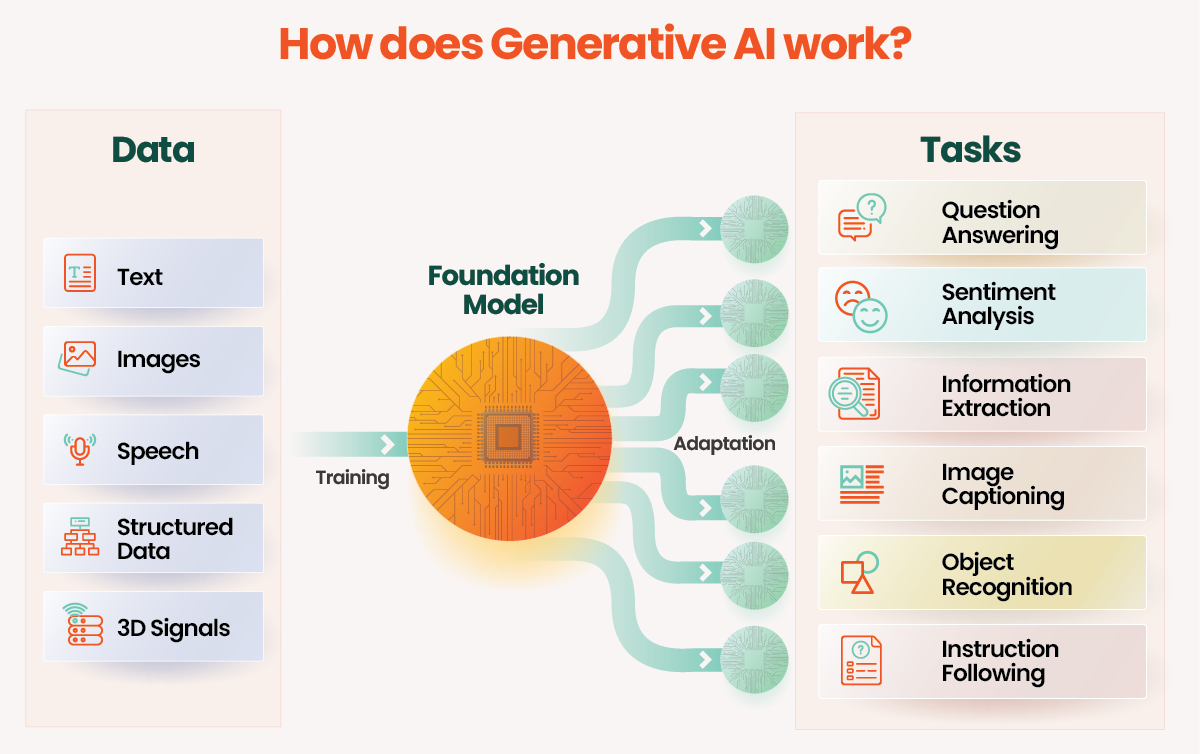
Core Principles Generative AI operates on probabilistic modeling, where systems learn the distribution of data to generate new samples. The process involves:
- Training on Large Datasets: Models ingest vast amounts of labeled or unlabeled data (e.g., books for text, images for vision tasks) to identify patterns.
- Learning Data Distributions: Neural networks approximate the underlying probability distribution of the input data.
- Sampling New Outputs: The model generates outputs by sampling from the learned distribution, ensuring novelty while maintaining coherence.
Key Architectures
- Generative Adversarial Networks (GANs)
- Components: A generator creates data (e.g., images), while a discriminator evaluates its realism.
- Training: The generator improves by fooling the discriminator, leading to progressively higher-quality outputs.
- Limitations: Mode collapse (limited diversity) and training instability.
- Variational Autoencoders (VAEs)
- Components: An encoder compresses data into a latent space, and a decoder reconstructs it.
- Strengths: Stable training, interpretable latent space.
- Weaknesses: Outputs may lack sharpness compared to GANs.
- Transformer-Based Models (e.g., GPT, BERT)
- Mechanism: Use self-attention to weigh input tokens, enabling context-aware generation.
- Applications: Text generation, code synthesis, and multimodal tasks.
- Example: GPT-4 processes prompts to generate human-like text, code, or even images when paired with auxiliary models.
- Diffusion Models
- Process: Gradually add noise to data (forward diffusion) and then reverse it to generate samples.
- Advantages: High-quality outputs, stable training.
- Use Cases: Image generation (e.g., Stable Diffusion), audio synthesis.
Training Process
- Supervised vs. Unsupervised Learning:
- Supervised: Models learn from labeled data (e.g., paired text-image datasets).
- Unsupervised: Models discover patterns without explicit labels (e.g., GANs).
- Fine-Tuning: Pre-trained models are adapted for specific tasks (e.g., medical image generation).
- Reinforcement Learning: Some systems (e.g., RLHF in GPT-4) use human feedback to refine outputs.
#Important Facts
Capabilities
- Text Generation: Models like GPT-4 can produce essays, code, or conversational responses.
- Image Synthesis: Tools like DALL·E 3 and Midjourney generate photorealistic or artistic images from text prompts.
- Audio & Music: Systems like MusicLM (Google) compose original melodies.
- Video Generation: Emerging models (e.g., Sora) create short videos from text descriptions.
- 3D Modeling: AI generates 3D assets for gaming and virtual reality.
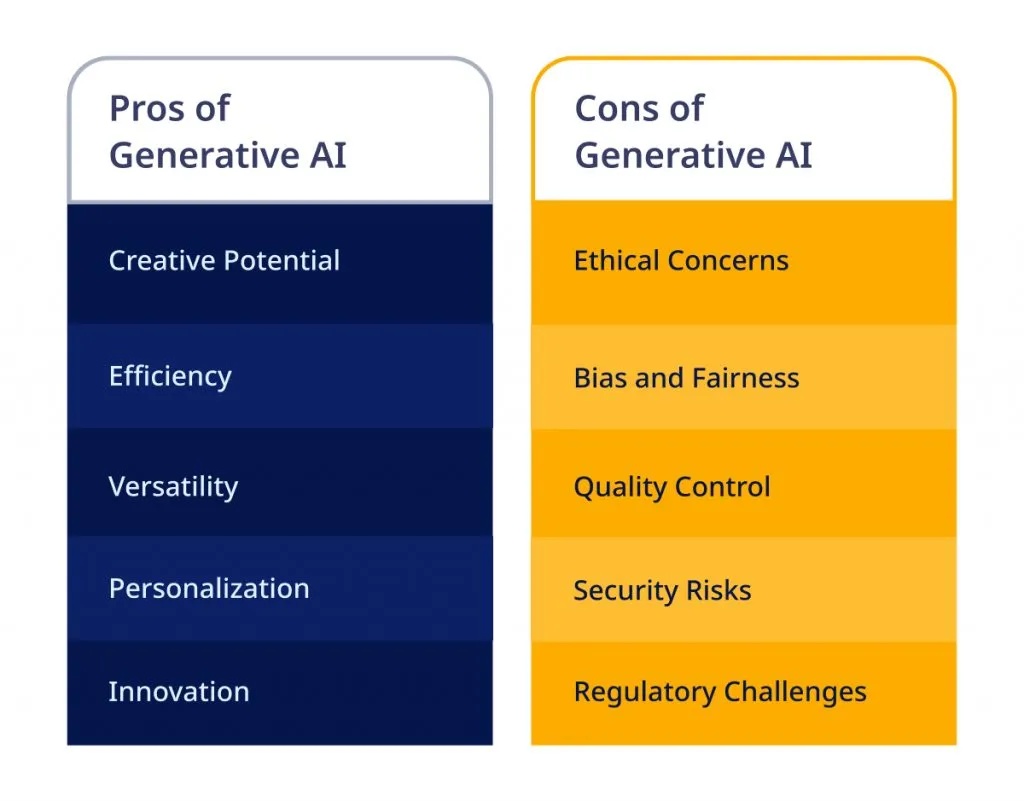
Limitations
- Hallucinations: Models may produce plausible but incorrect information (e.g., fake facts in text).
- Bias: Training data often reflects societal biases, leading to skewed outputs.
- Computational Cost: Training large models requires significant GPU/TPU resources.
- Ethical Risks: Deepfakes and misinformation pose societal challenges.
- Lack of Explainability: "Black box" nature makes it difficult to interpret decision-making.
Performance Metrics
- Fréchet Inception Distance (FID): Measures image quality in GANs/VAEs (lower = better).
- BLEU/ROUGE Scores: Evaluate text generation quality (higher = more accurate).
- Perplexity: Assesses language model performance (lower = better).
#Timeline
- Foundational ideas
Core concepts and early methods shape Exploring the Basics of Generative AI.
- Practical use
Tools, examples, and real-world deployments make the topic easier to evaluate.
- Responsible implementation
Current work focuses on reliability, governance, performance, and measurable impact.
#Related Terms
#FAQ
What does Exploring the Basics of Generative AI cover?
Covers exploring the basics of generative ai, including core concepts, practical examples, benefits, limitations, and risks in Generative AI.
Why is Exploring the Basics of Generative AI important?
It helps readers understand key concepts, compare practical use cases, and evaluate how Generative AI decisions affect outcomes, risks, and implementation choices.
What should readers verify before applying this topic?
Readers should compare benefits, limitations, data requirements, and related themes such as Exploring, Basics, Generative before using the ideas in real projects.
#References
- Exploring the Basics of Generative AI terminology and background research
- Exploring the Basics of Generative AI use cases, implementation examples, and limitations
- Generative AI best practices, standards, and risk guidance
- Exploring case studies, benchmarks, and current industry analysis



Comments
No comments yet. Start the discussion with a useful note.