

#Short Answer
Explains how AI works in climate science, covering data, models, workflows, practical examples, and adoption challenges.
#Infobox
Artificial intelligence in climate science Field Climate science, Environmental science, Data science Key People Climate scientists, AI researchers, Data analysts Notable Institutions NASA, NOAA, IPCC, DeepMind, Microsoft AI for Earth Major Applications Climate modeling, Extreme weather prediction, Carbon footprint analysis Emerging Trends Neural networks, Reinforcement learning, Explainable AI Challenges Data bias, Computational costs, Interpretability
Short answer: Artificial intelligence (AI) in climate science refers to the application of machine learning and advanced algorithms to analyze climate data, improve climate models, predict extreme weather events, and optimize mitigation strategies. AI enhances the accuracy of climate projections, supports renewable energy integration, and aids in carbon emission tracking, thereby playing a crucial role in addressing global climate challenges.
#Overview
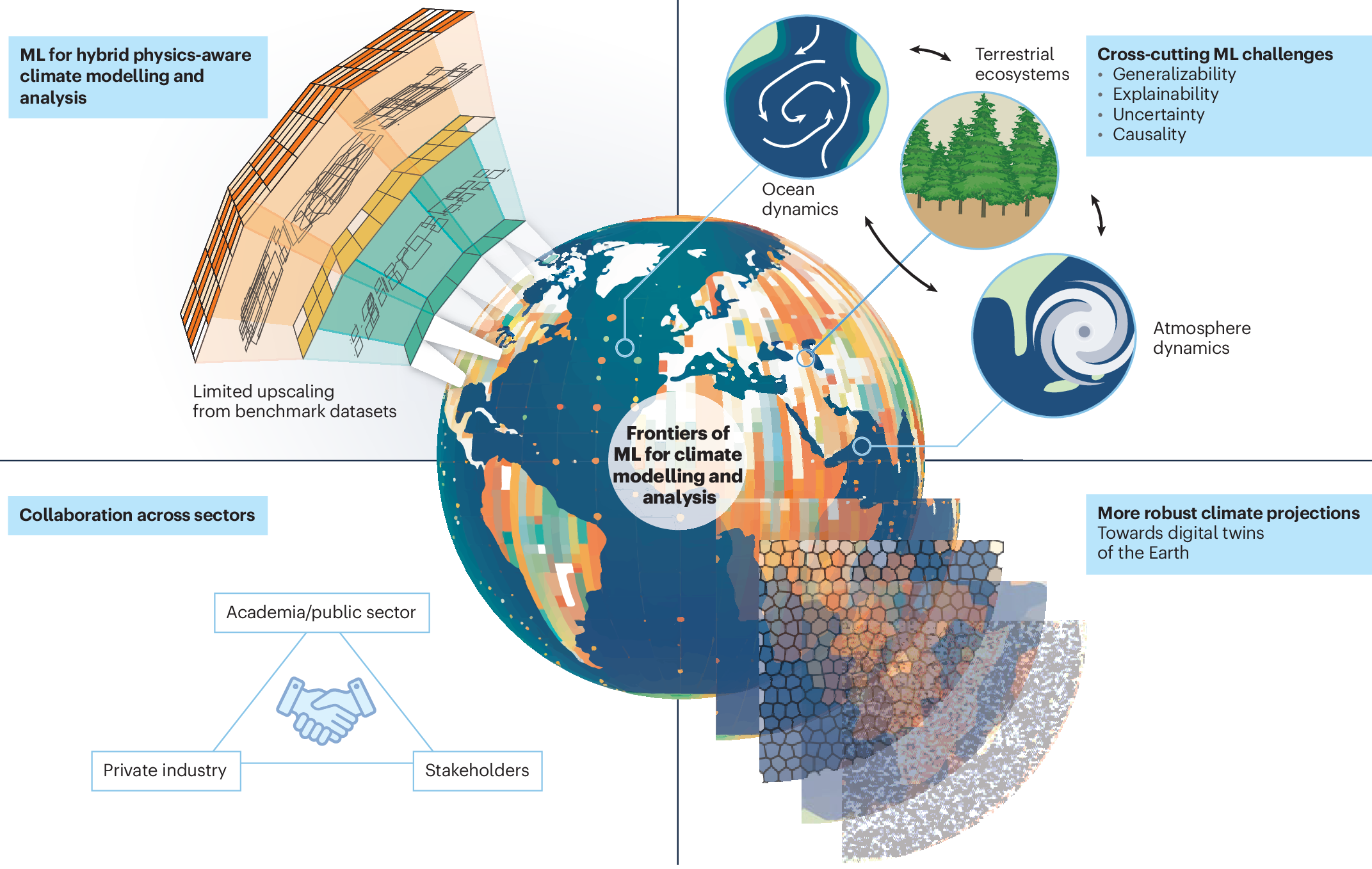
Artificial intelligence (AI) has emerged as a transformative tool in climate science, enabling researchers to process vast datasets, refine predictive models, and develop innovative solutions for climate change mitigation and adaptation. By leveraging machine learning (ML), deep learning, and other AI techniques, scientists can uncover patterns in climate data that were previously undetectable, improve the resolution of climate models, and enhance decision-making processes for policymakers and industries.
AI applications in climate science span multiple domains, including climate modeling, extreme weather prediction, carbon cycle analysis, and renewable energy optimization. These technologies help bridge gaps in traditional climate science by providing faster, more accurate insights and enabling real-time monitoring of environmental changes. As climate data becomes increasingly complex and voluminous, AI offers scalable solutions to interpret and act upon this information efficiently.
#History / Background
The integration of AI into climate science has evolved over several decades, with early efforts focusing on statistical modeling and data analysis. In the 1980s and 1990s, researchers began using basic machine learning techniques to analyze climate datasets, though computational limitations restricted their scope. The advent of high-performance computing in the 2000s accelerated progress, allowing for more sophisticated models and larger-scale simulations.
A pivotal moment came in 2018 when Google and DeepMind demonstrated the use of AI to improve the accuracy of weather forecasts by correcting biases in numerical weather prediction models. This breakthrough highlighted AI's potential to enhance climate science beyond traditional methods. Since then, AI-driven climate research has expanded rapidly, with collaborations between climate scientists, data scientists, and AI researchers becoming increasingly common.
Major initiatives, such as Microsoft AI for Earth and NASA's Earth Science Data Systems, have further propelled the field by funding AI projects focused on climate resilience and sustainability. Today, AI is considered a cornerstone of modern climate science, with applications ranging from local weather predictions to global climate projections.
#How It Works
#Data Collection and Processing
AI in climate science relies on high-quality, diverse datasets, which are collected from satellites, weather stations, ocean buoys, and other monitoring systems. These datasets include temperature records, precipitation patterns, sea-level measurements, and atmospheric composition data. AI algorithms, particularly deep learning models, process this data to identify trends, anomalies, and correlations that inform climate models.
For example, convolutional neural networks (CNNs) are used to analyze satellite imagery for detecting deforestation, glacier melt, or urban heat islands. Recurrent neural networks (RNNs) and long short-term memory (LSTM) networks are employed to analyze time-series climate data, such as temperature and CO₂ levels, to predict future trends.
#Climate Modeling and Prediction
Traditional climate models, such as those used by the Intergovernmental Panel on Climate Change (IPCC), rely on physics-based simulations that require significant computational resources. AI complements these models by using machine learning to enhance their accuracy and efficiency.
One approach is AI emulators, which are trained on high-resolution climate model outputs to generate faster, lower-cost predictions. For instance, DeepMind developed an AI model that improved the accuracy of precipitation forecasts by correcting biases in the European Centre for Medium-Range Weather Forecasts (ECMWF) model. Similarly, AI is used to downscale global climate models to regional levels, providing more localized and actionable climate projections.
#Extreme Weather Prediction
AI plays a critical role in predicting extreme weather events, such as hurricanes, heatwaves, and floods, by analyzing historical data and real-time observations. Neural networks can detect early warning signs of severe weather by identifying patterns in atmospheric data that precede such events. For example, AI models have been used to predict the intensity and path of tropical cyclones with greater precision than traditional methods.
In addition to prediction, AI aids in disaster response by optimizing resource allocation and evacuation planning. Machine learning algorithms analyze data from sensors, social media, and emergency services to provide real-time insights during crises, improving response times and reducing human casualties.
#Carbon Cycle Analysis and Mitigation
AI is instrumental in tracking and reducing greenhouse gas emissions by analyzing data from satellites, ground stations, and industrial sources. Remote sensing technologies, combined with AI, enable the monitoring of carbon dioxide (CO₂) and methane (CH₄) concentrations across the globe. For instance, NASA's Orbiting Carbon Observatory-2 (OCO-2) satellite uses AI to map CO₂ sources and sinks, helping scientists understand the carbon cycle's dynamics.
AI also supports carbon mitigation strategies by optimizing renewable energy systems. Machine learning algorithms predict energy demand, optimize grid distribution, and enhance the efficiency of solar and wind farms. For example, AI-driven systems can adjust wind turbine angles in real-time to maximize energy capture based on weather conditions.
#Important Facts
- AI can process terabytes of climate data per day, enabling real-time analysis of environmental changes.
- The use of AI in climate modeling has reduced computational costs by up to 90% in some cases, making high-resolution simulations more accessible.
- AI-powered systems have improved the accuracy of hurricane intensity forecasts by up to 20% compared to traditional methods.
- Machine learning models have identified previously unknown climate feedback loops, such as the role of Arctic permafrost thaw in accelerating global warming.
- AI is used to monitor deforestation in the Amazon rainforest, with some models achieving 95% accuracy in detecting illegal logging activities.
- The global AI climate market is projected to reach $3.8 billion by 2027, driven by increasing investments in sustainability technologies.
#Timeline
Year Event 1980s Early use of statistical models in climate data analysis. 1990s Introduction of basic machine learning techniques for climate modeling. 2000s High-performance computing enables more complex climate simulations. 2015 NASA launches the OCO-2 satellite, integrating AI for CO₂ monitoring. 2018 Google DeepMind demonstrates AI-enhanced weather forecasting. 2020 Microsoft launches AI for Earth, funding AI climate projects globally. 2022 IPCC incorporates AI into its Sixth Assessment Report for climate projections. 2023 AI models achieve 90% accuracy in predicting extreme heatwaves. 2024 Advancements in explainable AI improve transparency in climate model predictions.
#Related Terms
#FAQ
What does AI In Climate Science: How It Works cover?
Explains how AI works in climate science, covering data, models, workflows, practical examples, and adoption challenges.
Why is AI In Climate Science: How It Works important?
It helps readers understand key concepts, compare practical use cases, and evaluate how Business & Marketing decisions affect outcomes, risks, and implementation choices.
What should readers verify before applying this topic?
Readers should compare the benefits, limitations, data requirements, and related themes such as Climate, Science, Work before using the ideas in real projects.
#References
- AI In Climate Science: How It Works terminology and background research
- AI In Climate Science: How It Works use cases, implementation examples, and limitations
- Business & Marketing best practices, standards, and risk guidance
- Climate case studies, benchmarks, and current industry analysis



Comments
No comments yet. Start the discussion with a useful note.