

#Short Answer
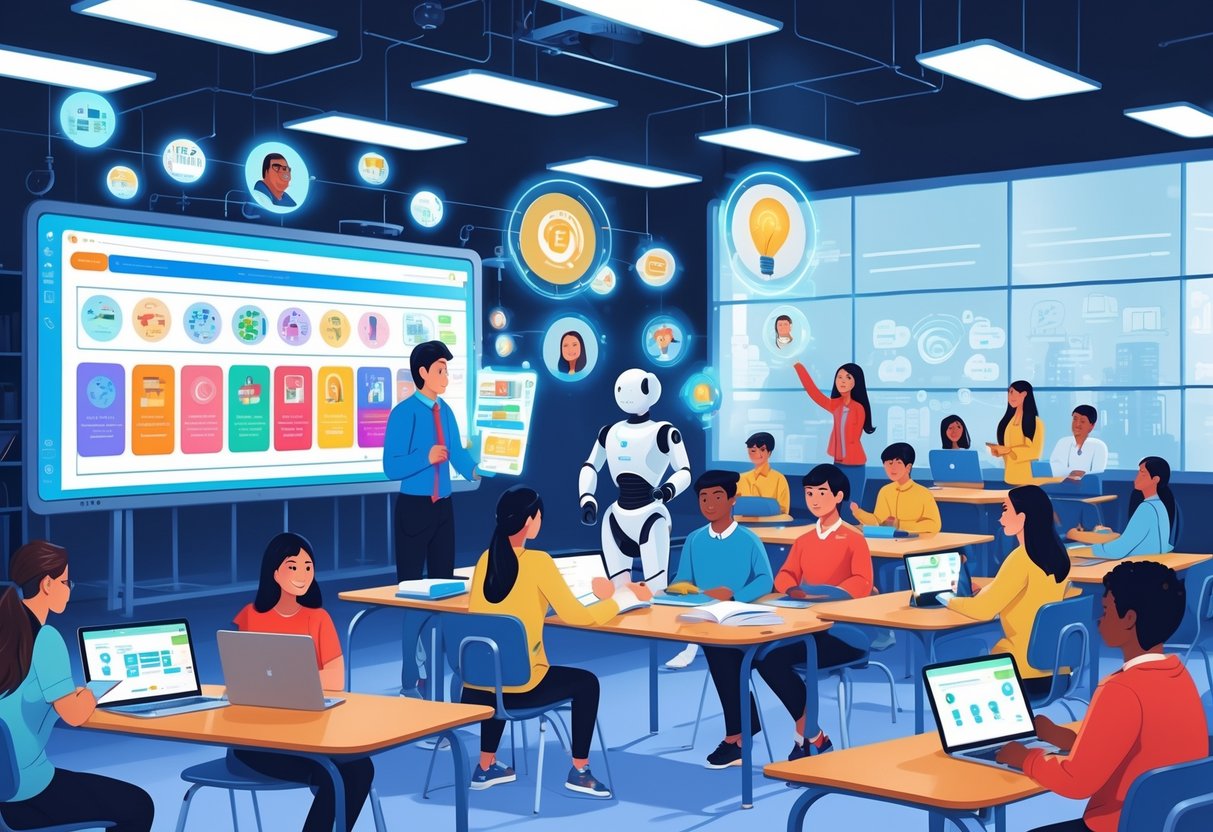
Explains how AI is applied in classrooms to support tools and techniques, with examples, workflows, benefits, and adoption challenges.
#Infobox
Artificial Intelligence in Education Field Education Focus AI tools and techniques for teaching and learning Key Developments Adaptive learning, automated grading, virtual tutors Major Applications Personalized learning, content generation, assessment tools Challenges Data privacy, equity, teacher training Notable Researchers Rose Luckin, Neil Selwyn, Sugata Mitra
#Overview
AI in classrooms encompasses a wide range of technologies designed to support educators and students. These tools leverage machine learning, natural language processing, and data analytics to automate tasks, provide personalized learning experiences, and improve educational outcomes. AI-powered systems can analyze vast amounts of data to identify learning patterns, predict student performance, and recommend customized learning paths. Additionally, AI facilitates the creation of interactive and engaging learning materials, such as simulations and gamified content, which can enhance student motivation and retention.
The adoption of AI in education is driven by the need to address challenges such as large class sizes, diverse learning needs, and limited resources. By automating routine tasks like grading and administrative duties, AI allows teachers to focus more on instruction and student interaction. However, the implementation of AI in classrooms also requires careful consideration of ethical, social, and technical factors to ensure equitable and effective use.
#History / Background
The concept of using technology to enhance education dates back to the mid-20th century, with early experiments in computer-assisted instruction (CAI) in the 1960s. One of the first notable examples was PLATO, a computer-based education system developed at the University of Illinois. However, it was not until the advent of more advanced AI techniques in the 1980s and 1990s that AI began to play a more significant role in education.
In the 1980s, researchers explored the use of expert systems and intelligent tutoring systems (ITS) to provide personalized instruction. These early AI systems were designed to mimic human tutors by adapting to individual student needs and providing targeted feedback. The development of machine learning algorithms in the 2000s further advanced the capabilities of AI in education, enabling systems to analyze large datasets and make data-driven predictions.
The proliferation of digital devices and internet connectivity in the 2010s accelerated the adoption of AI in classrooms. Platforms like Khan Academy and Duolingo began incorporating AI to personalize learning experiences. The COVID-19 pandemic in 2020 further highlighted the importance of AI tools in remote and hybrid learning environments, leading to increased investment and innovation in educational AI.
#How It Works
AI tools in classrooms operate through a combination of algorithms, data analytics, and user interfaces. The core functionality of these systems typically involves the following steps:
- Data Collection: AI systems gather data from various sources, including student interactions with digital platforms, assessments, and behavioral metrics. This data may include response times, accuracy rates, and engagement levels.
- Data Analysis: Machine learning models process the collected data to identify patterns, trends, and correlations. For example, an AI system might analyze a student's performance on quizzes to determine their strengths and weaknesses in specific topics.
- Personalization: Based on the analysis, AI systems generate personalized learning recommendations. These may include tailored lesson plans, additional practice exercises, or suggested resources to address gaps in understanding.
- Automation: AI automates repetitive tasks such as grading multiple-choice questions, generating progress reports, and organizing classroom schedules. This reduces the administrative burden on teachers and allows them to focus on instruction.
- Feedback and Adaptation: AI systems provide real-time feedback to students, helping them understand their mistakes and guiding them toward correct solutions. Additionally, these systems continuously adapt to changing student needs, ensuring that learning experiences remain relevant and effective.
Common AI techniques used in educational tools include:
- Natural Language Processing (NLP): Enables systems to understand and generate human language, facilitating features like chatbots and automated essay grading.
- Computer Vision: Analyzes visual data, such as handwritten answers or student interactions with physical objects, to provide feedback or assess performance.
- Predictive Analytics: Uses historical data to forecast student outcomes, such as the likelihood of passing an exam or dropping out of a course.
- Reinforcement Learning: Optimizes learning paths by rewarding systems for providing effective instruction and penalizing ineffective strategies.
#Important Facts
- Personalization: AI can tailor learning experiences to individual students, addressing diverse learning styles and paces. Studies show that personalized learning can improve student engagement and academic performance by up to 30%.
- Accessibility: AI tools can make education more accessible to students with disabilities. For example, speech-to-text software helps students with motor impairments, while AI-powered captioning improves accessibility for deaf or hard-of-hearing students.
- Efficiency: Automated grading and administrative tasks save teachers significant time. Some AI systems can grade assignments in seconds, allowing educators to provide faster feedback and focus on instruction.
- Global Reach: AI-powered platforms like Coursera and edX offer courses to millions of students worldwide, breaking down geographical barriers to education.
- Ethical Concerns: The use of AI in education raises ethical issues, including data privacy, algorithmic bias, and the potential for over-reliance on technology. Ensuring transparency and fairness in AI systems is critical to addressing these concerns.
- Teacher Role: While AI can automate many tasks, teachers remain essential for mentoring, emotional support, and fostering critical thinking. AI is best used as a tool to augment, rather than replace, human educators.
#Timeline
Year Event 1960 Development of PLATO, an early computer-assisted instruction system at the University of Illinois. 1980s Introduction of expert systems and intelligent tutoring systems (ITS) for personalized instruction. 1997 IBM's Deep Blue defeats world chess champion Garry Kasparov, demonstrating the potential of AI in problem-solving. 2006 Launch of Khan Academy, which later incorporates AI for personalized learning. 2011 IBM Watson wins Jeopardy!, showcasing advancements in natural language processing and AI. 2016 Google's DeepMind develops AlphaGo, an AI program that defeats a world champion Go player, highlighting the potential of AI in complex decision-making. 2020 COVID-19 pandemic accelerates the adoption of AI tools in remote and hybrid learning environments. 2023 Generative AI tools like ChatGPT and DALL-E gain widespread attention, leading to increased interest in AI for content creation and education.
#Related Terms
#FAQ
What does AI In Classrooms: Tools And Techniques cover?
Explains how AI is applied in classrooms to support tools and techniques, with examples, workflows, benefits, and adoption challenges.
Why is AI In Classrooms: Tools And Techniques important?
It helps readers understand key concepts, compare practical use cases, and evaluate how Education & Careers decisions affect outcomes, risks, and implementation choices.
What should readers verify before applying this topic?
Readers should compare the benefits, limitations, data requirements, and related themes such as Classroom, Tool, Technique before using the ideas in real projects.
#References
- AI In Classrooms: Tools And Techniques terminology and background research
- AI In Classrooms: Tools And Techniques use cases, implementation examples, and limitations
- Education & Careers best practices, standards, and risk guidance
- Classroom case studies, benchmarks, and current industry analysis




Comments
No comments yet. Start the discussion with a useful note.