

#Short Answer
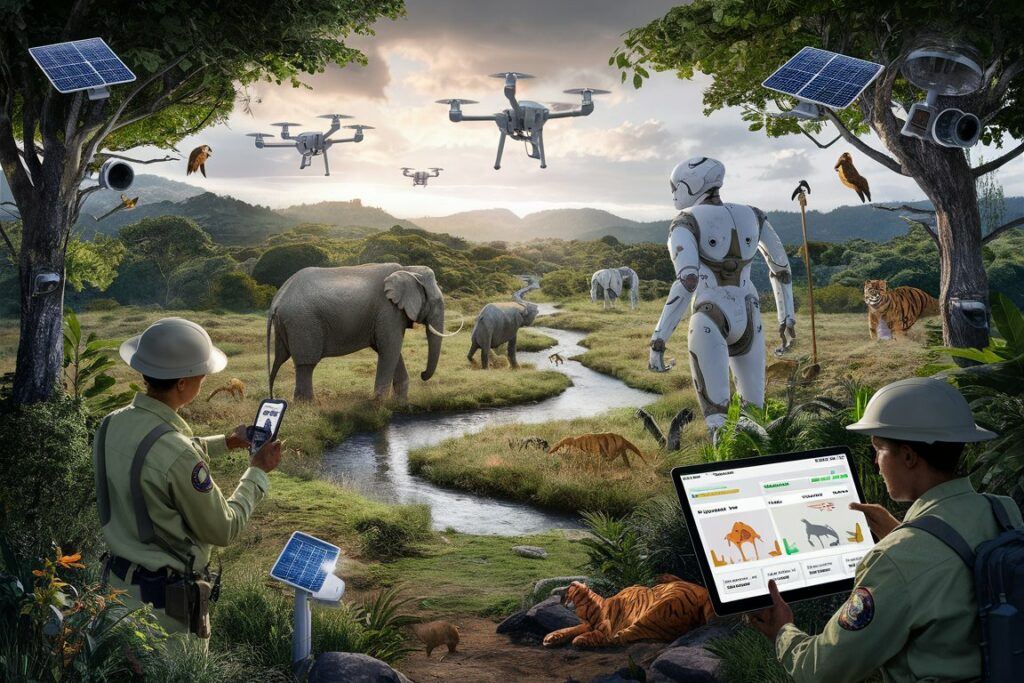
Explores how artificial intelligence shapes wildlife and tracking and conservation, covering practical use cases, benefits, limitations, and risks.
#Infobox
AI and Wildlife Tracking and Conservation refers to the application of artificial intelligence technologies to monitor, analyze, and protect wildlife populations and their habitats. These methods enhance traditional conservation efforts by providing real-time data, predictive insights, and automated solutions for threats such as poaching, habitat loss, and climate change.
AI in Wildlife Conservation Field Wildlife Conservation Focus Tracking, Monitoring, Protection Key Technologies Machine Learning, Computer Vision, Drones, IoT, Acoustic Sensors Applications Species Identification, Poaching Detection, Habitat Monitoring, Population Estimation Notable Projects Wildbook, TrailGuard AI, Conservation Metrics Impact Improved accuracy, reduced costs, real-time monitoring
#Overview
Artificial intelligence (AI) has emerged as a transformative tool in wildlife conservation, enabling researchers and conservationists to address long-standing challenges with greater efficiency and precision. By integrating AI with traditional conservation methods, organizations can enhance species monitoring, detect illegal activities, and predict environmental changes that threaten biodiversity.
AI-driven systems analyze vast datasets from camera traps, satellite imagery, acoustic sensors, and GPS collars to identify individual animals, track migration patterns, and assess habitat health. These technologies not only reduce human labor and operational costs but also provide actionable insights that inform policy decisions and conservation strategies.
The adoption of AI in wildlife conservation aligns with broader trends in smart conservation and precision conservation, where data-driven approaches are prioritized to maximize impact. As climate change accelerates and biodiversity loss intensifies, AI offers scalable solutions to monitor and protect ecosystems in real time.
#History / Background
#Early Developments
The integration of technology into wildlife conservation dates back to the mid-20th century with the use of radio telemetry for tracking animal movements. However, the application of AI in this field began in the late 1990s and early 2000s, coinciding with advancements in computing power and machine learning algorithms.
One of the earliest AI-driven conservation projects was the development of automated camera traps equipped with image recognition software. These systems, initially limited by processing power, evolved with the advent of deep learning in the 2010s, enabling more accurate species identification and behavior analysis.
#Milestones
- 2012: The launch of Wildbook, an open-source platform that uses AI to identify individual animals based on unique markings such as whale shark spots or cheetah fur patterns.
- 2016: Introduction of TrailGuard AI by the Rescue Wildlife Foundation, a system that uses AI-powered motion sensors to detect poachers in real time.
- 2018: Deployment of AI algorithms on drones to monitor deforestation and illegal logging in the Amazon rainforest.
- 2020: Expansion of acoustic monitoring systems that use AI to analyze animal vocalizations, enabling the detection of endangered species in dense forests.
- 2022: Integration of AI with satellite imagery to track large mammal migrations across continents, such as elephants in Africa.
#How It Works
#Data Collection
AI systems in wildlife conservation rely on diverse data sources, including:
- Camera Traps: High-resolution images and videos are captured in remote locations and processed using computer vision to identify species.
- Satellite Imagery: AI analyzes satellite data to detect habitat changes, deforestation, and illegal land use.
- Acoustic Sensors: Microphones record animal sounds, which AI algorithms classify to monitor biodiversity and detect endangered species.
- GPS Collars: Wearable devices track animal movements, and AI models predict migration patterns and habitat preferences.
- Drones: Aerial surveys use AI to identify and count animals in large areas, such as savannas or oceans.
#AI Techniques
The following AI techniques are commonly employed:
- Computer Vision: Deep learning models, such as Convolutional Neural Networks (CNNs), analyze images to identify species, count individuals, and detect anomalies like poaching activity.
- Machine Learning: Supervised and unsupervised learning algorithms classify data, predict species distributions, and assess habitat suitability.
- Natural Language Processing (NLP): Used to analyze scientific literature and citizen science reports for insights into species behavior and threats.
- Reinforcement Learning: Applied in dynamic conservation scenarios, such as optimizing patrol routes for anti-poaching teams.
#Applications
AI is applied across multiple conservation domains:
- Species Identification: AI models recognize individual animals based on unique features (e.g., tiger stripes, whale fins) for population studies.
- Poaching Detection: Motion-activated cameras and AI alert rangers to suspicious activity in protected areas.
- Habitat Monitoring: Satellite-based AI tracks deforestation, coral reef degradation, and wetland loss.
- Population Estimation: AI analyzes camera trap data to estimate animal populations without invasive methods.
- Disease Surveillance: AI detects early signs of outbreaks in wildlife populations by analyzing behavioral changes.
#Important Facts
- Accuracy: AI-powered image recognition can achieve over 90% accuracy in species identification, compared to 60-70% with manual methods.
- Cost-Effectiveness: Automated systems reduce the need for human fieldwork, cutting operational costs by up to 50% in some projects.
- Real-Time Monitoring: AI enables instant alerts for poaching or habitat threats, allowing rapid response.
- Scalability: AI models can process millions of images or hours of audio data, making them ideal for large-scale conservation efforts.
- Biodiversity Insights: AI helps discover new species and understand ecological interactions by analyzing vast datasets.
- Ethical Considerations: AI systems must be designed to avoid biases, such as misidentifying certain species or underrepresenting marginalized ecosystems.
- Global Reach: Projects like Wildbook operate in over 50 countries, supporting conservation efforts worldwide.
#Timeline
Year Event 1990s Early use of radio telemetry for animal tracking. 2005 First automated camera traps with basic image recognition. 2012 Launch of Wildbook, the first AI-driven wildlife tracking platform. 2016 TrailGuard AI deployed to detect poachers in real time. 2018 AI-powered drones used to monitor deforestation in the Amazon. 2020 Acoustic AI systems begin monitoring endangered species in dense forests. 2022 AI integrates with satellite imagery to track large mammal migrations. 2023 AI models predict extinction risks based on habitat and climate data.
#Related Terms
#FAQ
What does AI And Wildlife: Tracking And Conservation cover?
Explores how artificial intelligence shapes wildlife and tracking and conservation, covering practical use cases, benefits, limitations, and risks.
Why is AI And Wildlife: Tracking And Conservation important?
It helps readers understand key concepts, compare practical use cases, and evaluate how Climate & Society decisions affect outcomes, risks, and implementation choices.
What should readers verify before applying this topic?
Readers should compare the benefits, limitations, data requirements, and related themes such as Wildlife, Tracking, Conservation before using the ideas in real projects.
#References
- AI And Wildlife: Tracking And Conservation terminology and background research
- AI And Wildlife: Tracking And Conservation use cases, implementation examples, and limitations
- Climate & Society best practices, standards, and risk guidance
- Wildlife case studies, benchmarks, and current industry analysis


Comments
No comments yet. Start the discussion with a useful note.