

#Short Answer
Explores how artificial intelligence shapes productivity and efficiency boost, covering practical use cases, benefits, limitations, and risks.
#Infobox
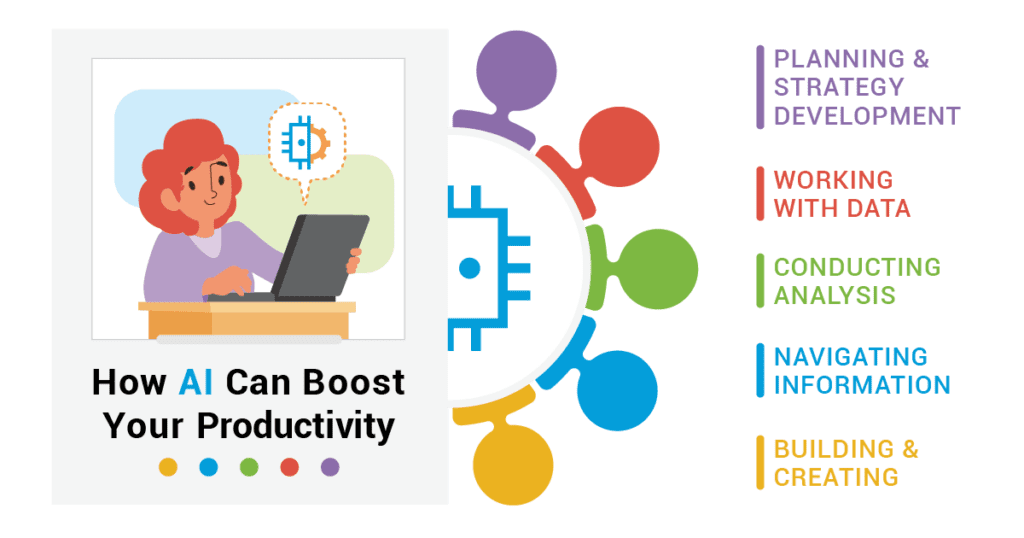
Artificial Intelligence (AI) enhances productivity by automating repetitive tasks, optimizing workflows, and providing data-driven insights, enabling individuals and organizations to achieve more in less time with reduced errors.
AI and Productivity AI and Productivity Field Artificial Intelligence, Business Productivity Key Technologies Machine Learning, Natural Language Processing, Robotic Process Automation Primary Benefits Time savings, Error reduction, Decision-making support Applications Task automation, Data analysis, Customer service Challenges Implementation costs, Data privacy, Workforce adaptation
#Overview
Artificial Intelligence (AI) refers to the simulation of human intelligence in machines programmed to think and learn. When applied to productivity, AI systems analyze vast amounts of data, identify patterns, and perform tasks autonomously or with minimal human intervention. This integration transforms traditional workflows by accelerating processes, reducing human error, and enabling strategic decision-making.
In both personal and professional contexts, AI-driven tools such as virtual assistants, predictive analytics platforms, and automated document processors streamline operations. For businesses, AI enhances competitiveness by improving efficiency across departments—from marketing and sales to operations and human resources. For individuals, AI-powered applications assist in time management, learning optimization, and task prioritization.
#History / Background
#Early Foundations (1950s–1980s)
The concept of AI dates back to the 1950s, with early research focused on symbolic reasoning and problem-solving. In 1956, the Dartmouth Conference marked the official birth of AI as a field. During this period, productivity tools were limited to basic automation and rule-based systems, primarily used in manufacturing and data processing.
#Rise of Machine Learning (1990s–2010s)
The advent of machine learning (ML) in the 1990s introduced systems capable of learning from data. This shift enabled AI to move beyond rigid programming and adapt to changing inputs. Productivity applications expanded into customer relationship management (CRM), supply chain optimization, and financial forecasting. The development of natural language processing (NLP) further enhanced human-computer interaction through voice recognition and chatbots.
#Modern Era (2010s–Present)
The 2010s saw exponential growth in AI capabilities, driven by advances in deep learning, cloud computing, and big data. Tools like AI-powered email filters, smart scheduling assistants, and robotic process automation (RPA) became mainstream. The integration of AI into enterprise software suites (e.g., Microsoft 365 Copilot, Google Workspace) has made intelligent productivity tools accessible to organizations of all sizes. Today, AI is a cornerstone of digital transformation strategies aimed at achieving operational excellence.
#How It Works
#Core AI Technologies
AI systems leverage several core technologies to enhance productivity:
- Machine Learning (ML): Algorithms that improve performance by learning from data without explicit programming. Supervised, unsupervised, and reinforcement learning models are used to predict trends, classify information, and optimize processes.
- Natural Language Processing (NLP): Enables machines to understand, interpret, and generate human language. Applications include sentiment analysis, automated transcription, and conversational AI (e.g., chatbots).
- Computer Vision: Analyzes visual data from images or videos to extract insights. Used in quality control, document digitization, and facial recognition for access management.
- Robotic Process Automation (RPA): Software robots mimic human actions to perform repetitive digital tasks such as data entry, invoice processing, and report generation.
#Integration into Workflows
AI tools integrate into existing systems through APIs, cloud platforms, or embedded software. For example:
- Task Automation: AI schedules meetings, filters emails, and prioritizes to-do lists based on user behavior and deadlines.
- Data Analysis: Predictive models forecast demand, detect anomalies in financial transactions, and recommend resource allocation.
- Decision Support: AI dashboards provide real-time insights, highlighting inefficiencies and suggesting corrective actions.
The effectiveness of AI in productivity hinges on data quality, algorithm transparency, and user adoption. Continuous feedback loops allow systems to refine their outputs over time.
#Important Facts
- Time Savings: AI can automate up to 40% of repetitive tasks, freeing employees to focus on high-value activities.
- Error Reduction: AI systems reduce human error in data processing by up to 90% in certain domains, such as accounting and logistics.
- ROI Impact: Companies using AI for productivity report an average return on investment (ROI) of 30–50% within the first year of implementation.
- Adoption Rates: As of 2024, over 60% of organizations have integrated AI into at least one business function, with adoption expected to reach 90% by 2027.
- Energy Efficiency: AI-driven optimization in data centers and manufacturing can reduce energy consumption by 15–30%.
- Skill Shift: While AI automates routine tasks, demand for skills such as data literacy, AI ethics, and human-AI collaboration is rising.
#Timeline
Year Milestone 1956 Dartmouth Conference establishes AI as a field of study. 1966 ELIZA, the first chatbot, demonstrates basic NLP capabilities. 1997 IBM's Deep Blue defeats world chess champion Garry Kasparov. 2006 Amazon launches its recommendation engine, showcasing AI in e-commerce. 2011 IBM Watson wins Jeopardy!, highlighting AI's potential in data analysis. 2016 DeepMind's AlphaGo defeats a professional Go player, demonstrating advanced ML. 2018 GDPR comes into effect, shaping AI's role in data privacy and compliance. 2020 COVID-19 pandemic accelerates AI adoption in remote work and automation. 2023 Generative AI tools (e.g., DALL·E, ChatGPT) become widely accessible, transforming content creation and collaboration. 2024 Over 70% of enterprises use AI for at least one productivity-related function.
#Related Terms
#FAQ
What does AI And Productivity: Efficiency Boost cover?
Explores how artificial intelligence shapes productivity and efficiency boost, covering practical use cases, benefits, limitations, and risks.
Why is AI And Productivity: Efficiency Boost important?
It helps readers understand key concepts, compare practical use cases, and evaluate how Business & Marketing decisions affect outcomes, risks, and implementation choices.
What should readers verify before applying this topic?
Readers should compare the benefits, limitations, data requirements, and related themes such as Productivity, Efficiency, Boost before using the ideas in real projects.
#References
- AI And Productivity: Efficiency Boost terminology and background research
- AI And Productivity: Efficiency Boost use cases, implementation examples, and limitations
- Business & Marketing best practices, standards, and risk guidance
- Productivity case studies, benchmarks, and current industry analysis

Comments
No comments yet. Start the discussion with a useful note.