

#Short Answer
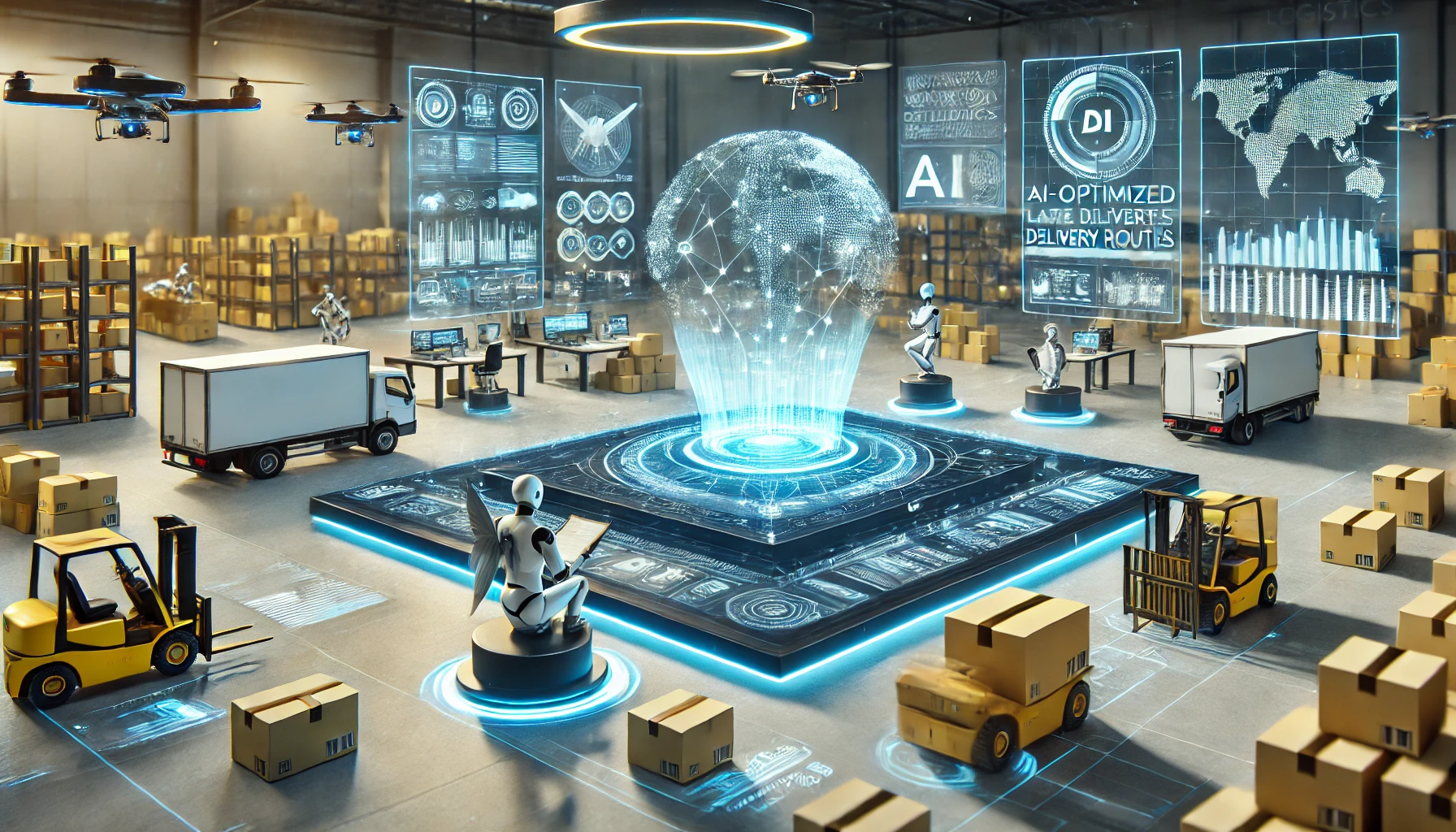
Explores how artificial intelligence shapes logistics and efficient delivery, covering practical use cases, benefits, limitations, and risks.
#Infobox
Artificial Intelligence in Logistics Field Logistics, Supply chain management Key Technologies Machine learning, Computer vision, Natural language processing, Predictive analytics Applications Route optimization, demand forecasting, warehouse automation, autonomous delivery, real-time tracking Benefits Reduced operational costs, improved delivery speed, enhanced accuracy, sustainability Challenges Data privacy, integration complexity, workforce adaptation, ethical concerns Industries E-commerce, manufacturing, healthcare, food delivery, retail
#Overview
AI in logistics leverages advanced algorithms and data-driven insights to streamline operations across the supply chain, from procurement to last-mile delivery. By integrating AI-powered tools such as route optimization software, warehouse management systems, and predictive maintenance models, businesses can achieve higher operational efficiency, cost savings, and improved customer satisfaction. The technology enables logistics providers to adapt to dynamic market conditions, reduce human error, and enhance sustainability through optimized fuel consumption and reduced carbon footprints.
#Key AI Technologies in Logistics
- Machine Learning (ML): Used for demand forecasting, inventory management, and anomaly detection in shipment patterns.
- Computer Vision: Enables automated quality control, package sorting, and damage detection in warehouses.
- Natural Language Processing (NLP): Facilitates chatbots for customer service, automated documentation processing, and sentiment analysis in feedback systems.
- Predictive Analytics: Helps in anticipating disruptions, optimizing delivery routes, and reducing lead times.
- Autonomous Systems: Includes self-driving delivery vehicles, drones, and robotic process automation (RPA) for warehouse tasks.
#History / Background
The integration of AI into logistics traces back to the early 2000s, when businesses began adopting enterprise resource planning (ERP) systems and basic automation tools. The advent of big data and cloud computing in the 2010s accelerated AI adoption, enabling real-time data analysis and predictive modeling. Major milestones include:
- 2005–2010: Introduction of AI-driven warehouse management systems (WMS) and early route optimization algorithms.
- 2011–2015: Rise of big data analytics in logistics, with companies like Amazon and FedEx implementing AI for demand forecasting.
- 2016–2020: Deployment of autonomous delivery vehicles and drones by companies such as Amazon (Prime Air) and UPS (UPS Flight Forward).
- 2021–Present: Expansion of AI in sustainable logistics, with a focus on reducing emissions and optimizing green supply chains.
#How It Works
AI in logistics operates through a combination of data collection, algorithmic processing, and automated execution. The process typically involves the following steps:
#Data Collection and Integration
Logistics AI systems rely on vast datasets sourced from IoT sensors, GPS trackers, customer orders, weather reports, and historical performance metrics. These datasets are integrated into centralized platforms, often using data lakes or data warehouses, to provide a unified view of the supply chain.
#Algorithm Training and Model Development
Machine learning models are trained using supervised, unsupervised, or reinforcement learning techniques. For example:
- Supervised Learning: Used for demand forecasting by analyzing past sales data and external factors like holidays or economic trends.
- Unsupervised Learning: Applied in clustering customer segments or identifying inefficiencies in delivery routes.
- Reinforcement Learning: Employed in dynamic route optimization, where the system learns from real-time traffic data to adjust delivery paths.
#Automation and Execution
Once trained, AI models generate actionable insights or automate tasks. Examples include:
- Autonomous Vehicles: Self-driving trucks and delivery robots navigate routes with minimal human intervention.
- Warehouse Robotics: AI-powered robots sort, pick, and pack orders in fulfillment centers.
- Predictive Maintenance: Sensors monitor vehicle and equipment health, predicting failures before they occur.
- Chatbots and Virtual Assistants: Handle customer inquiries, track shipments, and process returns.
#Important Facts
- Cost Reduction: AI can reduce logistics costs by up to 30% through optimized routing and inventory management.
- Speed and Accuracy: AI-driven systems improve delivery speed by 20–40% and reduce errors in order fulfillment.
- Sustainability Impact: Optimized routes and load balancing can cut fuel consumption by 10–15%, lowering carbon emissions.
- Market Growth: The global AI in logistics market is projected to reach USD 14.2 billion by 2027, growing at a CAGR of 24.5%.
- Adoption Barriers: Only 30% of logistics companies have fully integrated AI due to high implementation costs and data silos.
#Timeline
Year Milestone 1980s Introduction of early expert systems for inventory management. 2000 First AI-powered warehouse management systems (WMS) deployed by Manhattan Associates. 2007 Amazon begins using AI for demand forecasting and inventory optimization. 2012 Google’s self-driving car project (later Waymo) initiates research in autonomous logistics vehicles. 2016 DHL launches AI-powered predictive analytics for supply chain risk management. 2018 UPS deploys ORION (On-Road Integrated Optimization and Navigation), an AI system optimizing 1.5 million daily deliveries. 2020 Amazon Prime Air begins drone delivery trials in the U.S. and UK. 2023 Maersk and IBM launch TradeLens, a blockchain-AI platform for global trade logistics. 2024 Regulatory approvals for autonomous delivery trucks in select U.S. states.
#Related Terms
#FAQ
What does AI And Logistics: Efficient Delivery cover?
Explores how artificial intelligence shapes logistics and efficient delivery, covering practical use cases, benefits, limitations, and risks.
Why is AI And Logistics: Efficient Delivery important?
It helps readers understand key concepts, compare practical use cases, and evaluate how Business & Marketing decisions affect outcomes, risks, and implementation choices.
What should readers verify before applying this topic?
Readers should compare the benefits, limitations, data requirements, and related themes such as Logistic, Efficient, Delivery before using the ideas in real projects.
#References
- AI And Logistics: Efficient Delivery terminology and background research
- AI And Logistics: Efficient Delivery use cases, implementation examples, and limitations
- Business & Marketing best practices, standards, and risk guidance
- Logistic case studies, benchmarks, and current industry analysis


Comments
No comments yet. Start the discussion with a useful note.