

#Short Answer
Explores how artificial intelligence shapes human rights and key issues, covering practical use cases, benefits, limitations, and risks.
#Infobox
#Overview
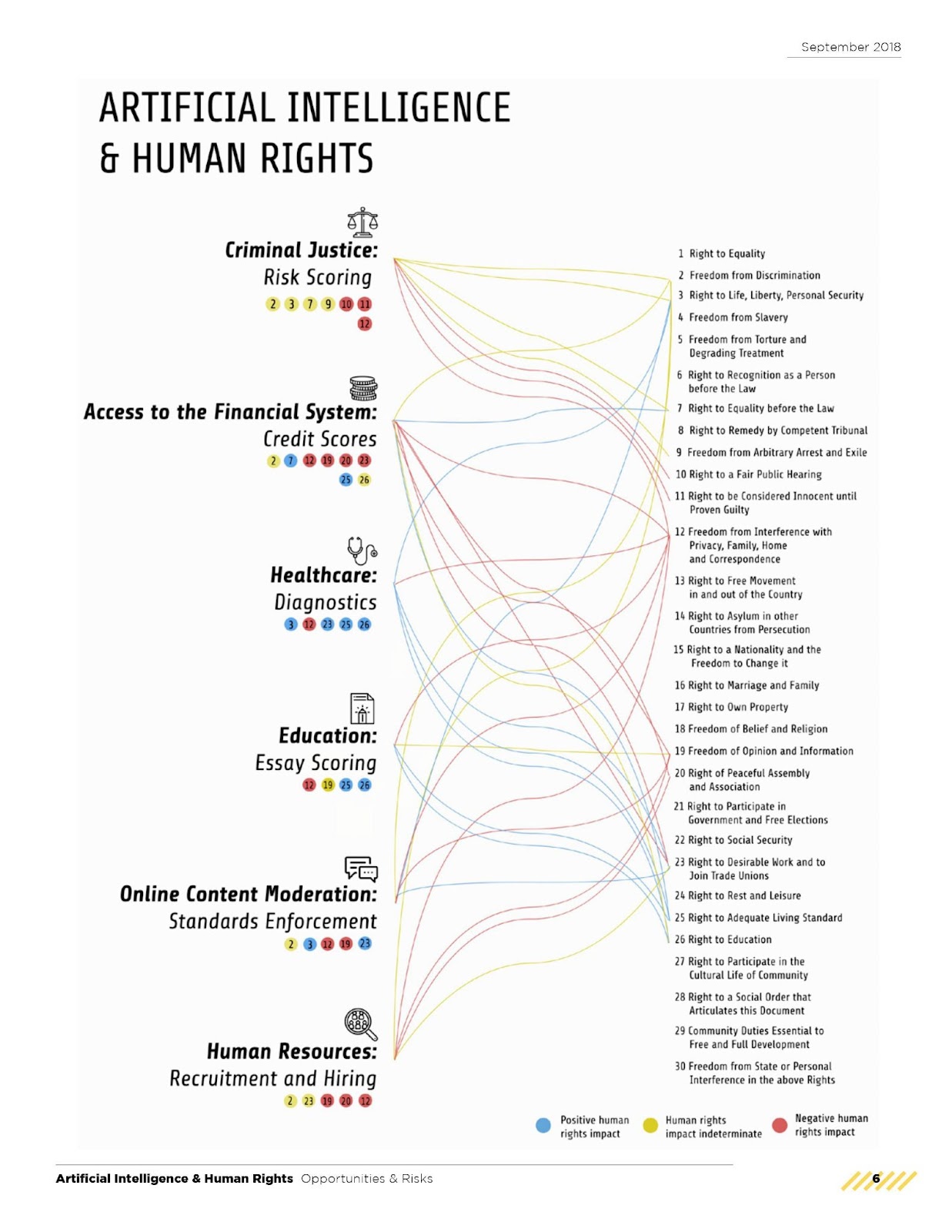
Artificial Intelligence (AI) is transforming societies by automating decision-making processes, enhancing productivity, and enabling new forms of interaction. However, its integration into critical sectors such as law enforcement, healthcare, and employment raises profound human rights concerns. Issues such as data privacy, algorithmic discrimination, mass surveillance, and the erosion of human autonomy are central to the discourse on AI governance. The dual-use nature of AI—its potential for both benefit and harm—necessitates a balanced approach that prioritizes human rights while fostering innovation.
AI systems rely on vast datasets, often containing sensitive personal information, which can be exploited for surveillance or discriminatory practices. Facial recognition technology, predictive policing algorithms, and automated hiring tools have been criticized for reinforcing biases and disproportionately affecting marginalized communities. Additionally, the lack of transparency in AI decision-making processes complicates accountability, making it difficult to challenge erroneous outcomes.
#History / Background
#Early Developments
The concept of AI dates back to the mid-20th century, with early research focused on symbolic reasoning and problem-solving. In 1956, the term "artificial intelligence" was coined at the Dartmouth Conference, marking the beginning of AI as a formal academic discipline. Early AI systems were rule-based and lacked the complexity of modern machine learning models. However, the field stagnated during the 1970s due to limited computational power and unrealized expectations, a period known as the "AI winter."
The resurgence of AI in the 21st century was driven by advances in computing power, big data, and deep learning techniques. The development of neural networks and reinforcement learning enabled AI systems to process vast amounts of data and perform tasks such as image recognition, natural language processing, and autonomous decision-making. These advancements have led to the widespread adoption of AI in industries ranging from finance to healthcare.
#Human Rights Concerns Emerge
As AI systems became more pervasive, concerns about their impact on human rights began to surface. In 2016, the United Nations Human Rights Council highlighted the risks of AI-driven surveillance and discrimination. Reports from organizations such as Amnesty International and Human Rights Watch have documented cases where AI systems have perpetuated racial and gender biases, particularly in facial recognition and predictive policing. The European Union's General Data Protection Regulation (GDPR), enacted in 2018, introduced provisions to protect individuals' data rights, including the "right to explanation" for automated decisions.
In 2019, the UN Special Rapporteur on the promotion and protection of the right to freedom of opinion and expression issued a report on AI and human rights, emphasizing the need for transparency, accountability, and human oversight in AI governance. The report warned against the unchecked deployment of AI in public spaces, citing risks to privacy and freedom of expression.
#How It Works
#AI Systems and Human Rights
AI systems operate through a combination of data collection, algorithmic processing, and decision-making. The process typically involves the following stages:
- Data Collection: AI systems rely on large datasets to train models. These datasets may include personal information such as biometric data, financial records, or social media activity. The collection and storage of such data raise concerns about privacy and consent.
- Algorithm Design: Machine learning algorithms, such as neural networks, are trained on datasets to identify patterns and make predictions. The design of these algorithms can inadvertently encode biases present in the training data, leading to discriminatory outcomes.
- Decision-Making: AI systems make decisions based on the patterns identified during training. These decisions can range from loan approvals to criminal sentencing, with significant implications for individuals' rights and freedoms. The lack of transparency in AI decision-making processes complicates efforts to challenge or appeal these outcomes.
- Feedback Loop: AI systems often operate in a feedback loop, where their decisions influence future data collection and training. This can reinforce existing biases and create a cycle of discrimination.
#Key Technologies
Several AI technologies have raised human rights concerns:
- Facial Recognition: Used for surveillance, law enforcement, and identity verification, facial recognition systems have been criticized for their high error rates, particularly for people of color and women. Misidentifications can lead to wrongful arrests and violations of privacy.
- Predictive Policing: Algorithms that predict crime hotspots or individual criminal behavior have been accused of reinforcing racial biases in policing. These systems can lead to over-policing in marginalized communities and undermine trust in law enforcement.
- Automated Hiring Tools: AI-driven hiring platforms analyze resumes and conduct interviews, potentially discriminating against candidates based on gender, race, or disability. The opacity of these tools makes it difficult to challenge biased decisions.
- Deepfakes: AI-generated synthetic media can be used to create realistic but false representations of individuals, posing risks to reputation, privacy, and democratic processes.
#Important Facts
- According to a 2021 study by the National Institute of Standards and Technology (NIST), facial recognition systems have higher error rates for Asian and Black individuals compared to white individuals.
- The EU AI Act, proposed in 2021, classifies AI systems into four risk categories, with high-risk systems subject to strict regulatory oversight.
- A 2020 report by the AI Now Institute found that AI-driven hiring tools disproportionately exclude candidates with disabilities and non-traditional career paths.
- The use of AI in predictive policing has been linked to increased incarceration rates in marginalized communities, as highlighted by a 2019 investigation by the Associated Press.
- In 2020, the city of Portland, Oregon, became one of the first in the U.S. to ban the use of facial recognition technology by law enforcement and city agencies.
#Timeline
YearEvent1956Dartmouth Conference: Coining of the term "artificial intelligence."1970sAI winter: Decline in AI research due to limited progress and funding.2016UN Human Rights Council raises concerns about AI-driven surveillance.2018EU General Data Protection Regulation (GDPR) enacted, introducing data protection rights.2019UN Special Rapporteur on AI and human rights issues a landmark report.2020Portland, Oregon, bans facial recognition technology for government use.2021EU AI Act proposed, classifying AI systems by risk levels.2022UN adopts a resolution on AI ethics, emphasizing human rights and transparency.
#Related Terms
#FAQ
What does AI And Human Rights: Key Issues cover?
Explores how artificial intelligence shapes human rights and key issues, covering practical use cases, benefits, limitations, and risks.
Why is AI And Human Rights: Key Issues important?
It helps readers understand key concepts, compare practical use cases, and evaluate how AI Ethics decisions affect outcomes, risks, and implementation choices.
What should readers verify before applying this topic?
Readers should compare the benefits, limitations, data requirements, and related themes such as Human, Right, Key before using the ideas in real projects.
#References
- AI And Human Rights: Key Issues terminology and background research
- AI And Human Rights: Key Issues use cases, implementation examples, and limitations
- AI Ethics best practices, standards, and risk guidance
- Human case studies, benchmarks, and current industry analysis


Comments
No comments yet. Start the discussion with a useful note.