


#Short Answer
The artificial intelligence market is experiencing rapid expansion in 2024, driven by advancements in machine learning, natural language processing, and cloud infrastructure. New markets are emerging across healthcare, finance, retail, and manufacturing, with global spending projected to reach over $1 trillion by 2030. The integration of AI into business processes is accelerating digital transformation, creating opportunities for innovation and efficiency gains.
#Infobox
#Overview
The artificial intelligence market represents one of the fastest-growing sectors in technology, characterized by continuous innovation and increasing adoption across industries. In 2024, AI systems are transitioning from experimental prototypes to mission-critical infrastructure, enabling organizations to automate complex tasks, enhance decision-making, and deliver personalized experiences. The convergence of big data, high-performance computing, and advanced algorithms has unlocked new capabilities in computer vision, predictive analytics, and generative AI.
Market expansion is fueled by several key factors: the proliferation of cloud platforms offering scalable AI services, the availability of vast datasets for training models, and the declining costs of computational resources. Additionally, regulatory frameworks are evolving to support ethical AI development, while public and private investments are pouring into research and infrastructure.
#Market Segmentation
- By Component: Software, hardware, and services
- By Technology: Machine learning, deep learning, natural language processing, computer vision
- By Deployment: Cloud-based, on-premises, hybrid
- By Application: Healthcare diagnostics, financial fraud detection, retail recommendation engines, industrial automation
- By End-User: Enterprises, small and medium businesses (SMBs), government agencies, consumers
#History / Background
The concept of artificial intelligence dates back to the mid-20th century, with early milestones including the Turing Test (1950) and the development of the first neural networks in the 1950s and 1960s. However, AI remained largely theoretical until the 1990s, when advancements in computing power and algorithmic efficiency enabled practical applications.
The modern AI boom began in the 2010s, catalyzed by breakthroughs in deep learning, particularly the success of convolutional neural networks (CNNs) in image recognition and recurrent neural networks (RNNs) in natural language processing. The launch of cloud-based AI platforms by major technology companies in the late 2010s democratized access to AI tools, accelerating adoption.
In 2020, the COVID-19 pandemic highlighted AI's role in crisis response, from contact tracing algorithms to drug discovery simulations. Since then, generative AI—capable of creating text, images, and code—has emerged as a transformative force, driving both commercial interest and ethical debates.
#Key Milestones
#How it works
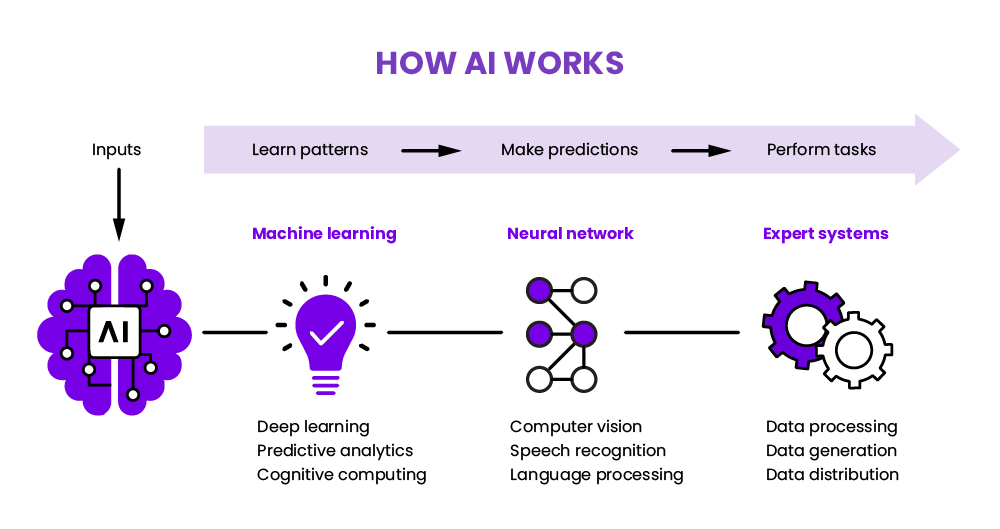
Artificial intelligence systems operate through a combination of data, algorithms, and computational power. The process typically begins with data collection and preprocessing, where raw information is cleaned, labeled, and structured for training. Machine learning models—particularly deep learning architectures—then learn patterns from this data through iterative optimization.
In supervised learning, models are trained on labeled datasets to make predictions or classifications. Unsupervised learning identifies hidden structures in unlabeled data, while reinforcement learning uses reward signals to optimize decision-making in dynamic environments. Generative AI models, such as large language models (LLMs) and diffusion models, create new content by learning statistical distributions from vast datasets.
Hardware acceleration, including GPUs and TPUs, enables efficient training and inference. Cloud platforms provide on-demand access to these resources, reducing barriers to entry for businesses and researchers. The integration of AI into existing workflows often involves application programming interfaces (APIs) and software development kits (SDKs), allowing seamless deployment across various platforms.
#Core Technologies
- Machine Learning: Algorithms that improve automatically through experience
- Deep Learning: Neural networks with multiple layers for complex pattern recognition
- Natural Language Processing (NLP): Techniques for understanding and generating human language
- Computer Vision: Systems that interpret and analyze visual information
- Robotics: Physical systems integrated with AI for automation and interaction
- Edge AI: Processing data locally on devices rather than in the cloud
#Important facts
- The global AI market was valued at approximately $184 billion in 2024 and is projected to grow at a compound annual growth rate (CAGR) of 37.3% from 2024 to 2030.
- North America holds the largest market share, followed by Asia-Pacific, which is expected to see the highest growth rate due to increasing investments in digital infrastructure.
- By 2025, it is estimated that 95% of customer interactions will involve AI-powered systems, including chatbots and virtual assistants.
- The healthcare sector is projected to be the fastest-growing application area, driven by AI's role in diagnostics, drug discovery, and personalized medicine.
- Ethical concerns, including bias in algorithms and data privacy, remain significant challenges for widespread adoption.
- Generative AI tools, such as those capable of creating text, images, and audio, are expected to contribute over $1.3 trillion in economic value by 2030.
- Regulatory frameworks, such as the EU Artificial Intelligence Act and the U.S. AI Executive Order, are being developed to ensure responsible AI deployment.
- The energy consumption of large AI models has raised sustainability concerns, prompting research into more efficient architectures and green computing practices.
#Timeline
- A subset of AI focused on building systems that learn from data
- A type of machine learning using neural networks with many layers
- A computational model inspired by the human brain
- The intersection of AI and linguistics
- AI systems that interpret visual data
- Models that create new content, including text, images, and audio
- AI training through trial
and-error with reward signals
- AI processing on local devices rather than in the cloud
- Techniques to make AI decisions transparent and interpretable
- A decentralized approach to training AI models on private data
#Related Terms
#FAQ
What does AI And Expansion: New Markets cover?
Explores how artificial intelligence shapes expansion and new markets, covering practical use cases, benefits, limitations, and risks.
Why is AI And Expansion: New Markets important?
It helps readers understand key concepts, compare practical use cases, and evaluate how Artificial Intelligence decisions affect outcomes, risks, and implementation choices.
What should readers verify before applying this topic?
Readers should compare the benefits, limitations, data requirements, and related themes such as Expansion, Market, AI Applications before using the ideas in real projects.
#References
- AI And Expansion: New Markets terminology and background research
- AI And Expansion: New Markets use cases, implementation examples, and limitations
- Artificial Intelligence best practices, standards, and risk guidance
- Expansion case studies, benchmarks, and current industry analysis


Comments
No comments yet. Start the discussion with a useful note.