


#Short Answer
Artificial intelligence refers to the simulation of human intelligence in machines, enabling them to perform tasks that typically require human cognition. These tasks include learning, reasoning, problem-solving, perception, and language understanding. AI systems are designed to analyze vast amounts of data, identify patterns, and make predictions or decisions with minimal human intervention.
#Infobox
#Overview
Artificial intelligence refers to the simulation of human intelligence in machines, enabling them to perform tasks that typically require human cognition. These tasks include learning, reasoning, problem-solving, perception, and language understanding. AI systems are designed to analyze vast amounts of data, identify patterns, and make predictions or decisions with minimal human intervention.
Despite its advanced capabilities, AI remains a tool created and controlled by humans. It lacks consciousness, emotions, and subjective experiences. The development of AI is driven by advancements in computing power, data availability, and algorithmic innovation, making it a transformative technology across industries.
#Common Misconceptions
Several myths about AI persist due to media portrayals and misinformation. One prevalent myth is that AI will eventually surpass human intelligence and pose an existential threat. In reality, current AI systems are specialized and lack general intelligence. Another misconception is that AI can think and reason like humans, which is not the case—AI operates based on predefined rules and learned patterns.
#History / Background
#Early developments
The concept of artificial intelligence dates back to ancient times, with myths and legends featuring artificial beings endowed with intelligence. However, the modern field of AI began in the mid-20th century. In 1950, Alan Turing proposed the Turing Test as a criterion for machine intelligence. The term "artificial intelligence" was coined in 1956 by John McCarthy during the Dartmouth Conference, marking the formal birth of AI as a scientific discipline.
#Key milestones
- 1951: The first AI program, written by Christopher Strachey and Dietrich Prinz, played chess.
- 1956: The Dartmouth Conference established AI as a field of study.
- 1966: The ELIZA chatbot, developed by Joseph Weizenbaum, demonstrated natural language processing capabilities.
- 1997: IBM's Deep Blue defeated world chess champion Garry Kasparov, showcasing AI's potential in strategic games.
- 2011: IBM's Watson won Jeopardy!, highlighting AI's ability to process and analyze large datasets.
- 2016: AlphaGo, developed by DeepMind, defeated a world champion Go player, demonstrating AI's prowess in complex decision-making.
#How It Works
#Core technologies
AI systems rely on several core technologies to function effectively:
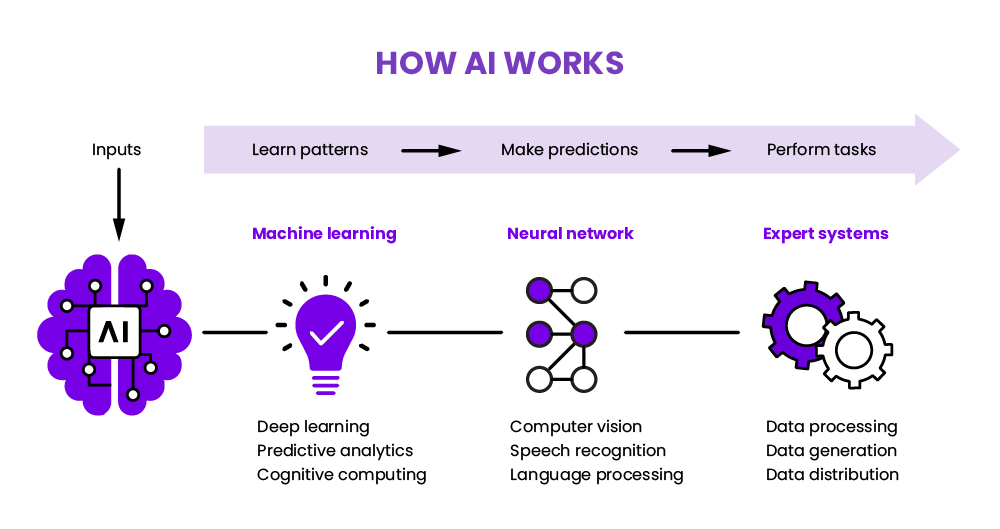
- Machine Learning (ML): A subset of AI that enables systems to learn from data without explicit programming. ML algorithms identify patterns and make predictions based on input data.
- Deep Learning: A specialized form of ML that uses neural networks with multiple layers to model complex data structures. Deep learning powers applications such as image and speech recognition.
- Natural Language Processing (NLP): Enables machines to understand, interpret, and generate human language. NLP is used in chatbots, translation services, and sentiment analysis.
- Computer Vision: Allows machines to analyze and interpret visual information from the world, such as images and videos. Applications include facial recognition, autonomous vehicles, and medical imaging.
- Robotics: Combines AI with mechanical engineering to create machines capable of performing physical tasks. Robotics is used in manufacturing, healthcare, and exploration.
#Data and Algorithms
AI systems require large datasets for training and validation. The quality and diversity of data significantly impact the performance of AI models. Algorithms, which are sets of rules or instructions, guide AI systems in processing data and making decisions. Common algorithms include decision trees, support vector machines, and neural networks.
Training an AI model involves feeding it labeled data, allowing it to learn patterns and relationships. Once trained, the model can make predictions or decisions based on new, unseen data. Continuous refinement and updating are essential to maintain accuracy and relevance.
#Important Facts
- AI excels at tasks requiring pattern recognition, such as image and speech recognition.
- AI can process and analyze large datasets faster than humans, enabling data-driven decision-making.
- AI-powered systems are used in healthcare for diagnostics, drug discovery, and personalized treatment plans.
- AI enhances cybersecurity by detecting anomalies and preventing fraudulent activities.
- AI-driven automation improves efficiency in manufacturing, logistics, and customer service.
- AI lacks general intelligence and cannot perform tasks outside its trained domain.
- AI systems require vast amounts of high-quality data to function effectively.
- Bias in training data can lead to biased outcomes, highlighting the importance of ethical AI development.
- AI cannot understand context or emotions in the same way humans do, limiting its ability to engage in meaningful conversations.
- AI systems are vulnerable to adversarial attacks, where malicious actors manipulate inputs to deceive the system.
#Timeline
- Alan Turing proposes the
Alan Turing proposes the Turing Test as a measure of machine intelligence.
- The Dartmouth Conference estab
The Dartmouth Conference establishes AI as a field of study.
- ELIZA, an early natural
ELIZA, an early natural language processing program, is developed.
- IBM's Deep Blue defeats
IBM's Deep Blue defeats world chess champion Garry Kasparov.
- IBM's Watson wins *Jeopardy!*
IBM's Watson wins *Jeopardy!* against human champions.
- AlphaGo defeats a world
AlphaGo defeats a world champion Go player, marking a milestone in AI.
- AI models like GPT-3
AI models like GPT-3 demonstrate advanced natural language generation capabilities.
- AI applications expand into
AI applications expand into healthcare, finance, and creative industries.
#Related Terms
#FAQ
What does AI Myths Debunked cover?
Debunks common myths about AI myths debunked, clarifying capabilities, limitations, risks, and practical expectations.
Why is AI Myths Debunked important?
It helps readers understand key concepts, compare practical use cases, and evaluate how Artificial Intelligence decisions affect outcomes, risks, and implementation choices.
What should readers verify before applying this topic?
Readers should compare the benefits, limitations, data requirements, and related themes such as Myth Busting, Myth, AI Applications before using the ideas in real projects.
#References
- AI Myths Debunked terminology and background research
- AI Myths Debunked use cases, implementation examples, and limitations
- Artificial Intelligence best practices, standards, and risk guidance
- Myth Busting case studies, benchmarks, and current industry analysis


Comments
No comments yet. Start the discussion with a useful note.