

#Short Answer
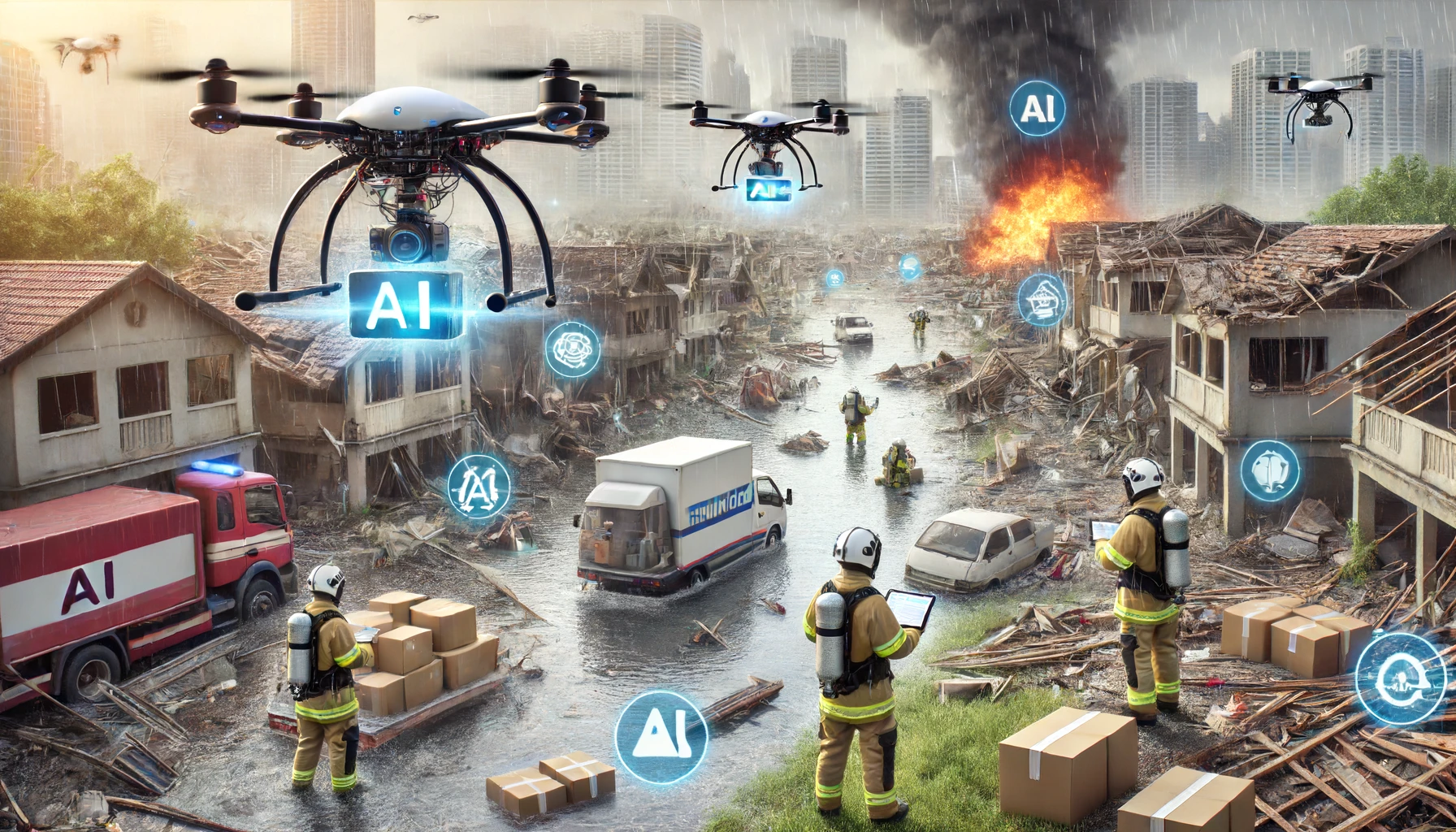
Artificial Intelligence (AI) is transforming disaster response by enabling faster, more accurate, and data-driven decision-making in emergencies. F...
#Infobox
AI in disaster response enhances real-time decision-making, predictive analytics, and autonomous resource deployment to mitigate risks, reduce response times, and save lives during natural and human-made emergencies.
#Overview
Artificial Intelligence (AI) is transforming disaster response by enabling faster, more accurate, and data-driven decision-making in emergencies. From predicting natural disasters to coordinating rescue operations, AI systems analyze vast datasets—including satellite imagery, social media feeds, and sensor networks—to identify risks, optimize resource allocation, and guide responders in real time. The integration of AI with robotics, machine learning, and big data analytics has led to breakthroughs in emergency management, particularly in high-stakes scenarios such as earthquakes, floods, wildfires, and pandemics.
AI-driven tools are now deployed across multiple phases of disaster management: prevention (risk assessment), preparedness (training simulations), response (search-and-rescue), and recovery (damage assessment). For instance, AI models can forecast flood zones days in advance, while autonomous drones equipped with computer vision navigate disaster zones to locate survivors. These advancements not only reduce human error but also minimize response times, which is critical in life-or-death situations.
#History and Background
#Early Developments
The roots of AI in disaster response trace back to the 1990s, when early expert systems and neural networks were used for risk modeling. Projects like the HAZUS software, developed by the U.S. Federal Emergency Management Agency (FEMA), applied AI to simulate earthquake impacts and plan mitigation strategies. However, these systems were limited by computational power and data availability.
#21st Century Advancements
The 2010s marked a turning point with the rise of big data and deep learning. The 2011 Tōhoku earthquake and tsunami in Japan highlighted the need for real-time disaster analytics, prompting investments in AI-driven early warning systems. In 2016, IBM launched IBM Watson for Emergency Management, which analyzed social media and news reports to predict disaster impacts. Concurrently, Google’s Crisis Response platform used AI to aggregate emergency information during hurricanes and wildfires.
#Modern Era
Post-2020, AI in disaster response has evolved into a multi-disciplinary field, integrating computer vision, natural language processing (NLP), and reinforcement learning. The COVID-19 pandemic accelerated the adoption of AI chatbots for public health guidance, while drones equipped with thermal imaging became standard in search-and-rescue missions. Today, AI systems are increasingly autonomous, with robots like Spot by Boston Dynamics navigating collapsed buildings to assess structural integrity.
#How AI in Disaster Response Works
#Data Collection and Processing
AI systems rely on diverse data sources to function effectively:
- Satellite and Aerial Imagery: High-resolution satellite data (e.g., from NASA’s Earth Observatory or ESA’s Sentinel) detects changes in terrain, such as landslides or flood extents. Drones with multispectral cameras provide real-time aerial surveillance.
- Sensor Networks: IoT devices (e.g., seismic sensors, water level gauges) feed data into AI models to predict events like earthquakes or tsunamis.
- Social Media and News: NLP algorithms scan platforms like Twitter and Facebook for distress signals or misinformation during crises.
- Historical Data: Machine learning models analyze past disasters (e.g., Hurricane Katrina, 2010 Haiti earthquake) to identify patterns in vulnerability and response failures.
#Key AI Techniques
- Predictive Analytics: Time-series models (e.g., LSTM networks) forecast disaster trajectories. For example, AI can predict flood peaks 72 hours in advance by analyzing rainfall patterns and river levels.
- Computer Vision: Convolutional Neural Networks (CNNs) process drone footage to detect survivors via thermal imaging or identify structural damage in buildings.
- Natural Language Processing (NLP): Chatbots and sentiment analysis tools (e.g., IBM Watson Assistant) provide real-time public guidance during emergencies.
- Reinforcement Learning: AI agents optimize resource allocation, such as dispatching ambulances or deploying firefighting teams based on dynamic risk assessments.
- Swarm Robotics: Groups of small robots coordinate autonomously to map disaster zones, as seen in projects like Harvard’s RoboBees.
#Integration with Other Technologies
AI is rarely used in isolation; it synergizes with other technologies:
- 5G and Edge Computing: Enables low-latency AI processing in remote areas without cloud dependency.
- Blockchain: Secures data integrity in disaster reporting systems.
- Augmented Reality (AR): Overlays real-time AI-generated insights (e.g., hazard zones) onto responders’ AR glasses.
#Important Facts
- Speed: AI can analyze satellite data in minutes, whereas manual analysis takes days. For example, during the 2017 California wildfires, AI identified evacuation zones 30% faster than traditional methods.
- Accuracy: AI models trained on historical disaster data reduce false alarms in early warning systems by up to 40%.
- Cost Savings: The World Bank estimates that AI-driven disaster prediction saves $3–$10 for every $1 invested in prevention.
- Autonomy: In 2023, the UN’s International Search and Rescue Advisory Group (INSARAG) approved AI-powered drones for post-disaster assessments in collapsed structures.
- Ethical Concerns: Bias in AI models (e.g., favoring wealthier neighborhoods in flood predictions) has led to calls for transparent, equitable algorithms.
- Global Adoption: Countries like Japan, India, and the U.S. have national AI disaster response programs, while the EU’s Copernicus Emergency Management Service uses AI for cross-border crises.
#Timeline
- Statistical techniques to forecast disaster impacts.
- AI that interprets visual data (e.g., drone footage).
- Cooperative robot teams for disaster zone exploration.
- AI processing on local devices (e.g., drones) without cloud dependency.
- Virtual replicas of physical systems (e.g., cities) for disaster simulation.
- AI systems designed to provide transparent decision
making.
- AI applications specifically for disaster relief and refugee support.
#Related Terms
#FAQ
What does AI And Disaster Response: Saving Lives cover?
Explores how artificial intelligence shapes disaster response and saving lives, covering practical use cases, benefits, limitations, and risks.
Why is AI And Disaster Response: Saving Lives important?
It helps readers understand key concepts, compare practical use cases, and evaluate how Climate & Society decisions affect outcomes, risks, and implementation choices.
What should readers verify before applying this topic?
Readers should compare the benefits, limitations, data requirements, and related themes such as Disaster, Response, Saving before using the ideas in real projects.
#References
- AI And Disaster Response: Saving Lives terminology and background research
- AI And Disaster Response: Saving Lives use cases, implementation examples, and limitations
- Climate & Society best practices, standards, and risk guidance
- Disaster case studies, benchmarks, and current industry analysis


Comments
No comments yet. Start the discussion with a useful note.