

#Short Answer
A cryptocurrency trading bot is an automated software application designed to execute buy and sell orders in digital asset markets without direct h...
#Infobox
AI-powered cryptocurrency trading bots are automated software programs that execute trades on behalf of users by analyzing market data, identifying patterns, and making decisions based on predefined algorithms or machine learning models. These bots enhance trading efficiency, reduce emotional bias, and operate 24/7 in volatile crypto markets.
#Overview
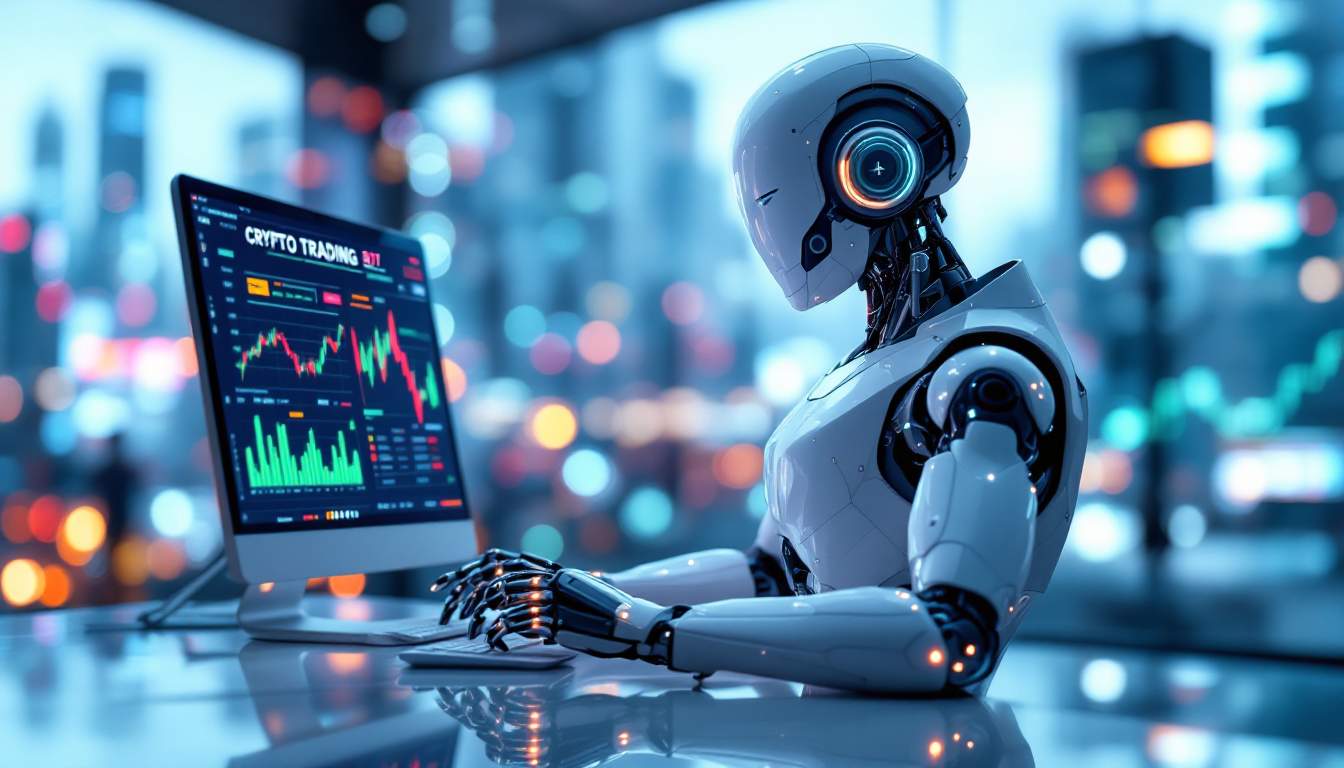
A cryptocurrency trading bot is an automated software application designed to execute buy and sell orders in digital asset markets without direct human intervention. These bots leverage artificial intelligence (AI), machine learning, and complex algorithms to analyze market trends, predict price movements, and optimize trading strategies in real time. Unlike traditional trading methods that rely on manual execution and emotional decision-making, trading bots operate continuously across global exchanges, responding to market conditions within milliseconds.
Trading bots are widely used by individual investors, hedge funds, and institutional traders to capitalize on arbitrage opportunities, execute high-frequency trades, and manage portfolios with minimal latency. Their ability to process vast amounts of data—including price charts, order book depth, trading volumes, and social media sentiment—allows them to identify profitable entry and exit points that may elude human traders. However, their effectiveness depends heavily on the quality of the underlying algorithms, data inputs, and risk management protocols.
#History / Background
#Early Developments (2010–2016)
The concept of automated trading predates cryptocurrency, with algorithmic trading systems emerging in traditional financial markets as early as the 1970s. However, the first cryptocurrency trading bots began to appear around 2010, coinciding with the launch of Bitcoin and the proliferation of early crypto exchanges like Mt. Gox. Early bots were rudimentary, often relying on simple technical indicators such as moving averages and relative strength index (RSI).
By 2014, the rise of Ethereum and the introduction of smart contracts enabled more sophisticated trading strategies, including decentralized finance (DeFi) arbitrage. Open-source projects like Freqtrade and Gekko emerged, allowing developers to customize and deploy trading bots on platforms like Poloniex and Kraken. During this period, most bots were rule-based, executing trades based on static parameters rather than adaptive learning.
#AI and Machine Learning Integration (2017–2020)
The 2017 bull market and the subsequent proliferation of altcoins accelerated the development of AI-driven trading bots. Machine learning models, particularly reinforcement learning and neural networks, were integrated to improve predictive accuracy. Bots began incorporating sentiment analysis from news articles and social media platforms like Twitter and Reddit to gauge market sentiment.
This era also saw the rise of cloud-based trading platforms such as 3Commas and Cryptohopper, which offered user-friendly interfaces and backtesting tools. These platforms democratized access to sophisticated trading tools, enabling non-technical users to deploy AI-powered strategies without coding expertise.
#Modern Era (2021–Present)
The 2021 bull run and the explosive growth of DeFi and non-fungible tokens (NFTs) further expanded the role of trading bots. Today, advanced bots utilize deep learning models, natural language processing (NLP), and quantum computing simulations to analyze market microstructures. Some platforms now support multi-exchange arbitrage, cross-chain swaps, and automated portfolio rebalancing.
Regulatory scrutiny has also increased, with authorities like the U.S. Securities and Exchange Commission (SEC) and the European Securities and Markets Authority (ESMA) monitoring the use of AI in trading to prevent market manipulation and insider trading. Despite these challenges, the global market for crypto trading bots is projected to grow significantly, driven by institutional adoption and the increasing complexity of digital asset markets.
#How It Works
#Core Components
A cryptocurrency trading bot typically consists of several key components:
- Data Feed Module: Continuously collects real-time market data from exchanges via APIs, including price feeds, order books, trade volumes, and blockchain transaction data.
- Strategy Engine: Applies trading algorithms to the data, which may include technical analysis (e.g., MACD, Bollinger Bands), statistical arbitrage, or machine learning models trained on historical price data.
- Execution Module: Interfaces with exchange APIs to place buy/sell orders, manage positions, and handle order types (e.g., limit, market, stop-loss).
- Risk Management System: Implements safeguards such as position sizing, maximum drawdown limits, and dynamic stop-loss mechanisms to protect capital.
- User Interface: Provides dashboards for monitoring performance, adjusting parameters, and visualizing trade history.
#Types of Trading Strategies
Trading bots employ various strategies, each suited to different market conditions and risk profiles:
- Market Making: Bots place simultaneous buy and sell orders around the current market price to profit from the bid-ask spread. This strategy requires high liquidity and low volatility.
- Trend Following: Uses technical indicators like moving averages or trend lines to identify and ride market trends. Popular among retail traders due to its simplicity.
- Arbitrage: Exploits price discrepancies across multiple exchanges by buying low on one platform and selling high on another. Requires fast execution and low transaction fees.
- Mean Reversion: Assumes that asset prices will revert to their historical averages over time. Bots identify overbought or oversold conditions and trade accordingly.
- Portfolio Rebalancing: Automatically adjusts asset allocations to maintain a target risk level or diversification ratio, often used in long-term investment strategies.
- Sentiment-Based Trading: Analyzes news, social media, and on-chain data (e.g., whale movements) to predict short-term price movements.
#AI and Machine Learning Integration
Modern bots increasingly incorporate AI techniques to enhance decision-making:
- Supervised Learning: Models are trained on labeled historical data to predict future price movements based on patterns in past market behavior.
- Reinforcement Learning (RL): Bots learn optimal trading strategies through trial and error, receiving rewards for profitable actions and penalties for losses. RL is particularly effective in dynamic environments like crypto markets.
- Natural Language Processing (NLP): Analyzes unstructured data such as news articles, earnings reports, and social media posts to gauge market sentiment and anticipate volatility.
- Ensemble Methods: Combines multiple models (e.g., decision trees, neural networks) to improve prediction accuracy and reduce overfitting.
#Important Facts
- Speed Advantage: Trading bots can execute orders in under 100 milliseconds, far faster than human traders, enabling them to capitalize on fleeting arbitrage opportunities.
- 24/7 Operation: Unlike human traders, bots operate continuously across all time zones, taking advantage of market movements during off-hours or weekends.
- Emotionless Execution: Bots eliminate emotional biases such as fear and greed, which often lead to poor trading decisions in humans.
- Backtesting Capability: Most platforms allow users to test strategies against historical data to evaluate performance before deploying real capital.
- Multi-Exchange Support: Advanced bots can simultaneously trade across dozens of exchanges, including decentralized platforms like Uniswap and PancakeSwap.
- Regulatory Risks: Some jurisdictions classify certain AI-driven trading strategies as market manipulation, particularly if they involve spoofing or wash trading.
- Hardware Requirements: High-frequency trading (HFT) bots may require low-latency infrastructure, including co-location services near exchange servers, to minimize execution delays.
- Cost Considerations: While many bots are free or low-cost, premium features such as AI model access, advanced analytics, and exchange integrations often require subscription fees ranging from $20 to $500 per month.
#Timeline
- The broader practice of using computer algorithms to execute trades, encompassing both traditional finance and cryptocurrency markets.
- A subset of algorithmic trading characterized by extremely high speeds and large order volumes.
- The practice of exploiting price differences for the same asset across different markets or exchanges.
- Providing liquidity by continuously quoting buy and sell prices, profiting from the spread.
- Evaluating a trading strategy by applying it to historical market data to assess its viability.
- Monitoring large transactions or wallet movements by major holders (whales) to predict market trends.
- Decentralized finance, a blockchain
based ecosystem enabling peer-to-peer financial services, often integrated with trading bots.
- A set of protocols that allows bots to interact with exchange platforms and retrieve market data.
- The difference between the expected price of a trade and the price at which it is executed, often exacerbated by high volatility.
- The peak
to-trough decline in the value of a trading account, used as a measure of risk.
#Related Terms
#FAQ
What does AI And Cryptocurrency: Trading Bots cover?
Explores how artificial intelligence shapes cryptocurrency and trading bots, covering practical use cases, benefits, limitations, and risks.
Why is AI And Cryptocurrency: Trading Bots important?
It helps readers understand key concepts, compare practical use cases, and evaluate how Business & Finance decisions affect outcomes, risks, and implementation choices.
What should readers verify before applying this topic?
Readers should compare the benefits, limitations, data requirements, and related themes such as Cryptocurrency, Trading, Bots before using the ideas in real projects.
#References
- AI And Cryptocurrency: Trading Bots terminology and background research
- AI And Cryptocurrency: Trading Bots use cases, implementation examples, and limitations
- Business & Finance best practices, standards, and risk guidance
- Cryptocurrency case studies, benchmarks, and current industry analysis


Comments
No comments yet. Start the discussion with a useful note.