

#Short Answer
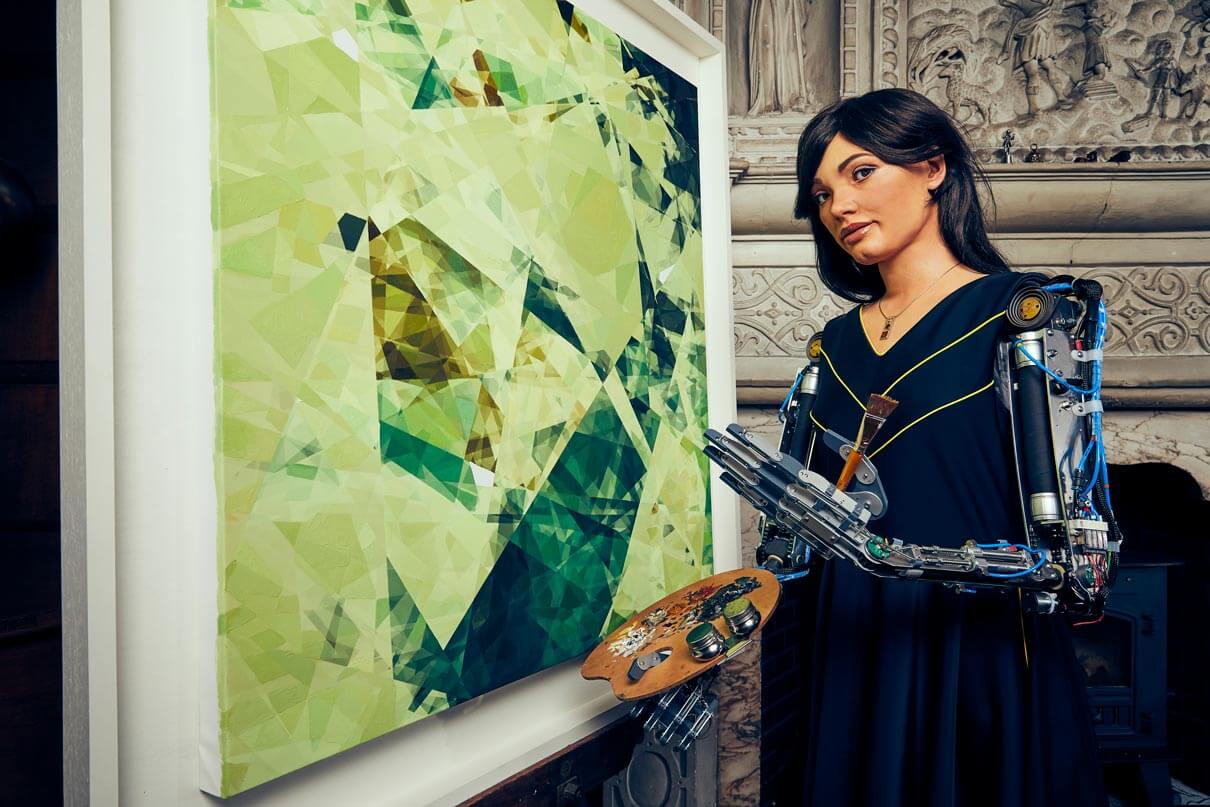
Exploration of artificial intelligence's role in generating visual art, music, and literature, and its implications for human creativity.
#Infobox
#Overview
AI and art refers to the intersection of artificial intelligence technologies and creative expression, where algorithms generate visual art, music, literature, and other forms of artistic output. This field has evolved from early experiments in computational creativity to sophisticated systems capable of producing works indistinguishable from those created by humans. AI art challenges traditional notions of authorship, creativity, and the role of the artist in the creative process.
The emergence of AI-generated art has sparked significant debate within the art world and beyond. While some view it as a revolutionary tool that democratizes creativity, others argue it threatens the livelihoods of human artists and undermines the intrinsic value of artistic expression. The technology behind AI art continues to advance rapidly, with new models and techniques pushing the boundaries of what is possible in generative creativity.
#History / Background
#Early Developments
The concept of machines creating art dates back to the mid-20th century. In 1951, British cybernetician William Grey Walter created one of the first art-generating machines, the Machina speculatrix, which produced abstract drawings. In 1960, mathematician A. Michael Noll programmed computers to generate geometric patterns and abstract compositions, some of which were exhibited at the Howard Wise Gallery in New York.
During the 1970s and 1980s, artists like Harold Cohen developed AARON, one of the first autonomous AI art systems. AARON could create original drawings and paintings by following a set of rules and algorithms, though its output was limited by the computational power of the era. Cohen's work demonstrated that machines could not only assist in the creative process but also generate art independently.
#Modern Era
The modern era of AI art began in the 2010s with the advent of deep learning and neural networks. The introduction of Generative Adversarial Networks (GANs) in 2014 by Ian Goodfellow and colleagues revolutionized the field. GANs consist of two neural networks—a generator and a discriminator—that compete against each other to produce increasingly realistic outputs. This technology enabled the creation of highly detailed and convincing AI-generated images.
In 2018, the Portrait of Edmond de Belamy became the first AI-generated artwork to be sold at auction by Christie's for $432,500, sparking global attention and debate. The same year, Obvious, a French art collective, created the piece using a GAN trained on a dataset of 15,000 portraits from the 14th to the 20th century.
The development of diffusion models, such as DALL-E (2021) and Stable Diffusion (2022), further expanded the capabilities of AI art. These models use a different approach to generate images from text prompts, allowing users to create highly detailed and imaginative visuals with minimal input. The accessibility of these tools has led to a surge in AI-generated art across various platforms and communities.
#How It Works
#Generative Adversarial Networks (GANs)
GANs are a class of machine learning frameworks that consist of two neural networks: the generator and the discriminator. The generator creates new data instances (e.g., images), while the discriminator evaluates them for authenticity. The two networks are trained simultaneously in a competitive process where the generator aims to produce increasingly realistic outputs, and the discriminator becomes better at distinguishing between real and generated data. Over time, the generator improves its ability to create convincing fakes, leading to high-quality AI-generated art.
GANs have been used to create a wide range of artistic outputs, from portraits and landscapes to abstract compositions. However, they require large datasets of training images and significant computational resources. Challenges include mode collapse, where the generator produces limited varieties of outputs, and the need for extensive fine-tuning to achieve desired results.
#Diffusion Models
Diffusion models, such as DALL-E and Stable Diffusion, generate images by progressively refining noise into coherent visuals. The process begins with a random noise image, which is gradually transformed through a series of denoising steps guided by a text prompt or other input. Each step refines the image, adding details and structure until a final output is produced.
Diffusion models are particularly effective for text-to-image generation, allowing users to describe a scene or concept in natural language and receive a corresponding image. These models have democratized AI art by making it accessible to non-experts and enabling a wide range of creative applications, from concept art to social media content.
#Neural Style Transfer
Neural Style Transfer (NST) is a technique that applies the artistic style of one image to the content of another. For example, NST can transform a photograph into a painting that mimics the style of Vincent van Gogh or Pablo Picasso. This method uses convolutional neural networks (CNNs) to separate and recombine the content and style features of images, resulting in visually striking hybrid artworks.
NST has been widely used in digital art and design, enabling artists to experiment with different styles and create unique visual effects. It has also been applied in commercial applications, such as generating personalized artwork for customers or enhancing visual content for marketing campaigns.
#Transformers and Large Language Models
Transformers, a type of neural network architecture introduced in 2017, have become foundational in AI art, particularly for text-to-image and text-to-video generation. Models like DALL-E 2, MidJourney, and Imagen use transformers to process text prompts and generate corresponding visuals. These models leverage large-scale training on diverse datasets to understand and interpret complex language inputs, enabling highly detailed and contextually accurate outputs.
Large language models (LLMs) also play a role in AI art by generating textual descriptions, captions, or even entire narratives that can be used as prompts for visual generation. This integration of language and visual processing has expanded the creative possibilities of AI-generated art, allowing for more nuanced and interactive artistic experiences.
#Important Facts
- First AI Art Auction: In 2018, Christie's sold Portrait of Edmond de Belamy for $432,500, marking the first time an AI-generated artwork was auctioned by a major house.
- Accessibility: Tools like DALL-E, MidJourney, and Stable Diffusion have made AI art accessible to the general public, enabling anyone to create complex visuals with simple text prompts.
- Ethical Concerns: AI art raises significant ethical questions, including issues of copyright infringement, the exploitation of artists' work in training datasets, and the potential devaluation of human creativity.
- Legal Challenges: Courts are still grappling with questions of authorship and copyright for AI-generated works. In 2023, the U.S. Copyright Office ruled that AI-generated images cannot be copyrighted, though human-AI collaborations may still qualify for protection.
- Cultural Impact: AI art has influenced popular culture, from music videos and films to fashion and advertising. Artists and creators are increasingly incorporating AI tools into their workflows, blurring the lines between traditional and digital art forms.
- Environmental Impact: Training large AI models requires significant computational power and energy, raising concerns about the environmental footprint of AI art. Efforts are underway to develop more energy-efficient models and sustainable practices in the field.
#Timeline
- William Grey Walter creates
William Grey Walter creates *Machina speculatrix*, one of the first art-generating machines.
- A. Michael Noll programs
A. Michael Noll programs computers to generate geometric patterns and abstract compositions.
- Harold Cohen develops *AARON*
Harold Cohen develops *AARON*, an early autonomous AI art system.
- Ian Goodfellow and colleagues
Ian Goodfellow and colleagues introduce [Generative Adversarial Networks (GANs)](# 'Generative Adversarial Network').
- Google's *DeepDream* algorithm
Google's *DeepDream* algorithm generates psychedelic images, popularizing AI art.
- *Portrait of Edmond de
*Portrait of Edmond de Belamy* is sold at Christie's for $432,500.
- OpenAI releases DALL-E, a
OpenAI releases [DALL-E](# 'DALL-E'), a text-to-image model.
- Stable Diffusion is released
[Stable Diffusion](# 'Stable Diffusion') is released, enabling widespread access to AI image generation.
- The U.S. Copyright Office
The U.S. Copyright Office rules that AI-generated images cannot be copyrighted.
#Related Terms
#FAQ
What does AI And Art: The Rise Of AI-Generated Creativity cover?
Explores how artificial intelligence shapes art and the rise of AI-generated creativity, covering practical use cases, benefits, limitations, and risks.
Why is AI And Art: The Rise Of AI-Generated Creativity important?
It helps readers understand key concepts, compare practical use cases, and evaluate how Creative AI decisions affect outcomes, risks, and implementation choices.
What should readers verify before applying this topic?
Readers should compare the benefits, limitations, data requirements, and related themes such as Art, Rise, Aigenerated before using the ideas in real projects.
#References
- AI And Art: The Rise Of AI-Generated Creativity terminology and background research
- AI And Art: The Rise Of AI-Generated Creativity use cases, implementation examples, and limitations
- Creative AI best practices, standards, and risk guidance
- Art case studies, benchmarks, and current industry analysis

Comments
No comments yet. Start the discussion with a useful note.