

#Short Answer
AI in air quality monitoring leverages advanced algorithms and machine learning to process vast amounts of data from sensors, satellites, and IoT devices. These systems analyze patterns in air pollutants such as particulate matter (PM2.5, PM10), nitrogen oxides (NOx), sulfur dioxide (SO2), carbon monoxide (CO), and ozone (O3). By integrating AI, monitoring becomes more precise, scalable, and responsive to environmental changes.
#Infobox
#Overview
AI in air quality monitoring leverages advanced algorithms and machine learning to process vast amounts of data from sensors, satellites, and IoT devices. These systems analyze patterns in air pollutants such as particulate matter (PM2.5, PM10), nitrogen oxides (NOx), sulfur dioxide (SO2), carbon monoxide (CO), and ozone (O3). By integrating AI, monitoring becomes more precise, scalable, and responsive to environmental changes.
AI-powered air quality monitoring supports urban planning, regulatory compliance, and public health initiatives. Cities worldwide deploy AI-driven solutions to combat air pollution, which is responsible for millions of premature deaths annually. The technology enables early warnings, source identification, and targeted interventions to reduce exposure risks.
#History / Background
The integration of AI into air quality monitoring began in the early 2000s with the advent of digital sensors and computational power. Early systems relied on basic statistical models to interpret sensor data, but advancements in machine learning and deep learning expanded capabilities significantly.
In 2010, researchers started using neural networks to predict air pollution levels based on historical and real-time data. The proliferation of IoT devices in the 2010s accelerated this trend, enabling widespread deployment of low-cost sensors. Governments and organizations began adopting AI to enhance traditional monitoring networks, which were often limited in coverage and resolution.
Key milestones include the development of the Air Quality Index (AQI) algorithms, the launch of AI-based platforms like Google’s Project Air View, and the integration of AI in smart city initiatives such as Singapore’s Virtual Singapore and Barcelona’s smart city programs.
#How It Works
#Data Collection
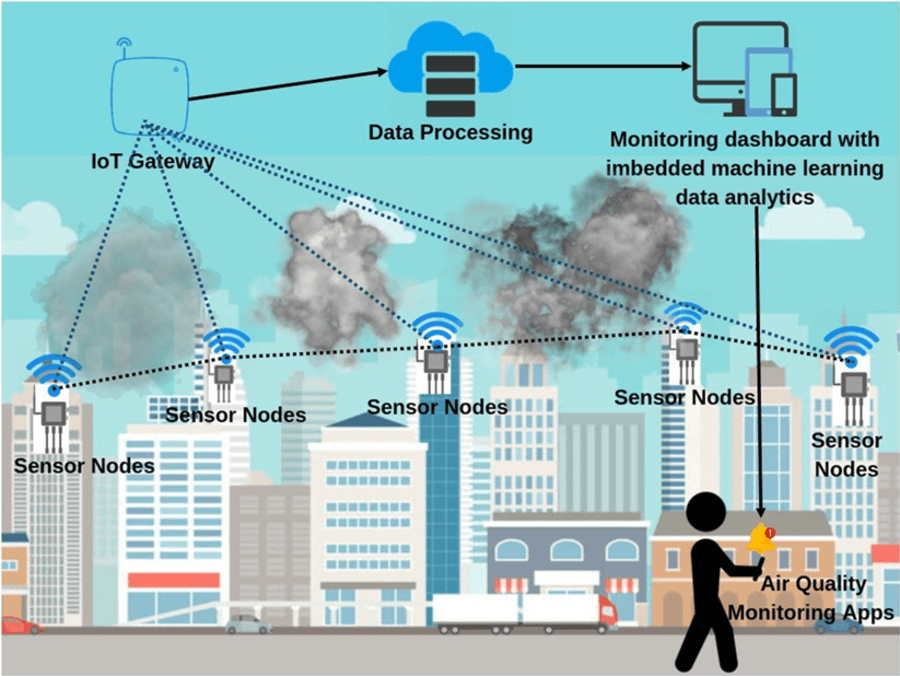
AI-driven air quality monitoring relies on diverse data sources:
- Sensor Networks: Deployed in urban areas, industrial zones, and highways, these sensors measure pollutant concentrations in real time.
- Satellite Imagery: Satellites like NASA’s Aura and ESA’s Sentinel-5P provide global air quality data, including tropospheric ozone and aerosol measurements.
- IoT Devices: Smart air quality monitors, often connected via LoRaWAN or cellular networks, transmit data to cloud platforms for analysis.
- Meteorological Data: Wind speed, temperature, and humidity influence pollutant dispersion and are critical inputs for AI models.
- Traffic and Industrial Data: Vehicle emissions and factory outputs are key contributors to air pollution and are incorporated into predictive models.
#AI Models and Algorithms
Several AI techniques are employed in air quality monitoring:
- Machine Learning (ML):
- Supervised Learning: Models like Random Forest and Support Vector Machines (SVM) are trained on labeled datasets to predict pollutant levels.
- Unsupervised Learning: Clustering algorithms identify pollution hotspots and seasonal patterns.
- Deep Learning:
- Convolutional Neural Networks (CNNs): Process satellite imagery to detect pollution plumes and land-use changes affecting air quality.
- Recurrent Neural Networks (RNNs) and Long Short-Term Memory (LSTM): Analyze time-series data to forecast pollution trends and identify anomalies.
- Graph Neural Networks (GNNs): Model spatial relationships between pollution sources and receptors, such as traffic networks or industrial clusters.
- Reinforcement Learning: Optimizes pollution control strategies by simulating policy interventions and their environmental impacts.
#Data Processing and Analysis
Collected data undergoes several processing steps:
- Data Cleaning: Removes noise and outliers from sensor data using statistical methods or AI-based anomaly detection.
- Data Fusion: Combines data from multiple sources (e.g., sensors, satellites) to create a unified dataset.
- Feature Engineering: Extracts relevant features such as pollutant ratios, meteorological conditions, and temporal patterns.
- Model Training: AI models are trained on historical data to recognize patterns and make predictions.
- Real-Time Processing: Streaming data is analyzed to provide up-to-date air quality assessments and alerts.
#Applications
- Urban Planning: AI identifies pollution hotspots to guide zoning, green space allocation, and traffic management.
- Public Health: Real-time AQI alerts help vulnerable populations (e.g., children, elderly) take precautions.
- Regulatory Compliance: Governments use AI to monitor industrial emissions and enforce environmental regulations.
- Wildfire and Dust Storm Prediction: AI models forecast pollution events caused by natural disasters.
- Personal Air Quality Monitors: Wearable devices and smartphone apps provide individualized exposure assessments.
#Important Facts
- According to the World Health Organization (WHO), 99% of the global population breathes air that exceeds WHO guideline limits for pollutants.
- AI can reduce the cost of air quality monitoring by up to 80% compared to traditional methods by leveraging low-cost sensors and cloud computing.
- The European Environment Agency (EEA) estimates that AI-driven pollution control could save €30–100 billion annually in health costs across Europe.
- Machine learning models have achieved up to 95% accuracy in predicting PM2.5 concentrations when trained on high-quality datasets.
- AI is used in air quality forecasting models such as the Copernicus Atmosphere Monitoring Service (CAMS).
- Cities like Beijing and Delhi have reduced pollution levels by 30–40% using AI-powered traffic management and industrial regulation.
#Timeline
- First use of machine
First use of machine learning for air pollution prediction in academic research.
- Development of neural network
Development of neural network-based AQI prediction models.
- Launch of low-cost air
Launch of low-cost air quality sensors, enabling crowdsourced data collection.
- Google’s Project Air View
Google’s Project Air View begins mapping urban air pollution using mobile sensors.
- Deep learning models achieve
Deep learning models achieve high accuracy in predicting PM2.5 levels.
- AI integrated into smart
AI integrated into smart city platforms for real-time pollution tracking.
- WHO updates air quality
WHO updates air quality guidelines, prompting AI-driven compliance monitoring.
- AI models begin incorporating
AI models begin incorporating satellite data for global air quality assessment.
#Related Terms
#FAQ
What does AI And Air: Quality Monitoring cover?
Explores how artificial intelligence shapes air and quality monitoring, covering practical use cases, benefits, limitations, and risks.
Why is AI And Air: Quality Monitoring important?
It helps readers understand key concepts, compare practical use cases, and evaluate how Artificial Intelligence decisions affect outcomes, risks, and implementation choices.
What should readers verify before applying this topic?
Readers should compare the benefits, limitations, data requirements, and related themes such as Air, Quality, Monitoring before using the ideas in real projects.
#References
- AI And Air: Quality Monitoring terminology and background research
- AI And Air: Quality Monitoring use cases, implementation examples, and limitations
- Artificial Intelligence best practices, standards, and risk guidance
- Air case studies, benchmarks, and current industry analysis



Comments
No comments yet. Start the discussion with a useful note.