

#Short Answer
Explains What Is Underfitting in AI, including the core definition, how it works, practical examples, and limitations.
#Infobox
#Overview
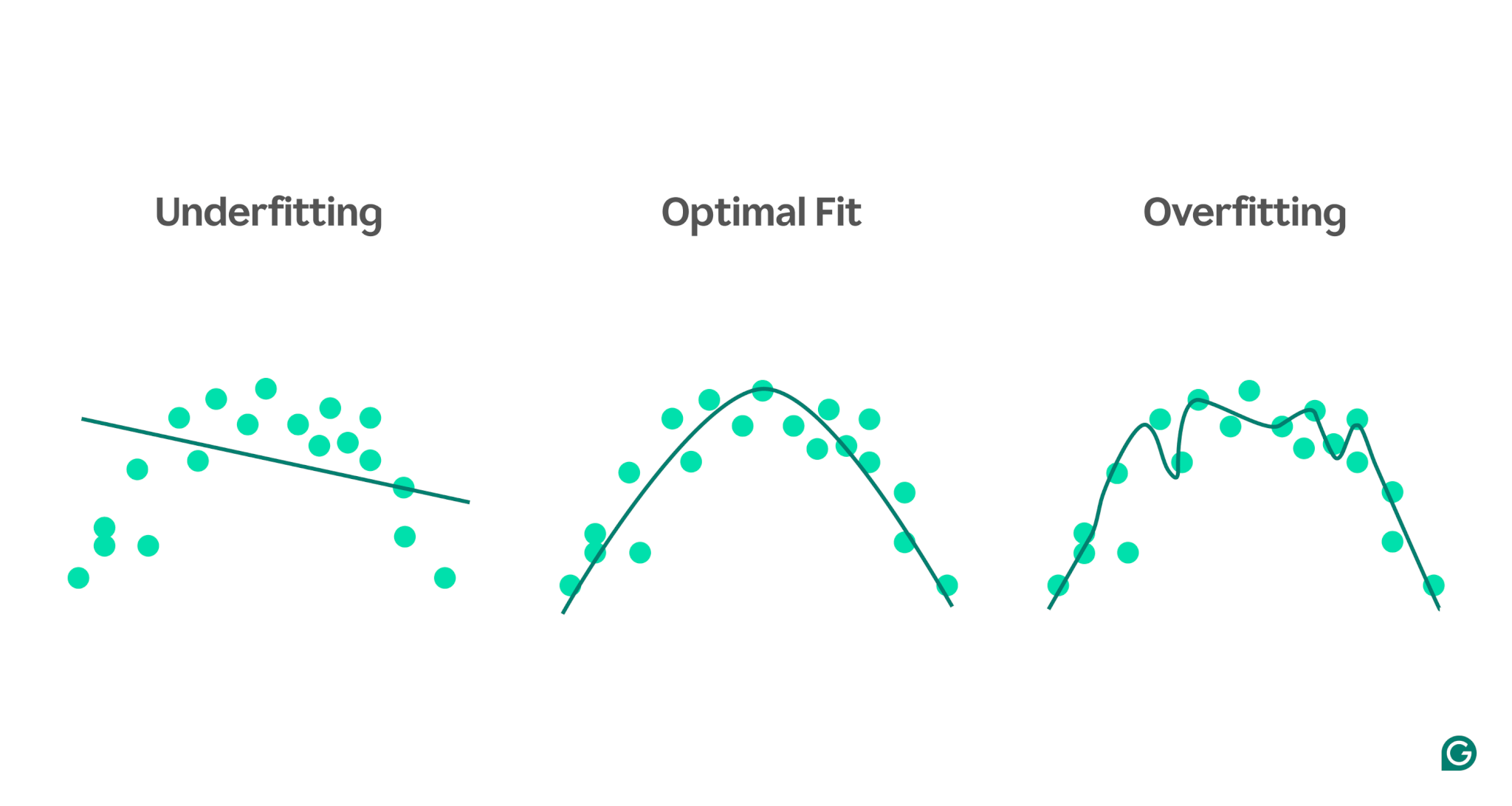
Underfitting is a fundamental challenge in AI and ML, where a model fails to learn the essential patterns from the training dataset. This issue contrasts with overfitting, where a model becomes overly complex and captures noise or irrelevant details, leading to poor generalization. Underfitting, however, stems from a model's inability to capture the underlying structure of the data, often due to excessive simplicity or inadequate training. A model suffering from underfitting exhibits high bias, meaning it makes overly simplistic assumptions about the data. This results in poor performance not only on unseen data but also on the training set itself. For instance, a linear regression model applied to a dataset with a nonlinear relationship between features and the target variable will likely underfit, as it cannot represent the true underlying pattern. Underfitting is particularly problematic in real-world applications where models must generalize to new, unseen data. It undermines the reliability and effectiveness of AI systems, making it crucial to identify and address this issue during model development.
#History / Background
The concept of underfitting emerged alongside the development of statistical learning theory and machine learning in the mid-to-late 20th century. Early work by statisticians and computer scientists, such as those in the field of regression analysis, highlighted the importance of balancing model complexity with generalization performance. In the 1960s and 1970s, researchers began formalizing the bias-variance tradeoff, a key principle in understanding underfitting and overfitting. The work of statisticians like John Tukey and pioneers in machine learning, including Vladimir Vapnik, laid the groundwork for modern understanding of model generalization. Vapnik's work on the Theory of the Learnable, particularly the concept of the VC dimension, provided a mathematical framework for analyzing model complexity and its impact on generalization. The rise of computational power in the late 20th and early 21st centuries enabled the training of more complex models, but it also highlighted the persistent challenge of underfitting. As AI systems became more integral to industries such as healthcare, finance, and autonomous systems, the need to address underfitting became more pressing. Today, underfitting remains a critical consideration in model development, with techniques like cross-validation, regularization, and ensemble methods being employed to mitigate its effects.
#How It Works
#Causes of Underfitting Underfitting occurs when a model is unable to capture the underlying patterns in the data due to several factors:
- High Bias: A model with high bias makes strong assumptions about the data, often oversimplifying the relationships between features and the target variable. For example, a linear model applied to a dataset with a nonlinear relationship will inherently underfit.
- Insufficient Training Data: When the training dataset is too small, the model may not have enough examples to learn the true patterns. This is particularly problematic in domains where data collection is expensive or time-consuming.
- Poor Feature Selection: If the features selected for training are not representative of the underlying problem, the model will struggle to learn meaningful patterns. For instance, using irrelevant or redundant features can lead to underfitting.
- Overly Simple Model Architecture: Models with insufficient capacity, such as shallow decision trees or linear models with few parameters, may fail to capture the complexity of the data.
- Inadequate Training Duration: If a model is not trained for a sufficient number of epochs or iterations, it may not converge to a solution that adequately represents the data.
#Symptoms of Underfitting A model suffering from underfitting typically exhibits the following characteristics:
- Poor Performance on Training Data: The model's accuracy or error metrics (e.g., mean squared error, F1 score) are suboptimal even on the training set.
- Poor Performance on Test Data: The model's performance on unseen data is similarly poor, indicating a lack of generalization.
- High Training and Validation Loss: In neural networks, both training and validation loss remain high throughout the training process, suggesting that the model is not learning effectively.
#Diagnosing Underfitting To diagnose underfitting, practitioners often compare the model's performance on the training and validation datasets. If both datasets yield poor performance, underfitting is likely the issue. Techniques such as learning curves, which plot the model's performance against the size of the training set, can also help identify underfitting. A learning curve that shows consistently poor performance regardless of the training set size is indicative of underfitting.
#Important Facts
- Bias-Variance Tradeoff: Underfitting is directly related to the bias-variance tradeoff. High bias leads to underfitting, while high variance leads to overfitting. Balancing these two is essential for building effective models.
- Impact on Generalization: Underfitting severely limits a model's ability to generalize to new data, making it unreliable in real-world applications.
- Common in Simple Models: Models such as linear regression, shallow decision trees, and naive Bayes classifiers are prone to underfitting when applied to complex datasets.
- Data Quality Matters: Even the most sophisticated models can underfit if the input data is noisy, incomplete, or poorly representative of the problem domain.
- Regularization Can Help: While regularization techniques like L1 and L2 are often used to prevent overfitting, they can also exacerbate underfitting if applied excessively. The key is to find the right balance.
- Cross-Validation: Techniques such as k-fold cross-validation can help identify underfitting by providing a more robust estimate of model performance across different subsets of the data.
- Feature Engineering: Proper feature selection and engineering can significantly reduce the risk of underfitting by ensuring that the model has access to relevant and informative features.
#Timeline
- Foundational ideas
Core concepts and early methods shape What Is Underfitting in AI?.
- Practical use
Tools, examples, and real-world deployments make the topic easier to evaluate.
- Responsible implementation
Current work focuses on reliability, governance, performance, and measurable impact.
#Related Terms
#FAQ
What does What Is Underfitting in AI? cover?
Explains What Is Underfitting in AI, including the core definition, how it works, practical examples, and limitations.
Why is What Is Underfitting in AI? important?
It helps readers understand key concepts, compare practical use cases, and evaluate how Machine Learning decisions affect outcomes, risks, and implementation choices.
What should readers verify before applying this topic?
Readers should compare benefits, limitations, data requirements, and related themes such as Underfitting, AI, Implementation before using the ideas in real projects.
#References
- What Is Underfitting in AI? terminology and background research
- What Is Underfitting in AI? use cases, implementation examples, and limitations
- Machine Learning best practices, standards, and risk guidance
- Underfitting case studies, benchmarks, and current industry analysis



Comments
No comments yet. Start the discussion with a useful note.