

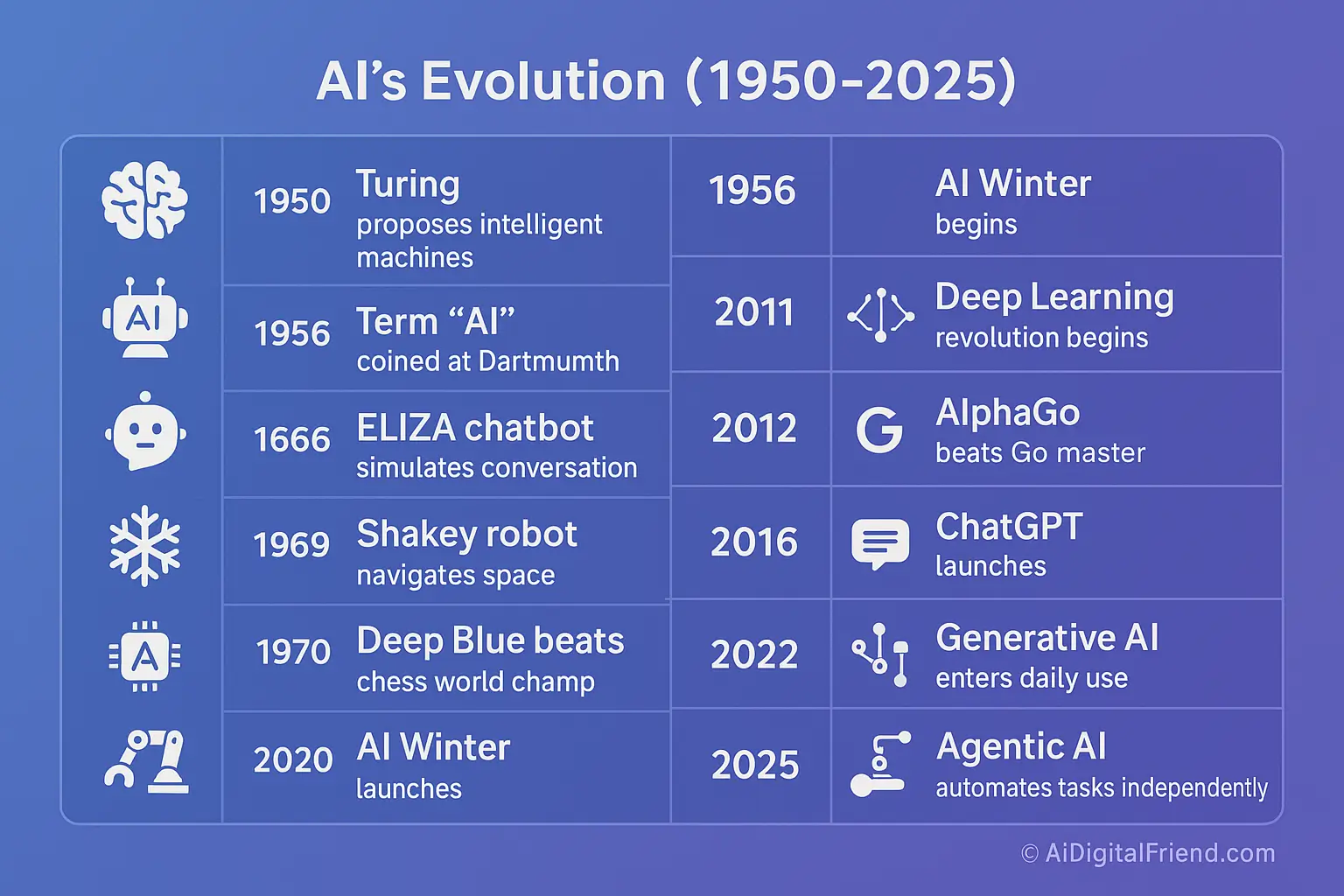
#Short Answer
Traces timeline of ai algorithms, highlighting major milestones, context, examples, and future implications.
#Infobox
#Overview
The Timeline of AI Algorithms traces the evolution of computational methods designed to simulate human-like intelligence. Beginning with early theoretical frameworks in the mid-20th century, the timeline progresses through symbolic AI, rule-based systems, and statistical learning approaches before culminating in modern deep learning architectures. This structured progression reflects the field's shift from rigid, handcrafted rules to adaptive, data-driven models capable of handling complex tasks such as natural language processing, computer vision, and decision-making. AI algorithms have evolved in response to computational advancements, data availability, and theoretical breakthroughs. The timeline serves as a historical roadmap, illustrating how incremental improvements in algorithms have led to transformative applications in industries ranging from healthcare to finance. Understanding this timeline is essential for grasping the foundational principles of AI and its current capabilities.
#History / Background
#Early Foundations (Pre-1950s)
The origins of AI algorithms can be traced to foundational work in mathematics, logic, and computation. Key milestones include:
- 1936: Alan Turing's introduction of the Turing Machine, a theoretical model of computation that laid the groundwork for algorithmic thinking.
- 1943: Warren McCulloch and Walter Pitts' artificial neuron model, which mimicked biological neural networks and inspired later neural network designs.
- 1950: Alan Turing's "Computing Machinery and Intelligence" paper, which proposed the Turing Test as a criterion for machine intelligence.
#The Birth of AI (1950s–1970s)
The formalization of AI as a discipline in the 1950s marked the beginning of algorithmic development:
- 1956: The Dartmouth Conference, where the term "artificial intelligence" was coined, and early AI research focused on symbolic reasoning and problem-solving.
- 1958: Frank Rosenblatt's Perceptron, the first algorithm capable of learning from data, though limited to linear separable problems.
- 1969: Marvin Minsky and Seymour Papert's critique of the Perceptron highlighted its limitations, leading to a temporary decline in neural network research.
#The AI Winter and Rule-Based Systems (1970s–1980s)
During this period, AI research shifted toward expert systems, which relied on rule-based logic to solve domain-specific problems:
- 1972: MYCIN, an early expert system for medical diagnosis, demonstrated the potential of rule-based AI.
- 1980s: The rise of knowledge-based systems and the Lisp programming language, which became dominant in AI research.
#The Revival of Neural Networks (1980s–1990s)
The resurgence of interest in neural networks was driven by key algorithmic advancements:
- 1986: David Rumelhart, Geoffrey Hinton, and Ronald Williams' Backpropagation algorithm, which enabled training of multi-layer neural networks.
- 1989: Yann LeCun's application of Convolutional Neural Networks (CNNs) to handwritten digit recognition, laying the groundwork for modern computer vision.
#The Machine Learning Era (2000s–2010s)
The proliferation of data and computational power led to the dominance of machine learning algorithms:
- 2006: Geoffrey Hinton's work on Deep Belief Networks, which demonstrated the power of unsupervised pre-training.
- 2012: Alex Krizhevsky's AlexNet, a CNN that won the ImageNet competition, revolutionizing computer vision.
- 2014: The introduction of Generative Adversarial Networks (GANs) by Ian Goodfellow, enabling realistic data generation.
#The Deep Learning Revolution (2010s–Present)
The 2010s saw the rise of deep learning, characterized by scalable neural architectures and massive datasets:
- 2017: The Transformer architecture introduced in "Attention Is All You Need" by Vaswani et al., enabling breakthroughs in natural language processing.
- 2020s: The development of Large Language Models (LLMs) such as GPT-3 and PaLM, which demonstrated human-like text generation capabilities.
#How It Works
AI algorithms function by processing input data through a series of computational steps to produce meaningful outputs. The evolution of these algorithms reflects shifts in computational paradigms:
#Symbolic AI (Rule-Based Systems)
- Mechanism: Relies on predefined rules and logical inferences to solve problems.
- Example: Expert systems use if-then rules to mimic human decision-making.
- Limitations: Inflexible to new scenarios not covered by existing rules.
#Machine Learning (Statistical Models)
- Mechanism: Learns patterns from data without explicit programming.
- Types:
- Supervised Learning: Trained on labeled data (e.g., classification, regression).
- Unsupervised Learning: Identifies patterns in unlabeled data (e.g., clustering, dimensionality reduction).
- Reinforcement Learning: Learns through trial and error using rewards (e.g., game-playing AI).
- Example: Support Vector Machines (SVMs) separate data points using hyperplanes.
#Deep Learning (Neural Networks)
- Mechanism: Uses layered neural networks to model complex, hierarchical representations.
- Key Components:
- Layers: Input, hidden, and output layers process data sequentially.
- Activation Functions: Introduce non-linearity (e.g., ReLU, Sigmoid).
- Optimization: Algorithms like Stochastic Gradient Descent (SGD) adjust weights to minimize error.
- Example: CNNs apply convolutional filters to extract features from images.
#Modern Architectures
- Transformers: Use self-attention mechanisms to weigh the importance of different input elements (e.g., in LLMs).
- Generative Models: Generate new data samples (e.g., GANs, Variational Autoencoders).
#Important Facts
- First AI Algorithm: The Perceptron (1958) was the first algorithm capable of learning from data, though it could only solve linearly separable problems.
- Backpropagation: The Backpropagation algorithm (1986) enabled training of multi-layer neural networks, reigniting interest in deep learning.
- ImageNet Breakthrough: AlexNet (2012) reduced the error rate in image classification by over 10%, demonstrating the power of deep learning.
- Transformer Impact: The Transformer architecture (2017) replaced recurrent models in NLP, leading to models like BERT and GPT.
- Ethical Concerns: Modern AI algorithms face scrutiny over bias, privacy, and interpretability, prompting research into explainable AI (XAI).
- Hardware Advancements: The rise of GPUs and TPUs accelerated training of large-scale models, enabling breakthroughs like LLMs.
#Timeline
- Foundational ideas
Core concepts and early methods shape Timeline of AI Algorithms.
- Practical use
Tools, examples, and real-world deployments make the topic easier to evaluate.
- Responsible implementation
Current work focuses on reliability, governance, performance, and measurable impact.
#Related Terms
#FAQ
What does Timeline of AI Algorithms cover?
Traces timeline of ai algorithms, highlighting major milestones, context, examples, and future implications.
Why is Timeline of AI Algorithms important?
It helps readers understand key concepts, compare practical use cases, and evaluate how Machine Learning decisions affect outcomes, risks, and implementation choices.
What should readers verify before applying this topic?
Readers should compare benefits, limitations, data requirements, and related themes such as Timeline, AI, Algorithms before using the ideas in real projects.
#References
- Timeline of AI Algorithms terminology and background research
- Timeline of AI Algorithms use cases, implementation examples, and limitations
- Machine Learning best practices, standards, and risk guidance
- Timeline case studies, benchmarks, and current industry analysis


Comments
No comments yet. Start the discussion with a useful note.