

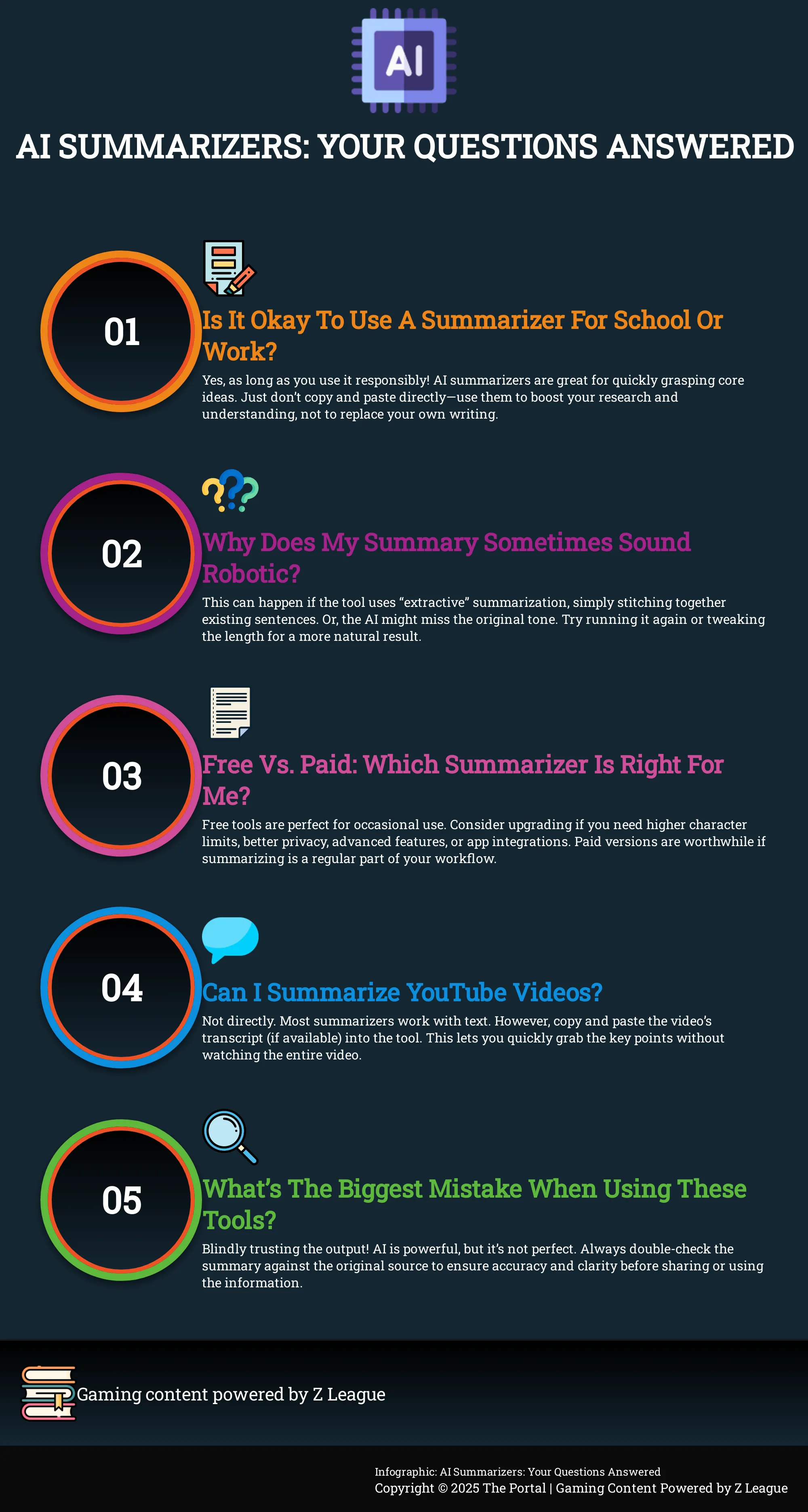
#Short Answer
Covers q&a: common ai questions answered, including core concepts, practical examples, benefits, limitations, and risks in Artificial Intelligence.
#Infobox
#Overview
AI text summarizers are computational tools that automate the process of extracting essential information from large volumes of text. Unlike traditional summarization methods, which rely on manual effort or basic keyword extraction, modern AI summarizers use advanced algorithms to understand context, semantics, and linguistic patterns. This enables them to produce summaries that are coherent, contextually accurate, and tailored to user needs. The demand for AI summarizers has surged with the exponential growth of digital content. In an era where information overload is a common challenge, these tools help users quickly grasp the core ideas of articles, research papers, or reports without reading entire documents. Businesses, students, journalists, and researchers increasingly rely on AI summarizers to enhance productivity and decision-making.
#History / Background
#Early Developments
The concept of automatic text summarization dates back to the 1950s, with early research focusing on extractive methods—identifying and compiling key sentences from a document. One of the first notable systems was Luhn’s algorithm (1958), which used word frequency to determine sentence importance. This laid the groundwork for rule-based summarization techniques.
#Evolution of Techniques In the 1990s and early 2000s, advancements in computational linguistics and statistical methods improved summarization accuracy. Tools like MEAD (2001) introduced sentence scoring based on features such as position, length, and term frequency. However, these methods often produced summaries that lacked coherence or nuance.
#Rise of AI and Machine Learning The 2010s marked a paradigm shift with the integration of machine learning and deep learning into summarization. Neural networks, particularly sequence-to-sequence models, enabled systems to understand context and generate abstractive summaries—paraphrasing rather than merely extracting sentences. Models like Pointer-Generator Networks (2017) and BERT-based summarizers (2018) further enhanced performance by leveraging pre-trained language models.
#Modern Era
Today, AI summarizers are powered by transformer architectures (e.g., Google’s T5, Facebook’s BART) and large language models (LLMs) like ChatGPT and Claude. These models can handle complex texts, adapt to specific domains, and even summarize across multiple languages. The proliferation of cloud-based APIs and open-source frameworks has democratized access to high-quality summarization tools.
#How It Works
AI text summarizers employ a combination of extractive and abstractive techniques, often enhanced by machine learning. The process can be broken down into several stages:
#
- Text Preprocessing
- Tokenization: Splitting text into sentences, words, or subword units (e.g., using Byte Pair Encoding).
- Normalization: Removing stopwords, stemming, or lemmatizing terms to reduce noise.
- Embedding: Converting words/sentences into numerical vectors (e.g., using Word2Vec, GloVe, or transformer-based embeddings like BERT).
#
- Feature Extraction
- Extractive Methods: Identify key sentences or phrases based on:
- Term Frequency-Inverse Document Frequency (TF-IDF): Highlights words that are important in a document but rare in general.
- TextRank: A graph-based algorithm that ranks sentences by their similarity to other sentences.
- Positional Bias: Prioritizes sentences at the beginning or end of a document.
- Abstractive Methods: Generate new sentences by:
- Attention Mechanisms: Focuses on relevant parts of the input text during generation.
- Transformer Models: Uses encoder-decoder architectures (e.g., BART, T5) to produce fluent summaries.
#
- Summary Generation
- Extractive Summaries: Combine top-ranked sentences into a coherent summary.
- Abstractive Summaries: Generate novel sentences that capture the essence of the text, often requiring advanced NLP techniques to avoid hallucinations or inaccuracies.
#
- Post-Processing
- Coherence Adjustment: Ensures the summary flows logically.
- Length Control: Adjusts summary size based on user preferences (e.g., short, medium, or long).
- Bias Mitigation: Filters out subjective or biased language to maintain neutrality.
#Example Workflow 1. Input: A 5,000-word research paper on climate change. 2. Preprocessing: Tokenize sentences, remove stopwords, and embed text using BERT. 3. Feature Extraction: Apply TF-IDF and TextRank to rank sentences. 4. Summary Generation: Select top 5 sentences for an extractive summary or use a T5 model for an abstractive summary. 5. Output: A 200-word summary highlighting key findings, methodologies, and conclusions.
#Important Facts
- Accuracy Variability: Abstractive summarizers (e.g., those using LLMs) generally produce more fluent summaries but may introduce factual errors. Extractive methods are more reliable but often less coherent.
- Domain Adaptation: Summarizers trained on general texts may perform poorly on specialized domains (e.g., legal or medical jargon). Fine-tuning on domain-specific data improves performance.
- Multilingual Support: Advanced models like mT5 or XLM-R can summarize text in multiple languages, though accuracy varies by language complexity.
- Ethical Concerns: AI summarizers may inadvertently propagate biases present in training data or omit critical nuances, especially in sensitive topics like politics or healthcare.
- Energy Consumption: Large transformer models require significant computational resources, raising concerns about their environmental impact.
- Real-Time Summarization: Some tools (e.g., NotebookLM) offer real-time summarization of audio or video transcripts, expanding their utility beyond text.
- Customization: Users can often adjust summary length, style (e.g., formal vs. casual), and focus areas (e.g., emphasizing methodology over results).
#Timeline
- Foundational ideas
Core concepts and early methods shape Q&a: Common AI Questions Answered.
- Practical use
Tools, examples, and real-world deployments make the topic easier to evaluate.
- Responsible implementation
Current work focuses on reliability, governance, performance, and measurable impact.
#Related Terms
#FAQ
What does Q&a: Common AI Questions Answered cover?
Covers q&a: common ai questions answered, including core concepts, practical examples, benefits, limitations, and risks in Artificial Intelligence.
Why is Q&a: Common AI Questions Answered important?
It helps readers understand key concepts, compare practical use cases, and evaluate how Artificial Intelligence decisions affect outcomes, risks, and implementation choices.
What should readers verify before applying this topic?
Readers should compare benefits, limitations, data requirements, and related themes such as Qa, Common, AI before using the ideas in real projects.
#References
- Q&a: Common AI Questions Answered terminology and background research
- Q&a: Common AI Questions Answered use cases, implementation examples, and limitations
- Artificial Intelligence best practices, standards, and risk guidance
- Qa case studies, benchmarks, and current industry analysis



Comments
No comments yet. Start the discussion with a useful note.