

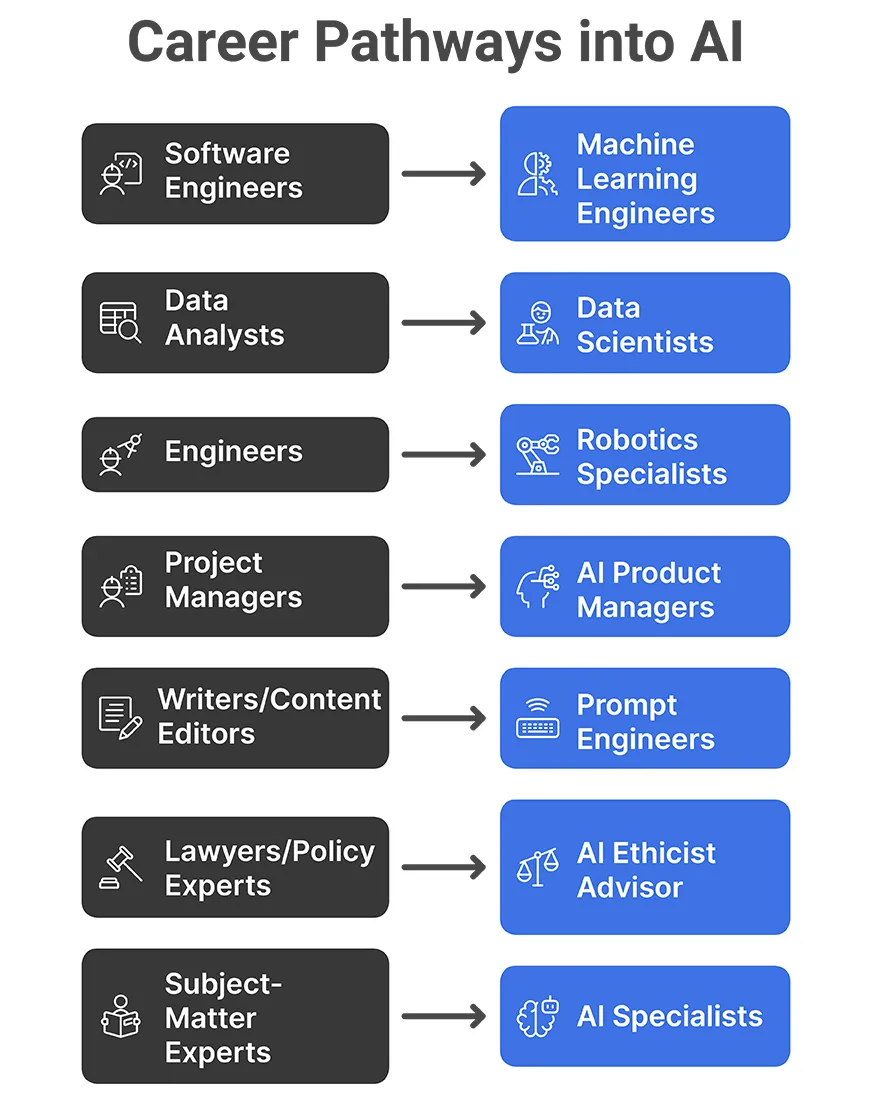
#Short Answer
Explains how to start a career in ai, including the main process, tools, examples, risks, and practical implementation steps.
#Infobox
#Overview
Artificial Intelligence (AI) is a transformative field that enables machines to perform tasks requiring human-like intelligence, such as reasoning, learning, perception, and decision-making. A career in AI offers diverse opportunities across industries, driven by advancements in computing power, big data, and algorithmic innovations. Professionals in this field develop intelligent systems, optimize processes, and solve complex problems using AI techniques like machine learning (ML), deep learning, and natural language processing (NLP). AI careers are interdisciplinary, requiring a blend of technical expertise, problem-solving skills, and creativity. The demand for AI professionals has surged due to the integration of AI in everyday applications, from virtual assistants and recommendation systems to autonomous vehicles and medical diagnostics. As organizations prioritize digital transformation, AI roles have become critical in driving innovation and efficiency.
#History / Background
The concept of AI dates back to the mid-20th century, with early milestones including:
- 1950s–1960s: The term "artificial intelligence" was coined by John McCarthy in 1956 at the Dartmouth Conference. Early AI research focused on symbolic reasoning and problem-solving, exemplified by programs like ELIZA (a natural language processing chatbot) and SHRDLU (a language understanding system).
- 1980s–1990s: The field saw a resurgence with the development of expert systems and machine learning algorithms. However, progress was limited by computational constraints and data availability.
- 2000s–Present: The explosion of big data, cloud computing, and advances in neural networks (e.g., deep learning) revolutionized AI. Key breakthroughs include:
- 2012: AlexNet, a deep convolutional neural network, achieved record accuracy in image recognition, sparking widespread interest in deep learning.
- 2016: AlphaGo defeated a world champion Go player, demonstrating AI’s potential in complex decision-making.
- 2020s: AI integration into consumer products (e.g., voice assistants, autonomous vehicles) and enterprise solutions (e.g., predictive analytics, generative AI) has become ubiquitous. The evolution of AI has been shaped by collaborations between academia, industry, and governments, with organizations like MIT, Stanford, and DeepMind leading research efforts.
#How It Works
#Core Concepts in AI
- Machine Learning (ML) - A subset of AI where models learn patterns from data without explicit programming.
- Types:
- Supervised Learning: Models are trained on labeled data (e.g., classification, regression).
- Unsupervised Learning: Models identify patterns in unlabeled data (e.g., clustering, dimensionality reduction).
- Reinforcement Learning: Models learn by interacting with an environment to maximize rewards (e.g., robotics, game AI).
- Deep Learning - A specialized form of ML using artificial neural networks with multiple layers (deep neural networks).
- Key Architectures:
- Convolutional Neural Networks (CNNs): Used for image and video analysis.
- Recurrent Neural Networks (RNNs): Applied to sequential data (e.g., time series, NLP).
- Transformers: Power modern NLP models (e.g., BERT, GPT) for tasks like translation and text generation.
- Natural Language Processing (NLP) - Enables machines to understand, interpret, and generate human language.
- Applications: Chatbots, sentiment analysis, machine translation (e.g., Google Translate).
- Computer Vision - Focuses on enabling machines to interpret and analyze visual data.
- Applications: Facial recognition, autonomous driving, medical imaging.
- Robotics - Combines AI with mechanical engineering to create autonomous systems.
- Applications: Industrial robots, drones, surgical robots.
#AI Development Workflow
- Problem Definition: Identify the problem and determine if AI is the right solution.
- Data Collection: Gather and preprocess relevant data (e.g., structured datasets, images, text).
- Model Selection: Choose an appropriate algorithm or architecture (e.g., decision trees, neural networks).
- Training: Feed data into the model to learn patterns.
- Evaluation: Assess model performance using metrics like accuracy, precision, and recall.
- Deployment: Integrate the model into real-world applications (e.g., APIs, embedded systems).
- Monitoring: Continuously update and refine the model based on feedback and new data.
#Important Facts
- AI vs. Automation: While automation performs predefined tasks, AI systems can learn and adapt over time.
- Bias in AI: AI models can perpetuate biases present in training data, requiring careful data selection and bias mitigation techniques.
- Explainable AI (XAI): Techniques like SHAP (SHapley Additive exPlanations) and LIME (Local Interpretable Model-agnostic Explanations) help interpret AI decisions.
- Ethical Considerations: AI raises concerns about privacy, job displacement, and autonomous weapons, necessitating ethical frameworks and regulations.
- Hardware Requirements: Training deep learning models often requires high-performance GPUs or TPUs (Tensor Processing Units).
- Open-Source Tools: Frameworks like TensorFlow, PyTorch, and scikit-learn democratize AI development.
- AI in Healthcare: AI is used for drug discovery, medical imaging analysis, and personalized treatment recommendations.
- Generative AI: Models like DALL·E and Stable Diffusion can create images, text, and music from prompts, expanding creative applications.
#Timeline
- Foundational ideas
Core concepts and early methods shape How to Start a Career in AI.
- Practical use
Tools, examples, and real-world deployments make the topic easier to evaluate.
- Responsible implementation
Current work focuses on reliability, governance, performance, and measurable impact.
#Related Terms
#FAQ
What does How to Start a Career in AI cover?
Explains how to start a career in ai, including the main process, tools, examples, risks, and practical implementation steps.
Why is How to Start a Career in AI important?
It helps readers understand key concepts, compare practical use cases, and evaluate how Artificial Intelligence decisions affect outcomes, risks, and implementation choices.
What should readers verify before applying this topic?
Readers should compare benefits, limitations, data requirements, and related themes such as Start, Career, AI before using the ideas in real projects.
#References
- How to Start a Career in AI terminology and background research
- How to Start a Career in AI use cases, implementation examples, and limitations
- Artificial Intelligence best practices, standards, and risk guidance
- Start case studies, benchmarks, and current industry analysis




Comments
No comments yet. Start the discussion with a useful note.