

#Short Answer
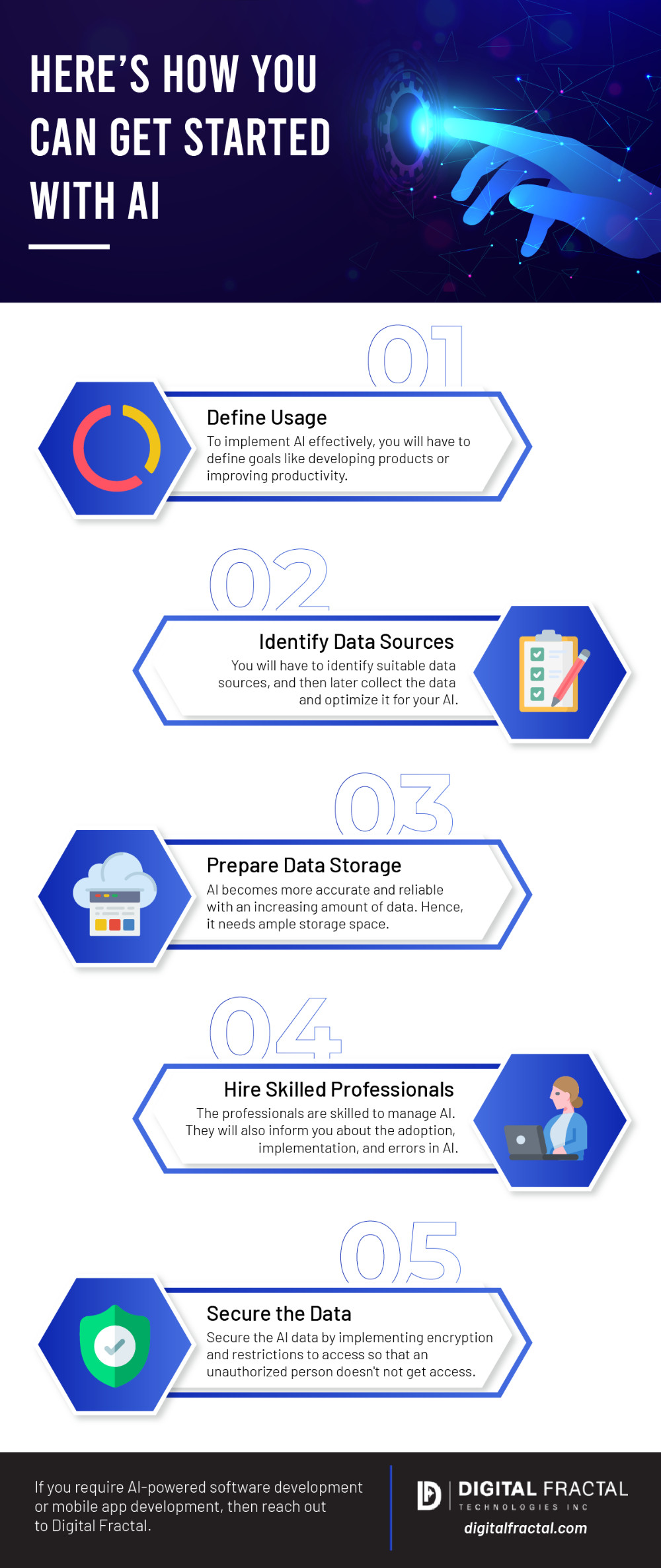
Explains how to get started with ai, including the main process, tools, examples, risks, and practical implementation steps.
#Infobox
#Overview
Artificial Intelligence (AI) refers to the simulation of human intelligence in machines, enabling them to perform tasks such as learning, reasoning, problem-solving, and decision-making. AI systems rely on algorithms and large datasets to identify patterns, make predictions, and automate complex processes. The field encompasses subdomains like machine learning (ML), where models improve with data; deep learning, which uses neural networks for high-level abstraction; and natural language processing (NLP), which enables machines to understand and generate human language. AI is transforming industries by enhancing efficiency, enabling personalized experiences, and solving problems previously deemed intractable. From chatbots and virtual assistants to autonomous vehicles and medical diagnostics, AI’s applications are vast and continually expanding. However, its development also raises ethical and societal challenges, including algorithmic bias, data privacy concerns, and the potential for job displacement.
#History / Background
#Early Foundations (1950s–1980s)
The concept of AI dates back to the mid-20th century, with key milestones including:
- 1950: Alan Turing’s Computing Machinery and Intelligence proposed the "Turing Test" to assess machine intelligence.
- 1956: The term "artificial intelligence" was coined at the Dartmouth Conference, marking the field’s formal inception.
- 1958: John McCarthy developed LISP, a programming language pivotal for AI research.
- 1966: ELIZA, an early NLP program, simulated human conversation.
- 1980s: Expert systems gained prominence, using rule-based logic to mimic human decision-making.
#The AI Winter and Revival (1980s–2010s)
- 1980s–1990s: Overhyped expectations led to reduced funding and interest, known as the "AI Winter."
- 1997: IBM’s Deep Blue defeated world chess champion Garry Kasparov, demonstrating AI’s potential in strategic games.
- 2011: IBM Watson won Jeopardy!, showcasing advancements in NLP and unstructured data processing.
- 2012: A breakthrough in deep learning occurred when AlexNet, a convolutional neural network, won the ImageNet competition, revolutionizing computer vision.
#The Modern Era (2010s–Present)
- 2016: Google’s AlphaGo defeated a world champion Go player, highlighting AI’s capability in complex decision-making.
- 2018: The adoption of AI in healthcare, finance, and retail surged, with applications like diagnostic imaging and fraud detection.
- 2020s: Generative AI, including models like DALL·E and ChatGPT, democratized creative and conversational AI, sparking widespread public interest and ethical debates.
#How It Works
#Core Concepts
- Machine Learning (ML)
- Supervised Learning: Models learn from labeled data (e.g., spam detection).
- Unsupervised Learning: Models identify patterns in unlabeled data (e.g., customer segmentation).
- Reinforcement Learning: Agents learn by interacting with an environment to maximize rewards (e.g., robotics, game AI).
- Deep Learning - Uses neural networks with multiple layers (deep networks) to model complex data.
- Convolutional Neural Networks (CNNs) excel in image recognition.
- Recurrent Neural Networks (RNNs) and Transformers (e.g., BERT, GPT) power NLP tasks.
- Data and Algorithms
- Data: High-quality, diverse datasets are critical for training AI models.
- Algorithms: Optimize model performance (e.g., gradient descent, backpropagation).
#The AI Pipeline
- Problem Definition: Identify the task (e.g., classification, prediction).
- Data Collection and Preprocessing: Clean, normalize, and augment data.
- Model Selection: Choose an algorithm (e.g., decision trees, neural networks).
- Training: Feed data into the model to learn patterns.
- Evaluation: Assess performance using metrics like accuracy, precision, or F1-score.
- Deployment: Integrate the model into applications (e.g., APIs, embedded systems).
- Monitoring and Maintenance: Update models with new data to maintain accuracy.
#Key Technologies
- Frameworks: TensorFlow, PyTorch, Keras.
- Libraries: Scikit-learn (ML), OpenCV (computer vision), NLTK (NLP).
- Hardware: GPUs/TPUs accelerate training; edge devices enable real-time inference.
#Important Facts
- AI vs. AGI: Artificial General Intelligence (AGI) refers to machines with human-like cognitive abilities, a goal still theoretical. Current AI is narrow AI, specialized in specific tasks.
- Bias and Fairness: AI models can inherit biases from training data, leading to discriminatory outcomes (e.g., facial recognition inaccuracies for certain demographics).
- Explainability: "Black box" models (e.g., deep neural networks) lack transparency, complicating trust and regulatory compliance.
- Energy Consumption: Training large AI models (e.g., LLMs) requires significant computational power, raising environmental concerns.
- Regulation: Governments are implementing frameworks (e.g., EU AI Act) to govern AI’s ethical and legal use.
- Democratization: Open-source tools (e.g., Hugging Face, Fast.ai) lower barriers to entry for AI development.
#Timeline
- Foundational ideas
Core concepts and early methods shape How to Get Started with AI.
- Practical use
Tools, examples, and real-world deployments make the topic easier to evaluate.
- Responsible implementation
Current work focuses on reliability, governance, performance, and measurable impact.
#Related Terms
#FAQ
What does How to Get Started with AI cover?
Explains how to get started with ai, including the main process, tools, examples, risks, and practical implementation steps.
Why is How to Get Started with AI important?
It helps readers understand key concepts, compare practical use cases, and evaluate how Artificial Intelligence decisions affect outcomes, risks, and implementation choices.
What should readers verify before applying this topic?
Readers should compare benefits, limitations, data requirements, and related themes such as Get, Started, AI before using the ideas in real projects.
#References
- How to Get Started with AI terminology and background research
- How to Get Started with AI use cases, implementation examples, and limitations
- Artificial Intelligence best practices, standards, and risk guidance
- Get case studies, benchmarks, and current industry analysis



Comments
No comments yet. Start the discussion with a useful note.