

#Short Answer
Covers generative ai explained: a simple guide, including core concepts, practical examples, benefits, limitations, and risks in Generative AI.
#Infobox
#Overview
Generative AI represents a paradigm shift in artificial intelligence by focusing on creation rather than analysis or prediction. At its core, it leverages deep learning models trained on vast datasets to generate novel outputs that mimic human-like creativity. Unlike discriminative AI, which classifies or predicts labels, generative AI learns the underlying structure of data to produce new instances. The technology has gained prominence due to its ability to automate creative tasks, enhance productivity, and enable personalized experiences. From generating realistic images from text prompts to composing music, generative AI is reshaping industries by bridging the gap between human creativity and computational power. Key characteristics of generative AI include:
- Unsupervised Learning: Many models operate without labeled data, learning patterns directly from raw inputs.
- Probabilistic Outputs: Generations are not deterministic; they reflect learned distributions with inherent variability.
- Multimodal Capabilities: Modern systems can generate content across text, images, and audio, often combining modalities.
#History / Background
The foundations of generative AI trace back to the early days of machine learning, but its evolution accelerated with advancements in deep learning and computational power.
#Early Foundations (1950s–2000s)
- 1950s–1960s: Early experiments in generative models included rule-based systems and Markov chains, which generated text or music based on predefined probabilities.
- 1980s–1990s: The introduction of neural networks laid groundwork for more sophisticated generative approaches, though computational limitations restricted progress.
- 2000s: The rise of Restricted Boltzmann Machines (RBMs) and Autoencoders enabled better representation learning, though their generative capabilities were limited.
#Breakthroughs (2010s–Present)
- 2014: Generative Adversarial Networks (GANs), introduced by Ian Goodfellow and colleagues, revolutionized generative AI by pitting two neural networks against each other—a generator and a discriminator—to produce high-quality outputs.
- 2017: The Transformer architecture, introduced in the paper "Attention Is All You Need", became the backbone of modern generative models, enabling efficient processing of sequential data (e.g., text).
- 2020s: The release of large language models (LLMs) like GPT-3 and text-to-image models like DALL·E and Stable Diffusion democratized generative AI, making it accessible to non-experts.
#Key Milestones
| Year | Event | |----------|---------------------------------------------------------------------------| | 2014 | Introduction of GANs | | 2017 | Transformer architecture published | | 2018 | BERT (Bidirectional Encoder Representations from Transformers) released | | 2020 | GPT-3 launched by OpenAI | | 2021 | DALL·E and Stable Diffusion released | | 2023 | Diffusion models dominate text-to-image generation |
#How It Works
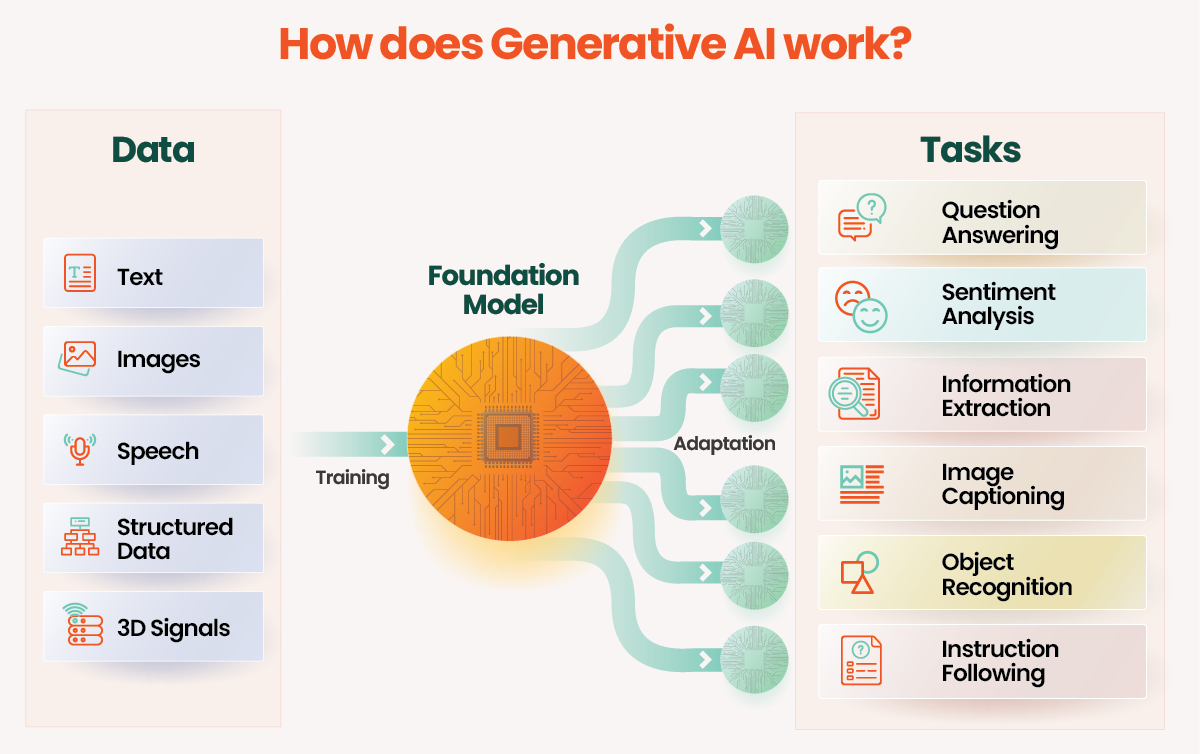
Generative AI operates through a combination of data representation learning and probabilistic generation. The process typically involves training a model on a large dataset to learn patterns, followed by sampling from the learned distribution to produce new content.
#Core Techniques
- Generative Adversarial Networks (GANs)
GANs consist of two neural networks:
- Generator: Creates synthetic data (e.g., images) from random noise.
- Discriminator: Distinguishes between real and generated data. The two networks compete in a minimax game, where the generator improves its outputs to fool the discriminator, while the discriminator becomes better at detecting fakes. This adversarial training leads to high-quality generations. Example: GANs are widely used for image synthesis, such as generating photorealistic faces or artistic styles.
- Variational Autoencoders (VAEs)
VAEs are probabilistic models that learn a latent space representation of data. They consist of:
- Encoder: Maps input data to a latent distribution.
- Decoder: Reconstructs data from the latent space. By sampling from the latent space, VAEs can generate new, similar data points. Example: VAEs are used for image denoising, anomaly detection, and generating variations of existing images.
- Transformers and Large Language Models (LLMs)
Transformers, introduced in 2017, use self-attention mechanisms to process sequential data (e.g., text) in parallel. LLMs like GPT-3 are trained on vast text corpora to predict the next word in a sequence, enabling them to generate coherent and contextually relevant text. Example: Chatbots, code generation, and creative writing assistants rely on transformer-based models.
- Diffusion Models
Diffusion models generate data by gradually adding and removing noise. They work in two phases:
- Forward Process: Gradually corrupts data with noise.
- Reverse Process: Learns to denoise, generating new data from pure noise. Example: Stable Diffusion and DALL·E 2 use diffusion models for high-fidelity image generation.
#Training Process
- Data Collection: Models are trained on large datasets (e.g., text corpora, image databases).
- Preprocessing: Data is cleaned, normalized, and tokenized (for text) or resized (for images).
- Model Training: The model learns to represent data distributions, often using techniques like backpropagation and gradient descent.
- Sampling: After training, the model generates new content by sampling from the learned distribution.
#Challenges
- Mode Collapse: GANs may produce limited varieties of outputs.
- Computational Cost: Training large models requires significant resources.
- Bias and Fairness: Models may inherit biases from training data.
- Interpretability: Understanding how models generate outputs remains difficult.
#Important Facts
#
- Generative AI vs. Discriminative AI | Aspect | Generative AI | Discriminative AI | |---------------------|--------------------------------------------|-------------------------------------------| | Primary Task | Creates new data | Classifies or predicts labels | | Training Data | Unlabeled or partially labeled | Labeled data | | Output | New instances (e.g., images, text) | Labels or probabilities | | Examples | GANs, VAEs, LLMs | Logistic Regression, SVM, Neural Classifiers |
#
- Applications Across Industries | Industry | Use Case | |--------------------|-----------------------------------------------------------------------------| | Creative Arts | AI-generated art, music composition, scriptwriting | | Healthcare | Drug discovery, medical imaging synthesis, personalized treatment plans | | Gaming | Procedural content generation (e.g., game levels, characters) | | Marketing | Personalized ad copy, chatbots, virtual influencers | | Education | Automated grading, interactive learning tools | | Finance | Fraud detection, synthetic data generation for testing |
#
- Ethical and Societal Implications
- Deepfakes: Generative AI can create hyper-realistic fake videos or audio, raising concerns about misinformation.
- Job Displacement: Automation of creative tasks may impact jobs in writing, design, and entertainment.
- Intellectual Property: Questions arise about ownership of AI-generated content.
- Bias and Fairness: Models may perpetuate stereotypes present in training data.
#
- Performance Metrics
- Inception Score (IS): Measures the quality and diversity of generated images.
- Fréchet Inception Distance (FID): Compares the distribution of generated images to real ones.
- Perplexity: Evaluates the performance of language models by measuring how well they predict text.
#Timeline
- Foundational ideas
Core concepts and early methods shape Generative AI Explained: a Simple Guide.
- Practical use
Tools, examples, and real-world deployments make the topic easier to evaluate.
- Responsible implementation
Current work focuses on reliability, governance, performance, and measurable impact.
#Related Terms
#FAQ
What does Generative AI Explained: a Simple Guide cover?
Covers generative ai explained: a simple guide, including core concepts, practical examples, benefits, limitations, and risks in Generative AI.
Why is Generative AI Explained: a Simple Guide important?
It helps readers understand key concepts, compare practical use cases, and evaluate how Generative AI decisions affect outcomes, risks, and implementation choices.
What should readers verify before applying this topic?
Readers should compare benefits, limitations, data requirements, and related themes such as Generative, AI, Explained before using the ideas in real projects.
#References
- Generative AI Explained: a Simple Guide terminology and background research
- Generative AI Explained: a Simple Guide use cases, implementation examples, and limitations
- Generative AI best practices, standards, and risk guidance
- Generative case studies, benchmarks, and current industry analysis


Comments
No comments yet. Start the discussion with a useful note.