

#Short Answer
Covers exploring the basics of ai, including core concepts, practical examples, benefits, limitations, and risks in Artificial Intelligence.
#Infobox
#Overview
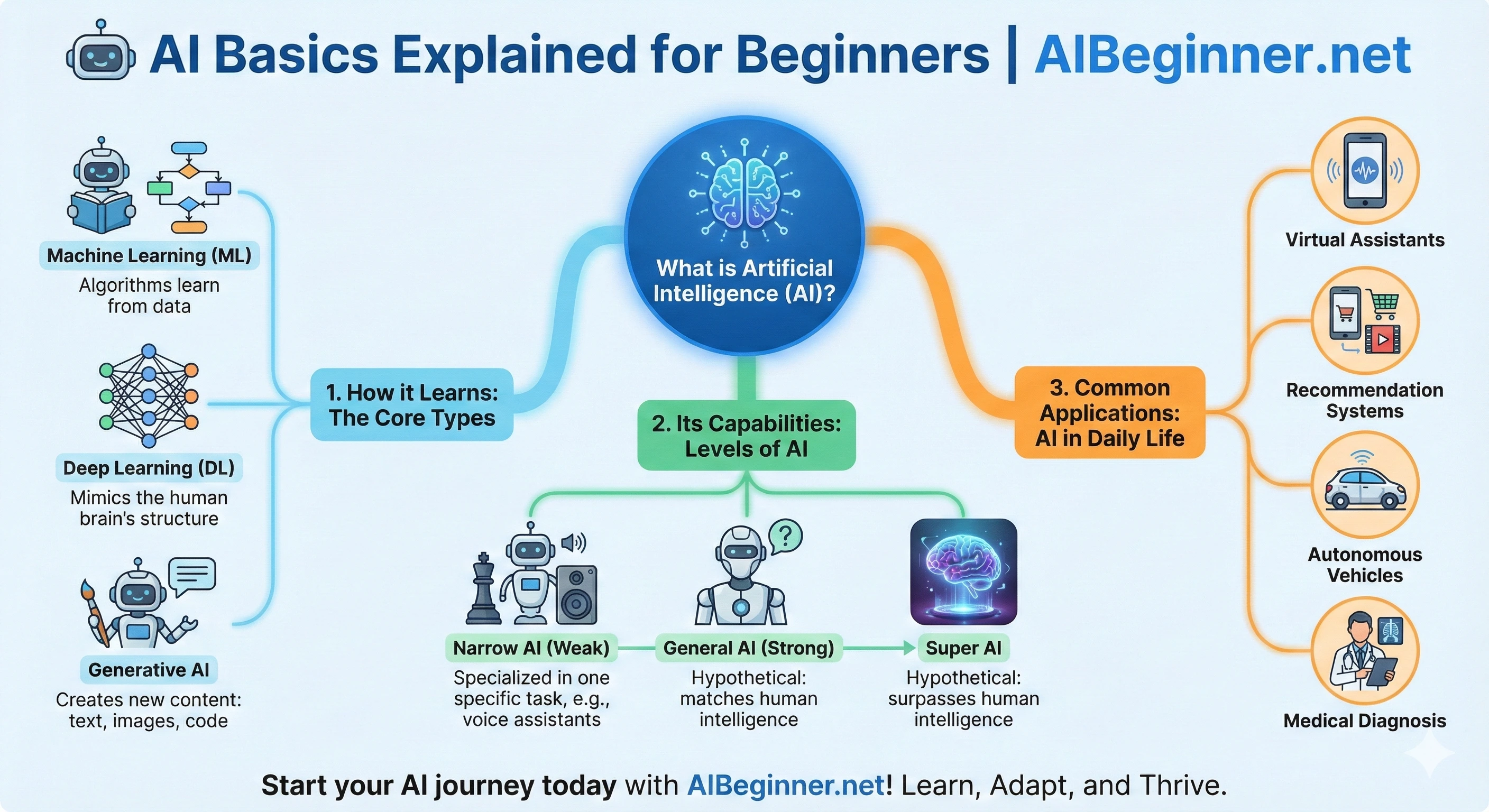
Artificial Intelligence (AI) is a branch of computer science focused on creating systems capable of performing tasks that typically require human intelligence. These tasks include reasoning, learning, perception, problem-solving, and language comprehension. AI systems are designed to analyze vast amounts of data, identify patterns, and make decisions with minimal human intervention. The field of AI is broadly categorized into two types: Narrow AI (or Weak AI), which is designed for specific tasks like voice recognition or image classification, and General AI (or Strong AI), which aims to replicate human-like cognitive abilities across diverse domains. While Narrow AI is already prevalent in everyday applications, General AI remains a theoretical goal. AI technologies are powered by algorithms, statistical models, and computational power. Machine Learning (ML), a subset of AI, enables systems to improve their performance over time by learning from data without explicit programming. Deep Learning, a more advanced form of ML, uses artificial neural networks to model complex patterns, driving breakthroughs in fields like computer vision and natural language processing.
#History / Background
#Early Foundations (1940s–1950s)
The conceptual roots of AI trace back to ancient history, with myths and stories of artificial beings. However, the modern field began in the mid-20th century. In 1950, Alan Turing proposed the Turing Test, a criterion for determining a machine's ability to exhibit intelligent behavior indistinguishable from a human. This laid the groundwork for AI as a scientific discipline. The term "Artificial Intelligence" was coined in 1956 during the Dartmouth Conference, organized by John McCarthy, Marvin Minsky, Nathaniel Rochester, and Claude Shannon. This event is widely regarded as the birth of AI as a formal field of study.
#The Golden Years (1956–1974)
During this period, AI research flourished with significant optimism. Programs like ELIZA (1966), an early natural language processing system, demonstrated the potential for machines to simulate human conversation. The General Problem Solver (GPS) developed by Herbert Simon and Allen Newell aimed to mimic human problem-solving strategies. However, the limitations of early AI systems became apparent due to the lack of computational power and data. The field experienced its first AI Winter in the 1970s, marked by reduced funding and skepticism.
#Revival and Expert Systems (1980s–1990s)
The 1980s saw a resurgence in AI research, driven by advancements in computing and the development of expert systems. These systems, such as MYCIN for medical diagnosis, used rule-based logic to solve specific problems. Japan's Fifth Generation Computer Systems project further fueled interest in AI. Despite progress, expert systems faced challenges in scalability and adaptability. The second AI Winter occurred in the late 1980s and early 1990s, as the limitations of rule-based approaches became evident.
#The Modern Era (2000s–Present)
The 21st century marked a renaissance for AI, fueled by three key factors:
- Big Data: The explosion of digital data provided the raw material for training AI models.
- Computational Power: Advances in hardware, particularly GPUs, enabled the training of complex neural networks.
- Algorithmic Innovations: Breakthroughs in machine learning, particularly deep learning, revolutionized AI capabilities. Landmark achievements include IBM's Watson defeating human champions in Jeopardy! (2011), Google's AlphaGo defeating a world champion Go player (2016), and the proliferation of AI-powered applications in smartphones, healthcare, and autonomous vehicles.
#How It Works
#Core Principles AI systems operate on fundamental principles that enable them to process information and make decisions. These principles include:
- Data Input: AI systems require data to learn and make predictions. This data can be structured (e.g., spreadsheets) or unstructured (e.g., text, images).
- Algorithms: Mathematical rules or procedures that guide the AI's decision-making process. Algorithms can be rule-based (e.g., expert systems) or data-driven (e.g., machine learning models).
- Training: In machine learning, models are trained on labeled data to recognize patterns. For example, a spam detection model learns to identify spam emails based on historical data.
- Inference: Once trained, the model applies its learned patterns to new, unseen data to make predictions or decisions.
- Feedback Loop: Some AI systems incorporate feedback to improve their performance over time, such as reinforcement learning where an agent learns from rewards or penalties.
#Key Techniques
- Machine Learning (ML): A subset of AI that focuses on building systems that learn from data. ML techniques include:
- Supervised Learning: Models are trained on labeled data (e.g., classification, regression).
- Unsupervised Learning: Models identify patterns in unlabeled data (e.g., clustering, dimensionality reduction).
- Reinforcement Learning: Models learn by interacting with an environment and receiving rewards or penalties (e.g., game-playing AI, robotics).
- Deep Learning: A specialized form of ML that uses artificial neural networks with multiple layers (hence "deep") to model complex patterns. Deep learning has driven advancements in:
- Computer Vision: Recognizing objects in images or videos (e.g., facial recognition, autonomous driving).
- Natural Language Processing (NLP): Understanding and generating human language (e.g., chatbots, translation services).
- Speech Recognition: Converting spoken language into text (e.g., virtual assistants like Siri or Alexa).
- Neural Networks: Inspired by the human brain, neural networks consist of interconnected nodes (neurons) that process information. Key architectures include:
- Convolutional Neural Networks (CNNs): Optimized for image processing.
- Recurrent Neural Networks (RNNs): Designed for sequential data like time series or text.
- Transformers: A recent breakthrough in NLP, enabling models like BERT and GPT to understand context in language.
- Natural Language Processing (NLP): Enables machines to understand, interpret, and generate human language. NLP techniques include:
- Tokenization: Breaking text into words or phrases.
- Part-of-Speech Tagging: Identifying grammatical components in a sentence.
- Sentiment Analysis: Determining the emotional tone of a text.
- Machine Translation: Automatically translating text between languages.
- Robotics: Combines AI with physical systems to perform tasks in the real world. Robotics applications include:
- Autonomous Vehicles: Self-driving cars that navigate roads using sensors and AI.
- Industrial Robots: Automated systems for manufacturing and assembly.
- Service Robots: Assistive robots for healthcare, hospitality, or household tasks.
#Important Facts
- AI is Ubiquitous: AI technologies are embedded in everyday devices, from smartphones and smart speakers to recommendation systems on streaming platforms.
- AI and Big Data: The growth of AI is closely tied to the availability of large datasets. Without data, AI models cannot learn effectively.
- Ethical Concerns: AI raises ethical questions, including bias in algorithms, privacy violations, and job displacement. Addressing these issues is critical for responsible AI development.
- AI in Healthcare: AI is transforming healthcare through applications like diagnostic imaging, drug discovery, and personalized treatment plans.
- AI and Creativity: AI is being used to generate art, music, and literature, blurring the lines between human and machine creativity.
- AI Safety: Ensuring that AI systems operate safely and predictably is a major focus of research, particularly for autonomous systems.
- AI and Education: AI-powered tools are being used to personalize learning experiences and assist educators in administrative tasks.
- AI in Finance: AI is used for fraud detection, algorithmic trading, credit scoring, and risk assessment in the financial sector.
#Timeline
- Foundational ideas
Core concepts and early methods shape Exploring the Basics of AI.
- Practical use
Tools, examples, and real-world deployments make the topic easier to evaluate.
- Responsible implementation
Current work focuses on reliability, governance, performance, and measurable impact.
#Related Terms
#FAQ
What does Exploring the Basics of AI cover?
Covers exploring the basics of ai, including core concepts, practical examples, benefits, limitations, and risks in Artificial Intelligence.
Why is Exploring the Basics of AI important?
It helps readers understand key concepts, compare practical use cases, and evaluate how Artificial Intelligence decisions affect outcomes, risks, and implementation choices.
What should readers verify before applying this topic?
Readers should compare benefits, limitations, data requirements, and related themes such as Exploring, Basics, AI before using the ideas in real projects.
#References
- Exploring the Basics of AI terminology and background research
- Exploring the Basics of AI use cases, implementation examples, and limitations
- Artificial Intelligence best practices, standards, and risk guidance
- Exploring case studies, benchmarks, and current industry analysis



Comments
No comments yet. Start the discussion with a useful note.