


#Short Answer
Introduces artificial intelligence for new readers, covering essential concepts, common examples, practical uses, and next steps for learning.
#Infobox
#Overview
Artificial Intelligence refers to the simulation of human intelligence in machines, designed to perform tasks autonomously or with minimal human intervention. AI systems are trained on vast datasets to recognize patterns, make decisions, and improve over time through iterative learning processes. The technology underpins modern advancements in automation, data analysis, and interactive technologies, transforming sectors such as healthcare, finance, and transportation.
AI can be broadly categorized into narrow AI (specialized in specific tasks) and general AI (hypothetical systems with human-like cognitive abilities). While narrow AI is prevalent today, general AI remains a subject of ongoing research and debate. The integration of AI into daily life has led to significant improvements in efficiency, accuracy, and accessibility, though it also raises ethical and societal concerns regarding job displacement, privacy, and algorithmic bias.
#Types of AI
- Reactive Machines: Systems with no memory, reacting to inputs based on predefined rules (e.g., IBM's Deep Blue).
- Limited Memory: AI that uses past data to inform decisions (e.g., self-driving cars).
- Theory of Mind: Hypothetical AI capable of understanding human emotions and intentions (still theoretical).
- Self-Aware AI: Advanced systems with consciousness and self-awareness (not yet achieved).
#History / Background
#Early Concepts
The idea of artificial intelligence dates back to ancient mythology and philosophy, with stories of mechanical men and artificial beings. In the 17th century, philosopher René Descartes speculated about the possibility of machines possessing thought. The formal study of AI began in the mid-20th century, with key milestones including:
- 1943: Warren McCulloch and Walter Pitts proposed a model of artificial neurons, laying the foundation for neural networks.
- 1950: Alan Turing published Computing Machinery and Intelligence, introducing the Turing Test to evaluate machine intelligence.
- 1956: The term "Artificial Intelligence" was coined at the Dartmouth Conference, marking the official birth of AI as a field.
#Development and AI Winters
During the 1960s and 1970s, AI research flourished with early programs like ELIZA (a natural language processing chatbot) and SHRDLU (a language-understanding program). However, unrealistic expectations led to funding cuts and periods known as "AI Winters" (1974–1980 and 1987–1993), where progress stalled due to technical limitations and skepticism.
The resurgence of AI in the 1990s and 2000s was driven by advances in computing power, the availability of big data, and breakthroughs in machine learning algorithms. Key developments included:
- 1997: IBM's Deep Blue defeated world chess champion Garry Kasparov.
- 2011: IBM Watson won Jeopardy!, showcasing AI's natural language processing capabilities.
- 2016: Google's AlphaGo defeated a top Go player, demonstrating the power of deep learning.
#How It Works
#Core Components
AI systems rely on several fundamental components to function:
- Data: The foundation of AI, providing the information needed for training and decision-making. High-quality, diverse datasets are critical for accurate models.
- Algorithms: Mathematical rules and procedures that enable machines to learn from data. Common algorithms include decision trees, support vector machines, and neural networks.
- Computational Power: AI requires significant processing capabilities, often provided by GPUs and specialized hardware like TPUs (Tensor Processing Units).
- Feedback Loops: Systems that allow AI to learn from outcomes, improving performance over time through reinforcement learning.
#Machine Learning
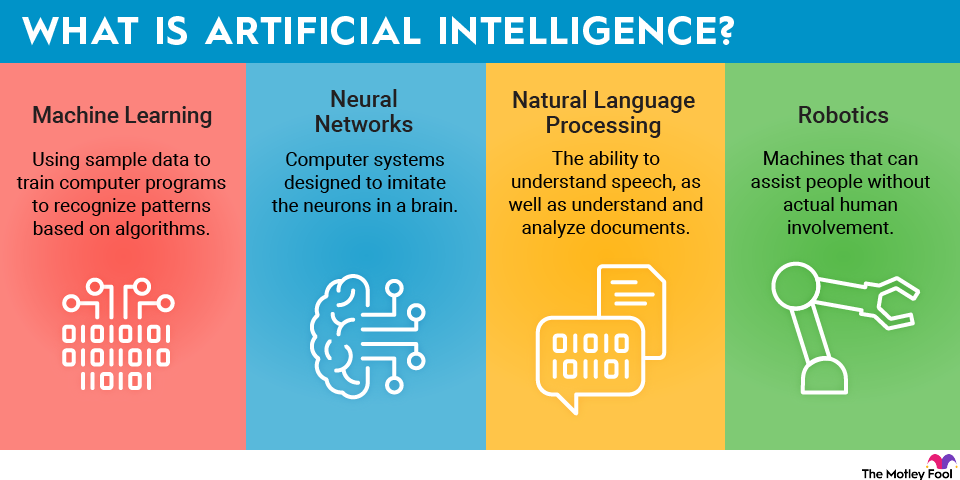
Machine learning (ML) is a subset of AI where systems learn from data without explicit programming. Key techniques include:
- Supervised Learning: Models are trained on labeled data (e.g., classification, regression).
- Unsupervised Learning: Models identify patterns in unlabeled data (e.g., clustering, dimensionality reduction).
- Reinforcement Learning: Systems learn by interacting with an environment and receiving rewards or penalties (e.g., robotics, game AI).
#Deep Learning
Deep learning is a specialized form of machine learning that uses artificial neural networks with multiple layers (hence "deep"). These networks, inspired by the human brain, excel at processing unstructured data such as images, audio, and text. Notable architectures include:
- Convolutional Neural Networks (CNNs): Used for image and video recognition.
- Recurrent Neural Networks (RNNs): Suitable for sequential data like time series or language.
- Transformers: Powering modern natural language processing (e.g., BERT, GPT).
#Important Facts
- AI vs. Machine Learning: While often used interchangeably, AI is the broader concept, whereas machine learning is a method to achieve AI.
- Bias in AI: AI systems can perpetuate biases present in training data, leading to unfair outcomes in hiring, lending, and law enforcement.
- Explainable AI (XAI): A growing field focused on making AI decisions transparent and understandable to humans.
- AI Ethics: Concerns include job displacement, privacy invasion, autonomous weapons, and the potential for superintelligent AI to surpass human control.
- Quantum AI: Emerging research explores the use of quantum computing to accelerate AI training and solve complex problems.
#Timeline
YearEvent1943McCulloch-Pitts neuron model proposed.1950Alan Turing publishes Computing Machinery and Intelligence.1956Dartmouth Conference coins the term "Artificial Intelligence."1966ELIZA, an early chatbot, is developed.1997IBM's Deep Blue defeats Garry Kasparov in chess.2011IBM Watson wins Jeopardy!.2016Google's AlphaGo defeats a top Go player.2020AI models like GPT-3 demonstrate advanced language generation.2023Generative AI tools (e.g., DALL-E, MidJourney) gain widespread adoption.
#Related Terms
#FAQ
What does Beginner Guide To Artificial Intelligence cover?
Introduces artificial intelligence for new readers, covering essential concepts, common examples, practical uses, and next steps for learning.
Why is Beginner Guide To Artificial Intelligence important?
It helps readers understand key concepts, compare practical use cases, and evaluate how Creative AI decisions affect outcomes, risks, and implementation choices.
What should readers verify before applying this topic?
Readers should compare the benefits, limitations, data requirements, and related themes such as Beginner Friendly, Artificial, Intelligence before using the ideas in real projects.
#References
- Beginner Guide To Artificial Intelligence terminology and background research
- Beginner Guide To Artificial Intelligence use cases, implementation examples, and limitations
- Creative AI best practices, standards, and risk guidance
- Beginner Friendly case studies, benchmarks, and current industry analysis



Comments
No comments yet. Start the discussion with a useful note.