


#Short Answer
Introduces AI in finance for new readers, covering essential concepts, common examples, practical uses, and next steps for learning.
#Infobox
Beginner Guide to AI in Finance Field Finance, Artificial Intelligence Key People Andrew Ng, Fei-Fei Li, Thomas Siebel Key Institutions Stanford University, MIT, Goldman Sachs, JPMorgan Chase Notable Works The Singularity Is Near, AI Superpowers, Life 3.0 Applications Algorithmic trading, Risk management, Fraud detection, Credit scoring, Personalized banking
#Overview
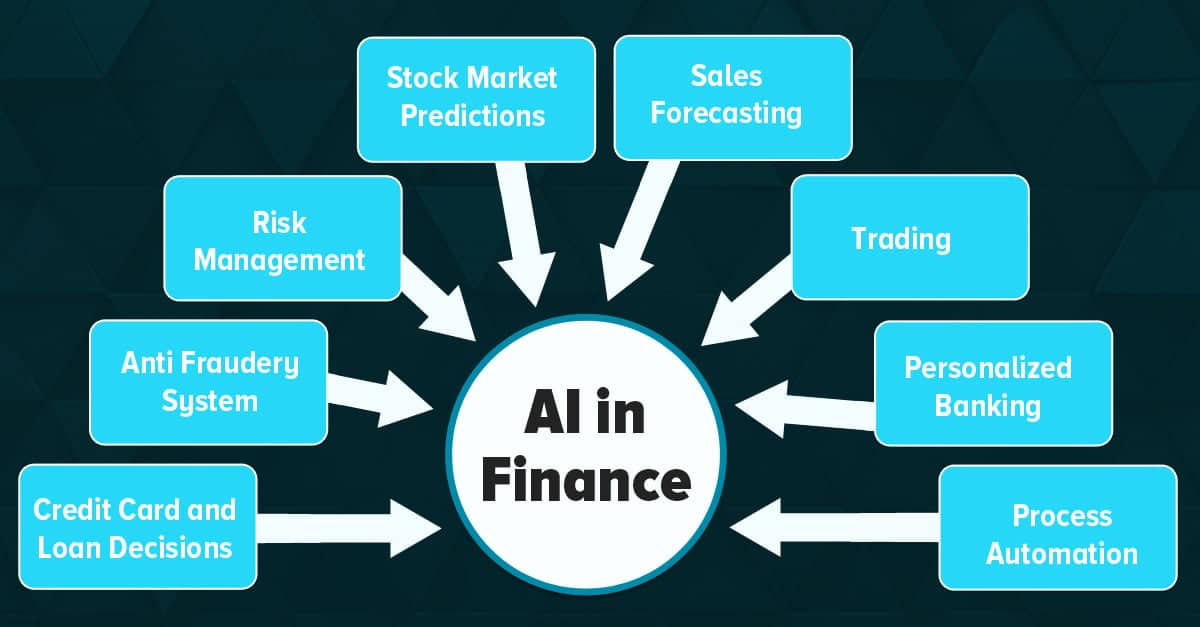
AI in finance leverages advanced algorithms and computational power to process vast datasets, identify patterns, and generate actionable insights. Financial institutions use AI for tasks such as algorithmic trading, fraud detection, credit risk assessment, and customer service automation. The integration of AI has led to increased efficiency, reduced operational costs, and improved accuracy in financial predictions.
Key AI technologies applied in finance include:
- Machine Learning (ML): Used for predictive analytics, customer segmentation, and anomaly detection.
- Natural Language Processing (NLP): Enables sentiment analysis, chatbots, and automated document processing.
- Deep Learning: Powers complex models like neural networks for high-frequency trading and risk modeling.
- Computer Vision: Applied in document verification, signature recognition, and fraud detection.
#History / Background
The use of AI in finance traces back to the 1980s with early applications in algorithmic trading and quantitative analysis. The development of expert systems and neural networks laid the foundation for modern AI-driven financial tools.
In the 1990s, financial institutions began adopting AI for risk management and fraud detection. The rise of big data in the 2000s accelerated AI adoption, enabling real-time data processing and predictive modeling. The 2010s saw a surge in AI applications, driven by advancements in deep learning and cloud computing.
Key milestones include:
- 1987: The first AI-based trading system, developed by Man Group.
- 2000: Introduction of AI-driven credit scoring models by FICO.
- 2012: Google’s DeepMind demonstrated AI’s potential in financial forecasting.
- 2016: JPMorgan Chase deployed AI for contract analysis, reducing processing time by 360,000 hours annually.
#How It Works
AI in finance operates through several core mechanisms:
#Data Collection and Processing
Financial institutions gather data from multiple sources, including transaction records, market feeds, customer interactions, and external datasets (e.g., economic indicators). AI systems preprocess this data to remove noise, handle missing values, and normalize formats for analysis.
#Model Training and Deployment
AI models are trained using historical data to recognize patterns and make predictions. Common techniques include:
- Supervised Learning: Used for classification (e.g., credit scoring) and regression (e.g., stock price prediction).
- Unsupervised Learning: Identifies clusters (e.g., customer segmentation) and anomalies (e.g., fraud detection).
- Reinforcement Learning: Optimizes trading strategies by learning from market feedback.
#Real-Time Analytics and Automation
AI systems process real-time data to generate insights and automate decisions. For example:
- Algorithmic Trading: AI models execute trades based on predefined criteria, adjusting to market conditions.
- Fraud Detection: Machine learning algorithms flag suspicious transactions by analyzing behavioral patterns.
- Customer Service: Chatbots and virtual assistants handle inquiries, reducing response times.
#Important Facts
- Efficiency Gains: AI reduces manual processing time by up to 70% in tasks like loan approvals and fraud detection.
- Cost Reduction: Financial institutions save billions annually by automating repetitive tasks.
- Accuracy Improvements: AI models achieve 90%+ accuracy in credit risk assessment and fraud detection.
- Regulatory Challenges: AI adoption in finance is subject to strict regulations, including GDPR and Basel III.
- Ethical Concerns: Bias in AI models can lead to discriminatory lending practices or unfair trading advantages.
#Timeline
Year Event 1987 First AI-based trading system developed by Man Group. 1995 FICO introduces AI-driven credit scoring models. 2006 IBM’s Watson begins research in financial AI applications. 2012 DeepMind demonstrates AI’s potential in financial forecasting. 2016 JPMorgan Chase deploys AI for contract analysis, saving 360,000 hours annually. 2018 European Union implements GDPR, impacting AI data usage in finance. 2020 AI adoption in finance accelerates due to COVID-19-driven digital transformation. 2023 Generative AI models like GPT-4 are tested for financial report generation.
#Related Terms
#FAQ
What does Beginner Guide To AI In Finance cover?
Introduces AI in finance for new readers, covering essential concepts, common examples, practical uses, and next steps for learning.
Why is Beginner Guide To AI In Finance important?
It helps readers understand key concepts, compare practical use cases, and evaluate how Business & Finance decisions affect outcomes, risks, and implementation choices.
What should readers verify before applying this topic?
Readers should compare the benefits, limitations, data requirements, and related themes such as Beginner Friendly, Finance, Financial Technology before using the ideas in real projects.
#References
- Beginner Guide To AI In Finance terminology and background research
- Beginner Guide To AI In Finance use cases, implementation examples, and limitations
- Business & Finance best practices, standards, and risk guidance
- Beginner Friendly case studies, benchmarks, and current industry analysis

.png)
Comments
No comments yet. Start the discussion with a useful note.