

#Short Answer
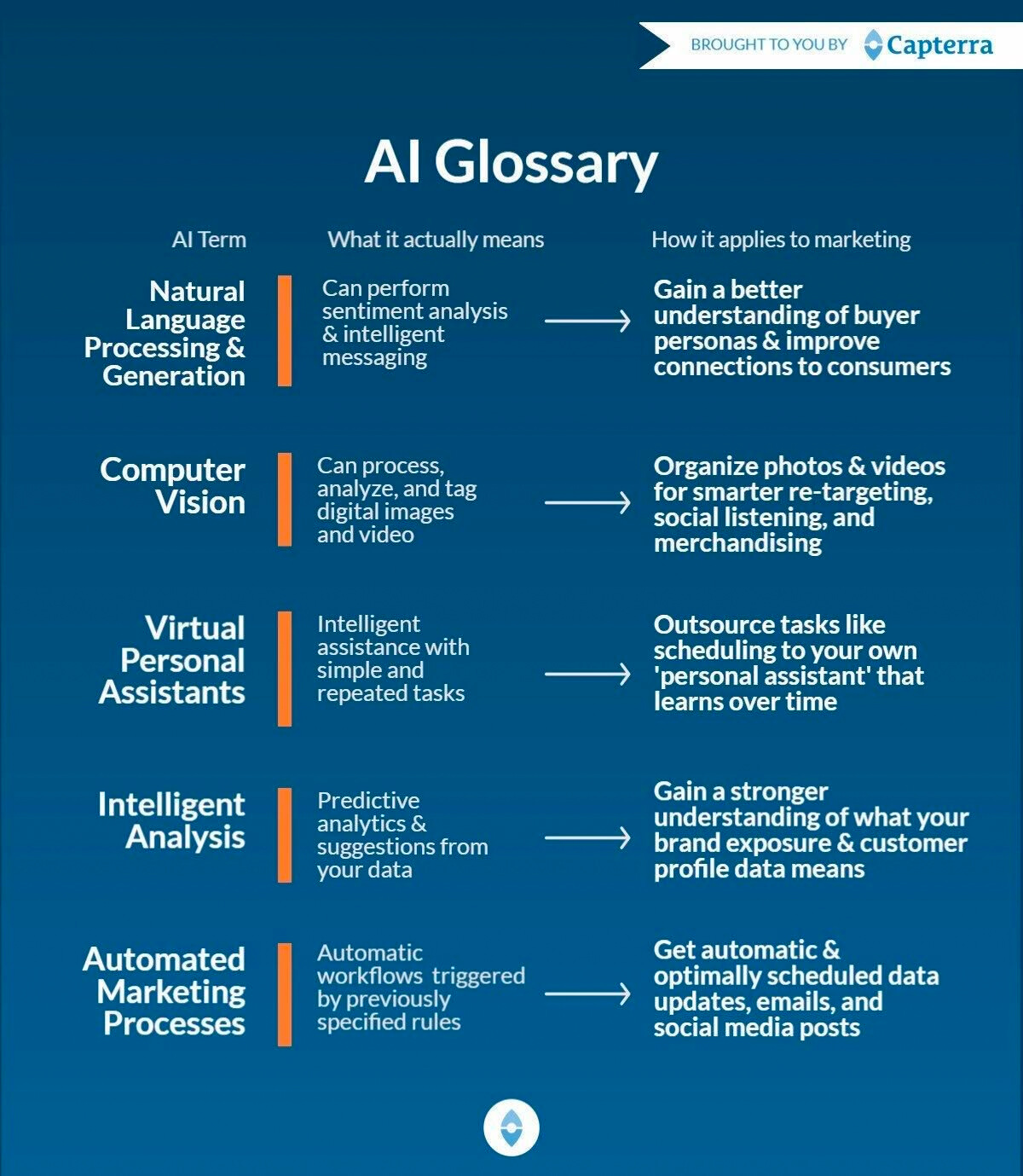
Artificial Intelligence (AI) has introduced a vast array of technical terms that can overwhelm newcomers. From algorithms to z-score normalization, the jargon often acts as a barrier to understanding AI’s capabilities and applications. This glossary aims to demystify essential AI terminology, providing clear definitions and context for foundational concepts.
#Infobox
#Overview
Artificial Intelligence (AI) has introduced a vast array of technical terms that can overwhelm newcomers. From algorithms to z-score normalization, the jargon often acts as a barrier to understanding AI’s capabilities and applications. This glossary aims to demystify essential AI terminology, providing clear definitions and context for foundational concepts.
AI jargon spans multiple domains, including machine learning, natural language processing, computer vision, and robotics. Terms like supervised learning, overfitting, and reinforcement learning are frequently encountered in discussions about AI models. Understanding these terms is crucial for grasping how AI systems learn, make decisions, and interact with data.
#History / Background
The evolution of AI jargon is closely tied to the development of artificial intelligence itself. The term artificial intelligence was coined in 1956 at the Dartmouth Conference, marking the formal beginning of AI as a field. Early AI research introduced terms like expert systems and heuristics, which were central to rule-based AI approaches.
As AI progressed, new paradigms emerged, each contributing to the lexicon. The 1980s and 1990s saw the rise of machine learning, popularized by algorithms like decision trees and support vector machines. The 2010s brought a surge in deep learning, fueled by advances in neural networks and computational power, introducing terms such as convolutional neural networks (CNNs) and recurrent neural networks (RNNs).
Today, AI jargon continues to expand with innovations like transformers, generative adversarial networks (GANs), and large language models (LLMs). The terminology reflects the field’s shift from symbolic AI to data-driven approaches, emphasizing statistical and probabilistic methods.
#How It Works
AI jargon operates within structured frameworks that define how AI systems process information and generate outputs. At its core, AI relies on algorithms, which are step-by-step instructions for solving problems. These algorithms are trained on datasets, collections of structured or unstructured data used to teach models.
Key processes include:
- Training: AI models learn patterns from data through supervised learning (labeled data), unsupervised learning (unlabeled data), or reinforcement learning (rewards-based feedback).
- Feature Extraction: Relevant attributes from raw data are identified and transformed into features, which the model uses for decision-making.
- Model Evaluation: Metrics like accuracy, precision, and recall assess performance. Techniques like cross-validation prevent overfitting, where a model memorizes training data instead of generalizing.
- Inference: Once trained, models apply learned patterns to new data, generating predictions or actions. Terms like inference speed and latency describe the efficiency of this process.
Understanding these mechanisms helps demystify how AI systems, such as chatbots or recommendation engines, function in real-world applications.
#Important Facts
- AI vs. Machine Learning: While AI is a broad field aiming to create intelligent machines, machine learning is a subset that uses data-driven techniques to enable systems to improve over time.
- Neural Networks: Inspired by the human brain, these models consist of interconnected neurons organized in layers. Deep learning uses multiple layers to process complex data, such as images or speech.
- Bias and Fairness: AI models can inherit biases from training data, leading to unfair outcomes. Terms like algorithmic bias and fairness metrics address these ethical concerns.
- Explainability: AI decisions are often opaque. Techniques like SHAP values and LIME aim to make models more interpretable.
- Hardware Acceleration: AI computations are resource-intensive. GPUs (Graphics Processing Units) and TPUs (Tensor Processing Units) are specialized hardware designed to speed up training and inference.
#Timeline
- Concept conceptualized
Initial research and foundations established for AI Jargon: A Glossary For Beginners.
- First integration
First successful deployment and testing phase of AI Jargon: A Glossary For Beginners in the industry.
- Global standards
Global standards are released for unified deployment and validation of AI Jargon: A Glossary For Beginners.
- Modern scaling
Widespread global adoption and real-time optimization of AI Jargon: A Glossary For Beginners networks.
#Related Terms
#FAQ
What does AI Jargon: A Glossary For Beginners cover?
AI jargon: a glossary for beginners covers practical examples, benefits, limitations, and important considerations for readers.
Why is AI Jargon: A Glossary For Beginners important?
It helps readers understand key concepts, compare practical use cases, and evaluate how Artificial Intelligence decisions affect outcomes, risks, and implementation choices.
What should readers verify before applying this topic?
Readers should compare the benefits, limitations, data requirements, and related themes such as Beginner Friendly, Jargon, Glossary before using the ideas in real projects.
#References
- AI Jargon: A Glossary For Beginners terminology and background research
- AI Jargon: A Glossary For Beginners use cases, implementation examples, and limitations
- Artificial Intelligence best practices, standards, and risk guidance
- Beginner Friendly case studies, benchmarks, and current industry analysis




Comments
No comments yet. Start the discussion with a useful note.