


#Short Answer
Explains how AI is applied in testing to support automated assessments, with examples, workflows, benefits, and adoption challenges.
#Infobox
Artificial Intelligence in Software Testing Field Software testing Subfield Automated testing Purpose Automated test case generation, execution, and analysis Key Technologies Machine learning, natural language processing, computer vision First Developed 1990s Major Contributors IBM, Microsoft, Google, Selenium, Appium Current Status Rapidly evolving with generative AI integration
#Overview
AI in testing represents a paradigm shift in software quality assurance (QA) by integrating intelligent algorithms to automate repetitive tasks, predict potential failures, and optimize test coverage. Unlike conventional automated testing tools that rely on predefined scripts, AI-powered testing systems can learn from past executions, recognize patterns, and make data-driven decisions. This evolution is particularly critical in agile and DevOps environments where continuous testing is essential.
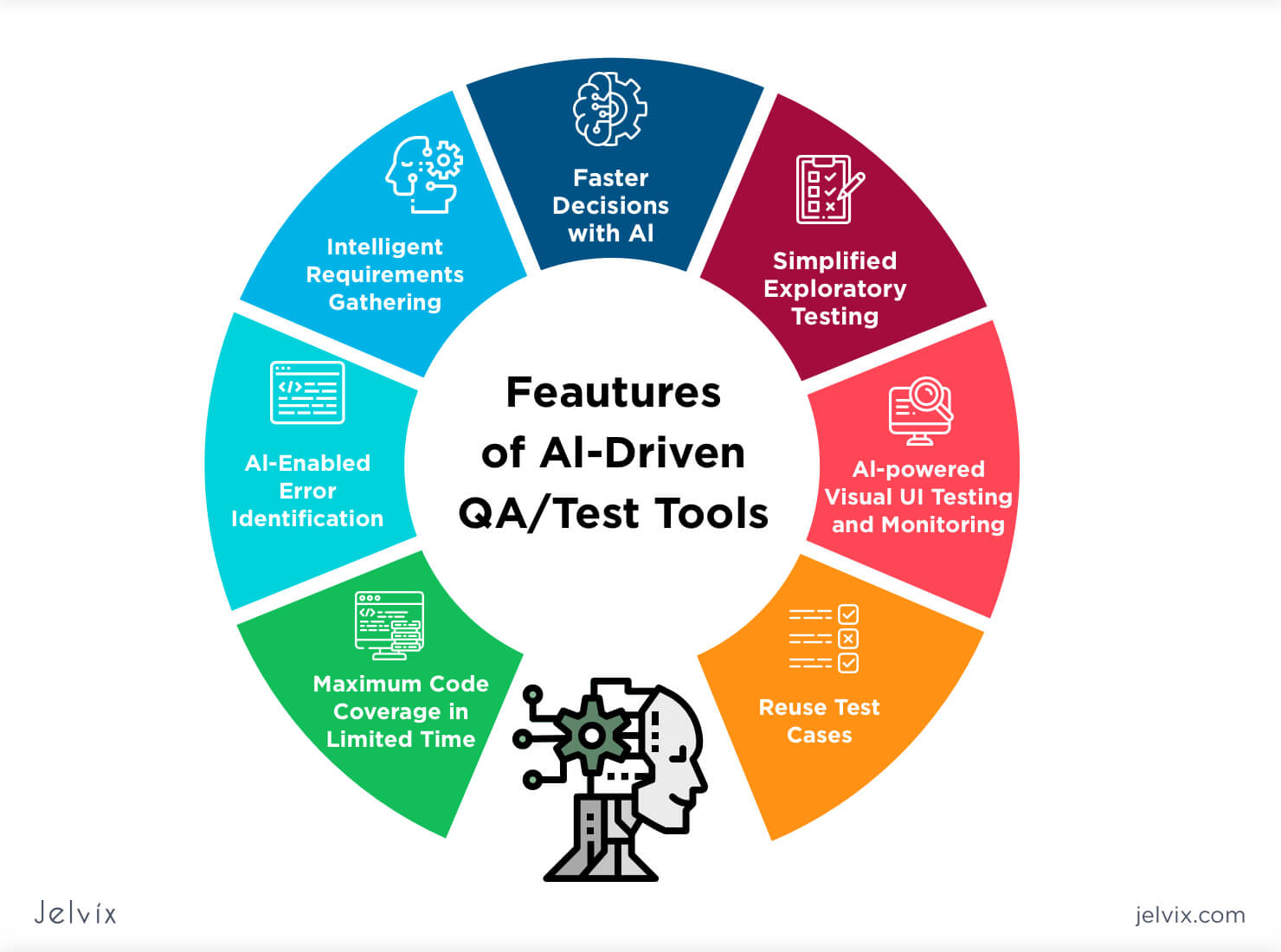
Key applications include test automation, defect prediction, self-healing test scripts, and intelligent test case prioritization. AI tools can also analyze user behavior data to simulate real-world scenarios, ensuring that software behaves as expected under diverse conditions. As AI technologies advance, their role in testing is expanding beyond mere automation to include autonomous testing agents capable of independently designing and executing test suites.
#History / Background
The integration of AI into software testing began in the late 1990s and early 2000s, coinciding with the rise of automated testing frameworks such as Selenium and JUnit. Early efforts focused on rule-based systems and simple pattern recognition to identify test failures. However, these approaches were limited by their inability to adapt to dynamic software environments.
By the 2010s, advancements in machine learning and natural language processing (NLP) enabled more sophisticated applications. Tools like Test.ai and Applitools emerged, leveraging computer vision to detect visual regressions in user interfaces. The introduction of deep learning further enhanced capabilities, allowing systems to analyze complex code structures and predict defects with higher accuracy.
In recent years, the proliferation of generative AI has revolutionized AI-driven testing. Models such as large language models (LLMs) can now generate human-like test cases from natural language requirements, reducing the dependency on manual scripting. Companies like Microsoft and Google have integrated AI into their testing pipelines, enabling continuous and autonomous testing workflows.
#How It Works
#AI-Powered Test Case Generation
AI systems generate test cases by analyzing software requirements, user stories, or existing codebases. Natural language processing (NLP) models parse textual descriptions to identify key functionalities and edge cases. For example, an AI tool might convert a requirement like "The login page should validate email formats" into multiple test scenarios covering valid, invalid, and edge-case email inputs.
Generative AI models, such as transformer-based architectures, can produce diverse test inputs by understanding contextual relationships in the input data. These models are trained on vast repositories of test cases, enabling them to mimic human-like test design patterns.
#Self-Healing Test Scripts
Traditional automated tests often break when the application undergoes minor changes, such as modified element locators (e.g., IDs or XPath). AI-driven testing tools use machine learning to dynamically adjust test scripts in response to such changes. For instance, if a button’s ID is updated, the AI system can recognize the new identifier and update the test script accordingly without manual intervention.
Computer vision is another critical component in self-healing scripts. Tools like Applitools use image recognition to identify UI elements visually, making tests resilient to changes in the underlying code structure.
#Defect Prediction and Analysis
AI models analyze historical test data, code changes, and bug reports to predict potential defects before they occur. Techniques such as anomaly detection and pattern recognition help identify areas of the codebase that are prone to failures. For example, if a specific module has a high defect rate in past releases, the AI system can flag it for additional testing in the current cycle.
Additionally, AI tools can analyze test execution logs to pinpoint root causes of failures, reducing the time spent on debugging. Natural language processing is used to extract meaningful insights from unstructured data, such as developer comments or support tickets, further enhancing defect prediction accuracy.
#Autonomous Test Execution
AI-driven testing platforms can autonomously execute test suites, prioritize test cases based on risk, and dynamically adjust test coverage. Reinforcement learning algorithms optimize the testing process by learning from past executions and adapting to new software changes. This autonomy is particularly valuable in continuous integration/continuous deployment (CI/CD) pipelines, where rapid feedback is essential.
Some advanced systems can even simulate user interactions in real-time, generating synthetic user data to test applications under realistic conditions. This approach is useful for validating performance, security, and usability aspects of software.
#Important Facts
- Efficiency Gains: AI-powered testing can reduce test execution time by up to 80% compared to traditional methods, according to studies by IBM and Microsoft.
- Cost Reduction: Automating repetitive testing tasks with AI lowers labor costs and minimizes human errors, leading to significant cost savings in QA budgets.
- Improved Accuracy: AI systems can detect subtle defects that human testers might overlook, such as visual inconsistencies or performance bottlenecks.
- Scalability: AI-driven testing scales effortlessly with the size and complexity of software projects, making it ideal for large-scale enterprise applications.
- Integration with CI/CD: AI tools seamlessly integrate with CI/CD pipelines, enabling continuous testing and faster release cycles.
- Challenges: Despite its advantages, AI in testing faces challenges such as high initial setup costs, the need for quality training data, and ethical concerns around autonomous decision-making.
#Timeline
Year Milestone 1990s Early automated testing frameworks like Selenium and JUnit emerge; initial AI applications focus on rule-based test case generation. 2000s Machine learning techniques are introduced to improve test case prioritization and defect prediction. 2010 Applitools launches, pioneering AI-driven visual testing with computer vision. 2015 Test.ai is founded, leveraging AI to automate mobile app testing. 2018 Google introduces AI-powered test automation in its CI/CD pipelines, reducing manual testing efforts by 50%. 2020 Generative AI models begin to generate test cases from natural language requirements. 2022 Microsoft integrates AI into Azure DevOps for autonomous test execution and defect prediction. 2023 Advancements in large language models enable fully autonomous test design and execution in some use cases.
#Related Terms
#FAQ
What does AI In Testing: Automated Assessments cover?
Explains how AI is applied in testing to support automated assessments, with examples, workflows, benefits, and adoption challenges.
Why is AI In Testing: Automated Assessments important?
It helps readers understand key concepts, compare practical use cases, and evaluate how Artificial Intelligence decisions affect outcomes, risks, and implementation choices.
What should readers verify before applying this topic?
Readers should compare the benefits, limitations, data requirements, and related themes such as Testing, Automated, Assessment before using the ideas in real projects.
#References
- AI In Testing: Automated Assessments terminology and background research
- AI In Testing: Automated Assessments use cases, implementation examples, and limitations
- Artificial Intelligence best practices, standards, and risk guidance
- Testing case studies, benchmarks, and current industry analysis
.png)


Comments
No comments yet. Start the discussion with a useful note.