

#Short Answer
Explains how artificial intelligence is changing healthcare myths debunked, with examples, trends, benefits, limitations, and implementation concerns.
#Infobox
AI in Healthcare: Myths and Facts Field Healthcare Focus Artificial intelligence applications in medical diagnosis, treatment, and management Key Technologies Machine learning, deep learning, natural language processing, computer vision Common Myths AI replaces doctors, AI is error-free, AI lacks transparency, AI is only for large hospitals Notable Applications Radiology, drug discovery, personalized medicine, robotic surgery, predictive analytics
#Overview
AI in healthcare leverages algorithms and computational models to analyze medical data, assist in clinical decision-making, and improve patient outcomes. Unlike traditional software, AI systems learn from data patterns, enabling them to identify trends invisible to human observers. Applications span from medical imaging analysis to predictive analytics for disease outbreaks. The integration of AI aims to reduce human error, optimize resource allocation, and democratize access to advanced medical care.
Despite its potential, AI adoption faces challenges, including data privacy concerns, algorithmic bias, and regulatory hurdles. Healthcare providers must balance innovation with ethical considerations, ensuring AI tools augment rather than replace human judgment.
#Key Myths Debunked
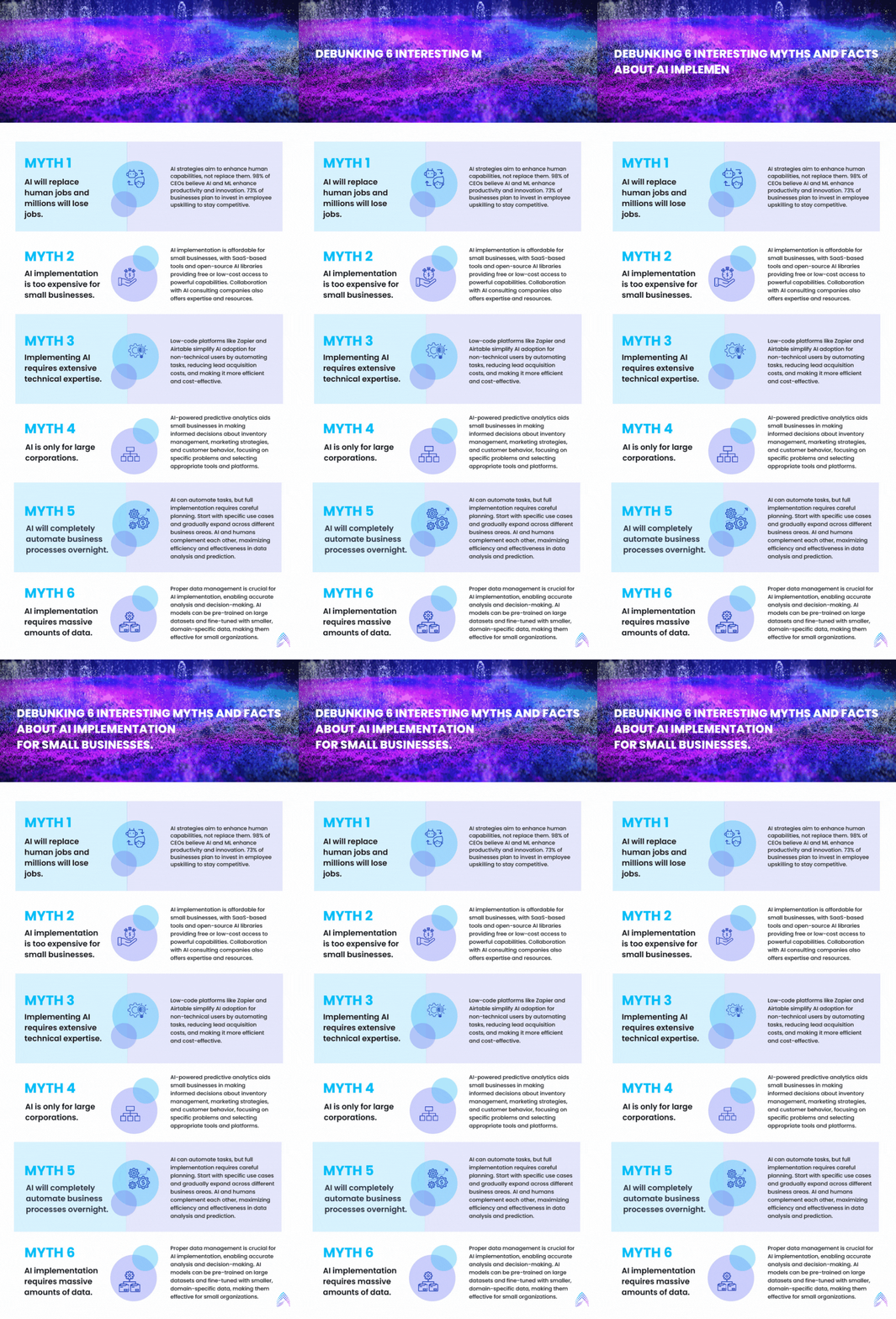
- Myth 1: AI replaces doctors. Reality: AI serves as a decision-support tool, handling repetitive tasks like image analysis while physicians focus on complex diagnostics and patient care.
- Myth 2: AI is error-free. Reality: AI systems depend on training data quality; biases in datasets can lead to inaccurate predictions, necessitating human oversight.
- Myth 3: AI is only for large hospitals. Reality: Cloud-based AI solutions and open-source tools make advanced analytics accessible to small clinics and rural providers.
- Myth 4: AI lacks transparency. Reality: Explainable AI (XAI) techniques, such as SHAP values and LIME, provide interpretable outputs, fostering trust among clinicians.
#History / Background
The concept of AI in healthcare dates to the 1970s with early expert systems like MYCIN, designed to diagnose bacterial infections. The field stagnated until the 2010s, when advancements in machine learning and computational power reignited interest. Landmark milestones include:
- 2012: Google’s deep learning algorithm outperformed humans in identifying breast cancer in mammograms.
- 2016: IBM Watson gained prominence for its oncology-focused AI, though later faced criticism for overpromising.
- 2018: The FDA approved the first AI-powered medical device, IDx-DR, for diabetic retinopathy screening.
- 2020: AI models like DeepMind’s AlphaFold revolutionized protein folding predictions, accelerating drug discovery.
Regulatory frameworks, such as the FDA’s SaMD guidelines, evolved to address AI’s unique challenges, distinguishing it from traditional software.
#How It Works
#Core Technologies
Machine learning (ML) Algorithms that improve with data exposure, used for tasks like predicting patient readmissions or drug interactions. Deep learning A subset of ML using neural networks to process unstructured data (e.g., medical images, clinical notes). Natural language processing (NLP) Enables AI to extract insights from physician notes, research papers, and patient records (e.g., IBM Watson for Oncology). Computer vision Analyzes visual data (X-rays, MRIs) to detect abnormalities with precision comparable to radiologists. ### Data Requirements
AI systems require high-quality, diverse datasets for training. Challenges include:
- Data silos: Fragmented electronic health records (EHRs) hinder interoperability.
- Bias: Underrepresented demographics in datasets can skew results (e.g., skin cancer detection in darker skin tones).
- Privacy: HIPAA and GDPR compliance necessitates anonymization techniques like federated learning.
#Implementation Models
- Assistive: AI augments human tasks (e.g., radiology triage).
- Autonomous: AI performs tasks independently (e.g., robotic surgery systems like da Vinci).
- Predictive: AI forecasts outcomes (e.g., sepsis risk in ICU patients).
#Important Facts
Fact Description Accuracy AI achieves 90–95% accuracy in detecting lung cancer nodules in CT scans, rivaling radiologists. Cost Reduction AI-driven drug discovery reduces R&D costs by up to 70% by prioritizing viable compounds. Global Adoption Over 30% of healthcare providers worldwide use AI for administrative or clinical tasks (2023 data). Regulation The EU’s AI Act classifies high-risk AI systems (e.g., medical diagnostics) under strict oversight.
#Timeline
Year Event 1970s MYCIN expert system for bacterial infection diagnosis. 2012 Google’s deep learning algorithm outperforms humans in mammogram analysis. 2016 IBM Watson for Oncology debuts in hospitals. 2018 FDA approves IDx-DR for diabetic retinopathy screening. 2020 DeepMind’s AlphaFold predicts protein structures with unprecedented accuracy. 2022 Microsoft’s AI tool for multiple sclerosis progression prediction gains FDA clearance. 2023 AI-driven personalized medicine platforms enter mainstream clinical trials.
#Related Terms
#FAQ
What does AI In Healthcare Myths Debunked cover?
Explains how artificial intelligence is changing healthcare myths debunked, with examples, trends, benefits, limitations, and implementation concerns.
Why is AI In Healthcare Myths Debunked important?
It helps readers understand key concepts, compare practical use cases, and evaluate how Healthcare AI decisions affect outcomes, risks, and implementation choices.
What should readers verify before applying this topic?
Readers should compare the benefits, limitations, data requirements, and related themes such as Myth Busting, Healthcare, Myth before using the ideas in real projects.
#References
- AI In Healthcare Myths Debunked terminology and background research
- AI In Healthcare Myths Debunked use cases, implementation examples, and limitations
- Healthcare AI best practices, standards, and risk guidance
- Myth Busting case studies, benchmarks, and current industry analysis

Comments
No comments yet. Start the discussion with a useful note.