

#Short Answer
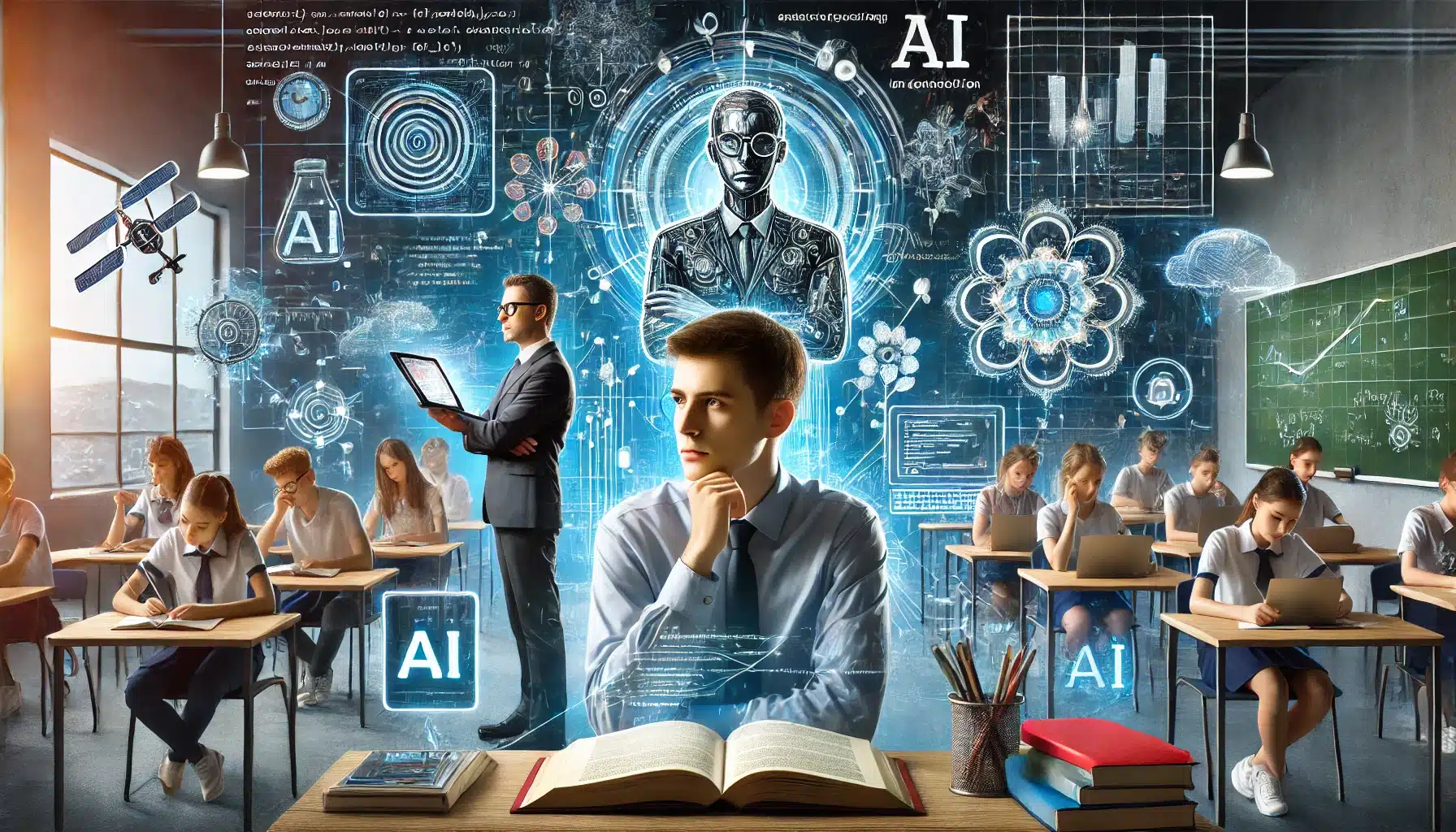
Explains how AI is applied in education to support revolution or risk, with examples, workflows, benefits, and adoption challenges.
#Infobox
Artificial Intelligence in Education Short Answer Artificial Intelligence (AI) in education is transforming learning through personalized instruction, adaptive assessments, and administrative automation, but raises concerns about data privacy, equity, and over-reliance on technology. Focus Personalized learning, adaptive systems, automation, ethical considerations Key Figures Seymour Papert, Sugata Mitra, Rose Luckin Notable Projects Duolingo, Khan Academy, Coursera, Socratic Impact Improved engagement, accessibility, efficiency; concerns over bias and job displacement
#Overview
Artificial Intelligence (AI) in education refers to the integration of machine learning, natural language processing, and data analytics into educational systems to enhance teaching, learning, and administrative processes. AI-powered tools analyze student performance, tailor content to individual needs, automate grading, and provide real-time feedback, fostering a more adaptive and inclusive learning environment. While AI promises to democratize education by making it more accessible and personalized, it also introduces ethical dilemmas, including data privacy risks, algorithmic bias, and the potential erosion of human interaction in pedagogy.
#History / Background
The concept of AI in education dates back to the 1950s, with early experiments in computer-assisted instruction (CAI). In 1956, the term "artificial intelligence" was coined at Dartmouth College, marking the beginning of AI research. By the 1970s, AI systems like SCHOLAR, a computer-based tutoring system, demonstrated the potential for AI to simulate human tutoring. The 1980s and 1990s saw the rise of intelligent tutoring systems (ITS), such as Cognitive Tutor, which used AI to adapt to student learning patterns.
The 21st century brought exponential growth in AI applications, fueled by advances in big data, cloud computing, and deep learning. Projects like Khan Academy and Duolingo leveraged AI to personalize learning experiences, while platforms like Coursera and edX used AI to recommend courses and assess student submissions. The COVID-19 pandemic accelerated AI adoption, as remote learning necessitated scalable, automated solutions for engagement and assessment.
#How It Works
#Personalized Learning
AI systems analyze student data—such as performance metrics, learning styles, and behavioral patterns—to create customized learning paths. Adaptive learning platforms, like DreamBox and Smart Sparrow, adjust difficulty levels in real-time, ensuring that students receive content tailored to their proficiency. Natural language processing (NLP) enables chatbots and virtual assistants, such as Socratic and Grammarly, to provide instant feedback on assignments and answer student queries.
#Automated Assessment
AI automates grading for multiple-choice and short-answer questions, reducing teacher workload. Tools like Turnitin use AI to detect plagiarism, while Gradescope employs machine learning to evaluate handwritten responses and coding assignments. Automated essay scoring (AES) systems, such as those used by Pearson, analyze writing quality, coherence, and structure, though they remain controversial due to concerns about subjectivity and bias.
#Administrative Automation
AI streamlines administrative tasks, including scheduling, resource allocation, and student support. Chatbots handle routine inquiries about enrollment, deadlines, and financial aid, while predictive analytics identify at-risk students by analyzing attendance, grades, and engagement metrics. Institutions like Georgia State University have used AI-driven early alert systems to improve retention rates by 22%.
#Content Creation and Curation
AI generates educational content, such as quizzes, lesson plans, and even entire courses. Tools like Content Technologies Inc. use NLP to create textbooks, while platforms like Joule (by OpenStax) curate open educational resources (OER) based on student needs. AI also powers language translation services, breaking down linguistic barriers in global education.
#Important Facts
- Market Growth: The global AI in education market is projected to reach $6 billion by 2024, growing at a CAGR of 47% from 2019 to 2024.
- Student Engagement: AI-driven platforms like Duolingo report a 30% increase in user retention compared to traditional methods.
- Bias in Algorithms: Studies have shown that AI grading systems can exhibit racial and gender biases, favoring certain dialects or writing styles.
- Accessibility: AI tools like Microsoft Immersive Reader assist students with dyslexia by adjusting text spacing and providing audio support.
- Teacher Concerns: A 2023 survey found that 68% of educators worry about over-reliance on AI, fearing it may reduce critical thinking skills.
#Timeline
Year Event 1956 Dartmouth Conference coins the term "artificial intelligence"; early AI research begins. 1970 Development of SCHOLAR, the first AI-based tutoring system. 1984 Introduction of Cognitive Tutor, an intelligent tutoring system for mathematics. 1997 IBM's Deep Blue defeats world chess champion Garry Kasparov, showcasing AI's potential. 2011 IBM's Watson wins Jeopardy!, demonstrating advanced natural language processing. 2012 Launch of Khan Academy, popularizing AI-driven personalized learning. 2016 Google's DeepMind develops AI that can play Atari games and later beats human champions in Go. 2020 COVID-19 pandemic accelerates AI adoption in remote learning, with platforms like Zoom integrating AI for transcription and translation. 2023 OpenAI's ChatGPT and Google's Bard spark debates about AI's role in education, including concerns over academic integrity.
#Related Terms
#FAQ
What does AI In Education: Revolution Or Risk? cover?
Explains how AI is applied in education to support revolution or risk, with examples, workflows, benefits, and adoption challenges.
Why is AI In Education: Revolution Or Risk? important?
It helps readers understand key concepts, compare practical use cases, and evaluate how Education & Careers decisions affect outcomes, risks, and implementation choices.
What should readers verify before applying this topic?
Readers should compare the benefits, limitations, data requirements, and related themes such as Education, Revolution, Risk before using the ideas in real projects.
#References
- AI In Education: Revolution Or Risk? terminology and background research
- AI In Education: Revolution Or Risk? use cases, implementation examples, and limitations
- Education & Careers best practices, standards, and risk guidance
- Education case studies, benchmarks, and current industry analysis



Comments
No comments yet. Start the discussion with a useful note.