

#Short Answer
AI failures in business often stem from misaligned expectations, poor data quality, lack of domain expertise, and inadequate governance frameworks. These failures highlight the importance of robust testing, ethical considerations, and continuous monitoring to ensure reliable and responsible AI deployment.
#Infobox
#Overview
Artificial Intelligence (AI) has transformed industries by automating processes, enhancing decision-making, and driving innovation. However, its integration into business operations is not without challenges. AI failures—defined as instances where AI systems underperform, produce erroneous results, or fail to meet business objectives—have become a critical concern for organizations across sectors. These failures can lead to financial losses, reputational damage, and even legal repercussions.
Common manifestations of AI failures include biased algorithms, poor data quality, lack of interpretability, and misalignment with business goals. For instance, AI systems deployed in hiring processes have been criticized for perpetuating gender or racial biases, while autonomous vehicles have faced scrutiny due to safety concerns. Understanding the root causes of these failures is essential for developing robust AI strategies that mitigate risks and maximize benefits.
#How It Works
#How AI Failures Occur
#Root Causes
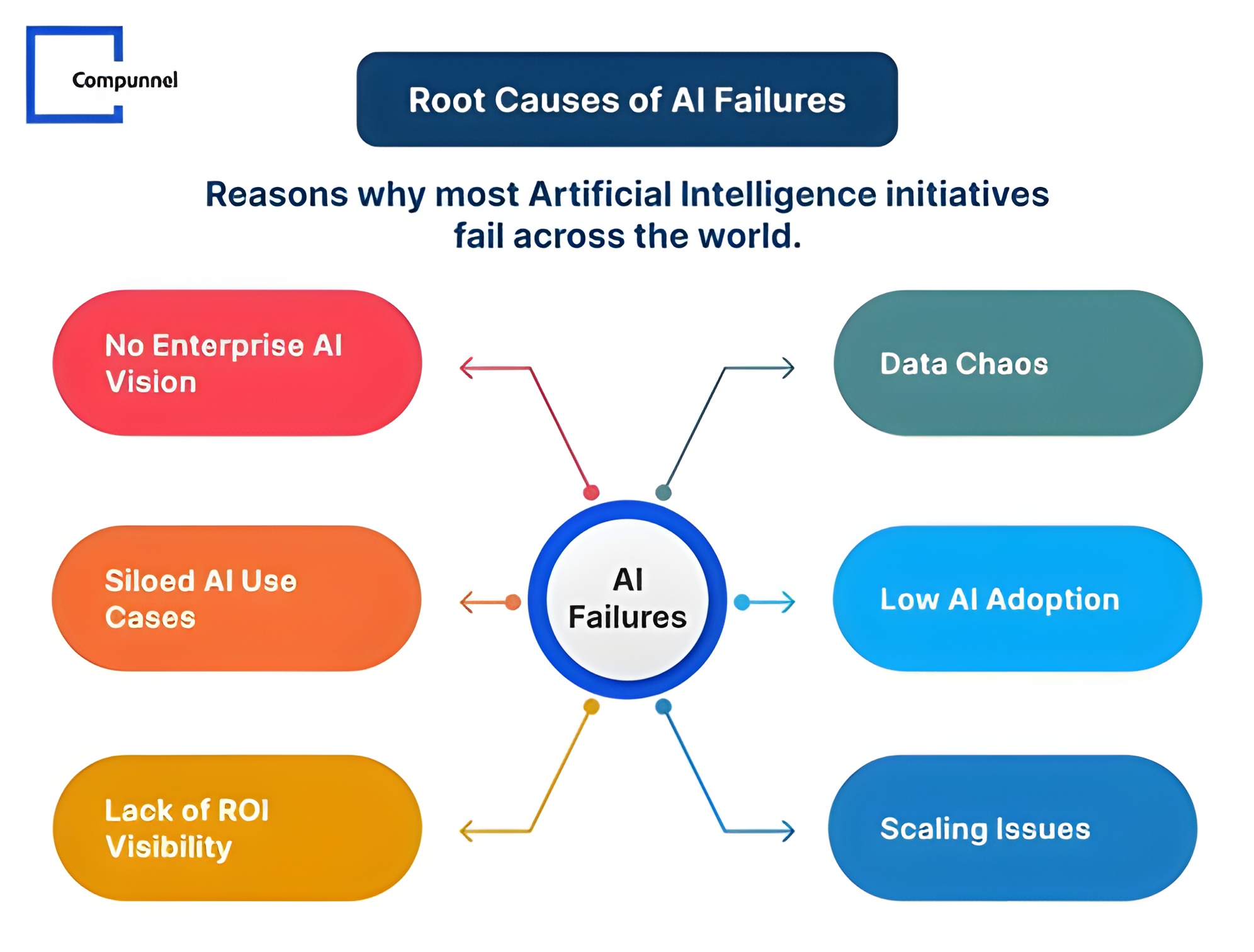
AI failures typically arise from one or more of the following root causes:
- Poor Data Quality: AI systems rely on high-quality data. If the input data is incomplete, biased, or outdated, the AI model will produce inaccurate or unfair results. For example, an AI system trained on biased historical hiring data may replicate those biases in its recommendations.
- Misaligned Goals: AI projects often fail when they are not aligned with business objectives. For instance, deploying an AI chatbot for customer service without clear performance metrics or user expectations can lead to poor customer satisfaction.
- Lack of Domain Expertise: AI models require input from domain experts to ensure they address real-world problems. Without this expertise, models may be trained on irrelevant features or fail to account for industry-specific nuances.
- Inadequate Testing and Validation: AI systems must undergo rigorous testing to identify vulnerabilities, biases, and edge cases. Skipping this step can result in catastrophic failures, such as an autonomous vehicle misclassifying a pedestrian.
- Ethical and Legal Risks: AI failures can also stem from ethical lapses, such as privacy violations or discriminatory practices. For example, facial recognition systems have been criticized for disproportionately misidentifying individuals from minority groups.
#Common Types of AI Failures
AI failures can be categorized based on their nature and impact:
- Technical Failures: These include model drift, where the AI's performance degrades over time due to changing data patterns, and overfitting, where the model performs well on training data but poorly on real-world data.
- Operational Failures: These occur when AI systems fail to integrate seamlessly into existing workflows, leading to inefficiencies or user frustration. For example, an AI-powered inventory management system that disrupts warehouse operations.
- Ethical Failures: These involve AI systems that produce biased, discriminatory, or harmful outcomes. A notable example is COMPAS, a risk assessment tool used in the U.S. criminal justice system, which was found to be biased against African American defendants.
- Regulatory Failures: AI systems that violate data protection laws, such as GDPR or CCPA, can result in legal penalties and reputational damage. For instance, a company using AI to process personal data without proper consent may face fines.
#Important Facts
- AI Failure Rate: Studies suggest that up to 50% of AI projects fail to deliver their intended value, with many never making it to production. This high failure rate is often attributed to poor planning, lack of expertise, and unrealistic expectations.
- Cost of AI Failures: The financial impact of AI failures can be substantial. For example, IBM's Watson for Oncology, an AI system designed to assist in cancer treatment, was discontinued in 2022 after failing to meet clinical expectations, resulting in significant losses.
- Bias in AI: A 2020 study by the AI Now Institute found that 80% of AI systems deployed in hiring processes exhibited some form of bias, highlighting the need for diverse training data and fairness-aware algorithms.
- Regulatory Scrutiny: Governments worldwide are tightening regulations around AI. The EU's AI Act, for instance, classifies AI systems into risk categories and imposes strict requirements on high-risk applications, such as facial recognition and autonomous vehicles.
- Human-AI Collaboration: The most successful AI deployments involve a collaborative approach, where humans oversee and guide AI systems. This hybrid model ensures that AI augments human decision-making rather than replacing it entirely.
#Timeline
- Concept conceptualized
Initial research and foundations established for AI Failures: Lessons Learned.
- First integration
First successful deployment and testing phase of AI Failures: Lessons Learned in the industry.
- Global standards
Global standards are released for unified deployment and validation of AI Failures: Lessons Learned.
- Modern scaling
Widespread global adoption and real-time optimization of AI Failures: Lessons Learned networks.
#Related Terms
#FAQ
What does AI Failures: Lessons Learned cover?
AI failures: lessons learned covers practical examples, benefits, limitations, and important considerations for readers.
Why is AI Failures: Lessons Learned important?
It helps readers understand key concepts, compare practical use cases, and evaluate how Artificial Intelligence decisions affect outcomes, risks, and implementation choices.
What should readers verify before applying this topic?
Readers should compare the benefits, limitations, data requirements, and related themes such as Failure, Lesson, Learned before using the ideas in real projects.
#References
- AI Failures: Lessons Learned terminology and background research
- AI Failures: Lessons Learned use cases, implementation examples, and limitations
- Artificial Intelligence best practices, standards, and risk guidance
- Failure case studies, benchmarks, and current industry analysis



Comments
No comments yet. Start the discussion with a useful note.