

#Short Answer
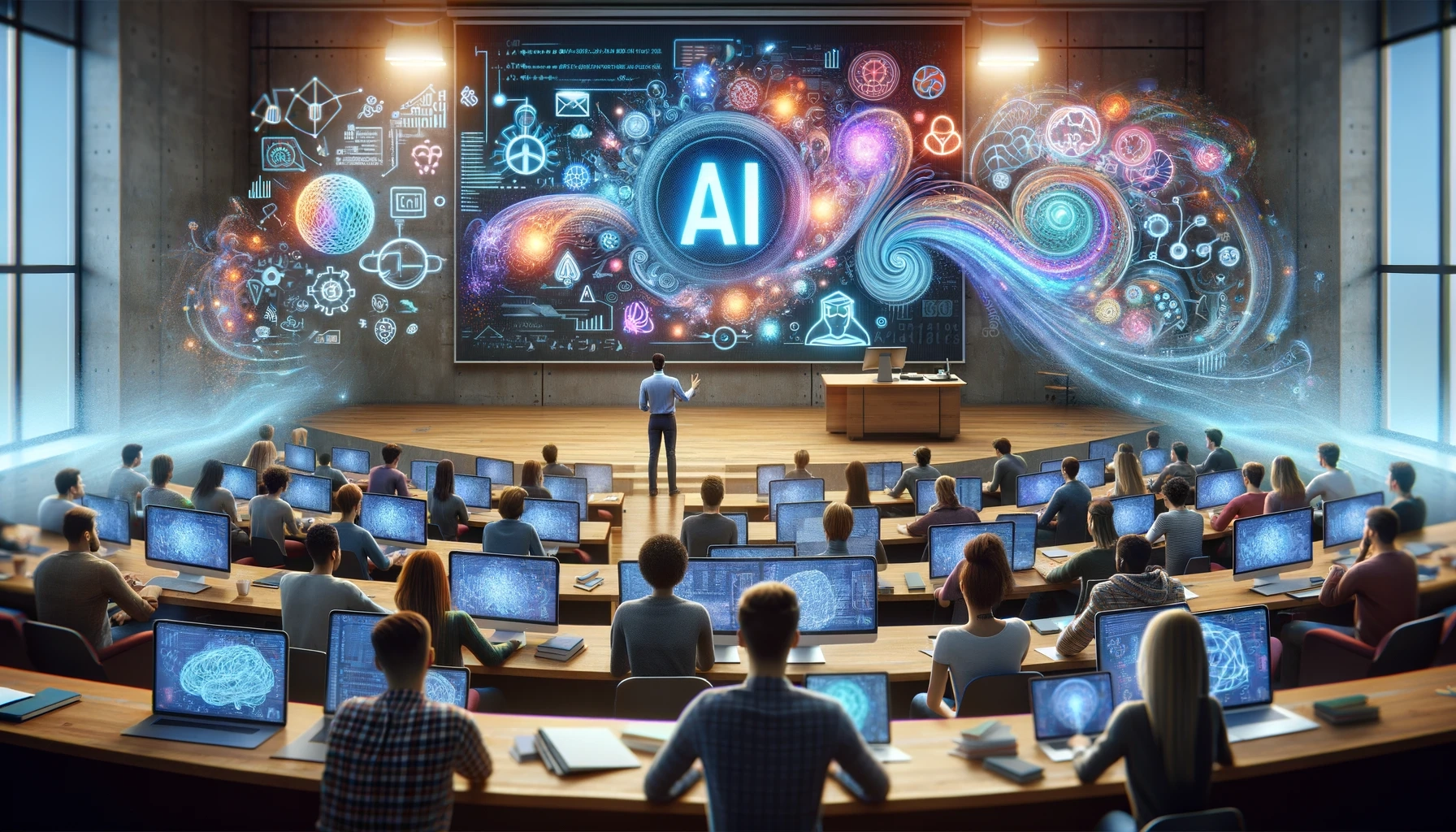
Explores how artificial intelligence shapes universities and research and teaching, covering practical use cases, benefits, limitations, and risks.
#Infobox
Artificial intelligence (AI) is transforming higher education through enhanced research capabilities, personalized learning, and administrative efficiency in universities worldwide.
Artificial Intelligence in Universities Field Education Key Applications Research acceleration, personalized learning, administrative automation, AI-driven tutoring Major Institutions Massachusetts Institute of Technology (MIT), Stanford University, University of Oxford, Tsinghua University Notable AI Tools IBM Watson, Google DeepMind, Coursera, Khan Academy Impact on Curriculum New AI-focused degrees, interdisciplinary programs, ethics courses Challenges Data privacy, algorithmic bias, faculty adaptation, equitable access
#Overview
Artificial intelligence in universities refers to the integration of AI technologies into academic research, teaching methodologies, and institutional operations. AI systems are increasingly employed to analyze vast datasets, personalize learning experiences, automate administrative tasks, and enhance decision-making processes. This integration spans disciplines, from computer science and engineering to humanities and social sciences, fostering interdisciplinary collaboration and innovation.
The adoption of AI in higher education is driven by the need to improve educational outcomes, increase accessibility, and address challenges such as rising student enrollment and resource constraints. Universities are leveraging AI to create adaptive learning platforms, develop intelligent tutoring systems, and optimize campus management through predictive analytics. Additionally, AI is playing a pivotal role in accelerating scientific research by enabling faster data processing, hypothesis testing, and discovery in fields such as genomics, climate science, and materials engineering.
#History / Background
The concept of AI in education dates back to the mid-20th century, with early experiments in computer-assisted instruction during the 1960s. One of the first notable examples was PLATO, a computer-assisted instruction system developed at the University of Illinois. However, the practical application of AI in universities remained limited due to technological constraints and high computational costs.
The 1980s and 1990s saw the emergence of intelligent tutoring systems (ITS), such as Cognitive Tutor, which used AI to provide personalized feedback to students. These systems laid the groundwork for modern adaptive learning platforms. The 2000s witnessed significant advancements in machine learning and natural language processing, enabling the development of more sophisticated AI tools for education.
The 2010s marked a turning point with the proliferation of big data, cloud computing, and open-source AI frameworks. Universities began incorporating AI into their curricula, offering courses on machine learning, data science, and AI ethics. Institutions such as MIT and Stanford launched dedicated AI research centers, while platforms like Coursera and edX integrated AI-driven personalized learning features. The COVID-19 pandemic further accelerated AI adoption, as universities sought to enhance remote learning and virtual collaboration.
#How It Works
AI in universities operates through a combination of algorithms, data processing techniques, and human-computer interaction models. The core components include:
- Machine Learning (ML): AI systems use ML algorithms to analyze large datasets, identify patterns, and make predictions. In education, ML is employed to tailor learning experiences to individual student needs by analyzing performance data and adapting content accordingly.
- Natural Language Processing (NLP): NLP enables AI systems to understand, interpret, and generate human language. This technology powers chatbots, virtual assistants, and automated grading systems, facilitating real-time interaction and feedback.
- Computer Vision: AI-driven computer vision is used in applications such as automated proctoring, lecture transcription, and image-based research analysis. For example, AI can analyze microscopic images in biology or detect anomalies in engineering designs.
- Predictive Analytics: Universities use predictive models to forecast student performance, identify at-risk students, and optimize resource allocation. These models analyze historical data, including grades, attendance, and engagement metrics, to provide actionable insights.
- Robotics and Automation: AI-powered robots assist in administrative tasks, such as grading assignments, managing libraries, and even delivering lectures in hybrid learning environments.
AI systems in universities are typically integrated into existing digital infrastructure, such as learning management systems (LMS) like Moodle or Canvas. These systems collect and process data from various sources, including student interactions, research outputs, and institutional records, to deliver personalized and efficient services.
#Important Facts
- As of 2023, over 60% of universities worldwide have integrated AI tools into their teaching or administrative processes.
- The global AI in education market is projected to reach USD 25.7 billion by 2027, growing at a compound annual growth rate (CAGR) of 36.5%.
- AI-powered adaptive learning platforms can increase student retention rates by up to 30% compared to traditional teaching methods.
- Universities are increasingly offering AI-focused degrees, with over 1,500 programs worldwide as of 2023.
- AI is being used to analyze research papers and identify potential collaborations, accelerating scientific discovery.
- Concerns about AI bias have led to the development of ethical guidelines for AI use in education, such as those proposed by the European Commission.
- AI-driven chatbots, such as Georgia State University’s "Pounce," have reduced summer melt (students not enrolling after admission) by 22%.
#Timeline
Year Event 1960 Development of PLATO, an early computer-assisted instruction system at the University of Illinois. 1984 Introduction of the first intelligent tutoring system, Cognitive Tutor, at Carnegie Mellon University. 2006 Launch of Khan Academy, an AI-driven online learning platform. 2011 IBM Watson wins Jeopardy!, demonstrating the potential of AI in natural language processing and decision-making. 2016 Stanford University launches the Stanford AI Lab (SAIL) to advance AI research and education. 2018 MIT announces the MIT Schwarzman College of Computing, a $1 billion initiative to integrate AI and computing into all disciplines. 2020 COVID-19 pandemic accelerates AI adoption in universities, with a 400% increase in the use of AI-powered remote learning tools. 2022 Over 1,000 universities worldwide offer AI-related courses or degrees. 2023 AI-generated content becomes a standard feature in many university LMS platforms, enabling personalized feedback and automated grading.
#Related Terms
#FAQ
What does AI And Universities: Research And Teaching cover?
Explores how artificial intelligence shapes universities and research and teaching, covering practical use cases, benefits, limitations, and risks.
Why is AI And Universities: Research And Teaching important?
It helps readers understand key concepts, compare practical use cases, and evaluate how Education & Careers decisions affect outcomes, risks, and implementation choices.
What should readers verify before applying this topic?
Readers should compare the benefits, limitations, data requirements, and related themes such as Universitie, Research, Teaching before using the ideas in real projects.
#References
- AI And Universities: Research And Teaching terminology and background research
- AI And Universities: Research And Teaching use cases, implementation examples, and limitations
- Education & Careers best practices, standards, and risk guidance
- Universitie case studies, benchmarks, and current industry analysis



Comments
No comments yet. Start the discussion with a useful note.