

#Short Answer
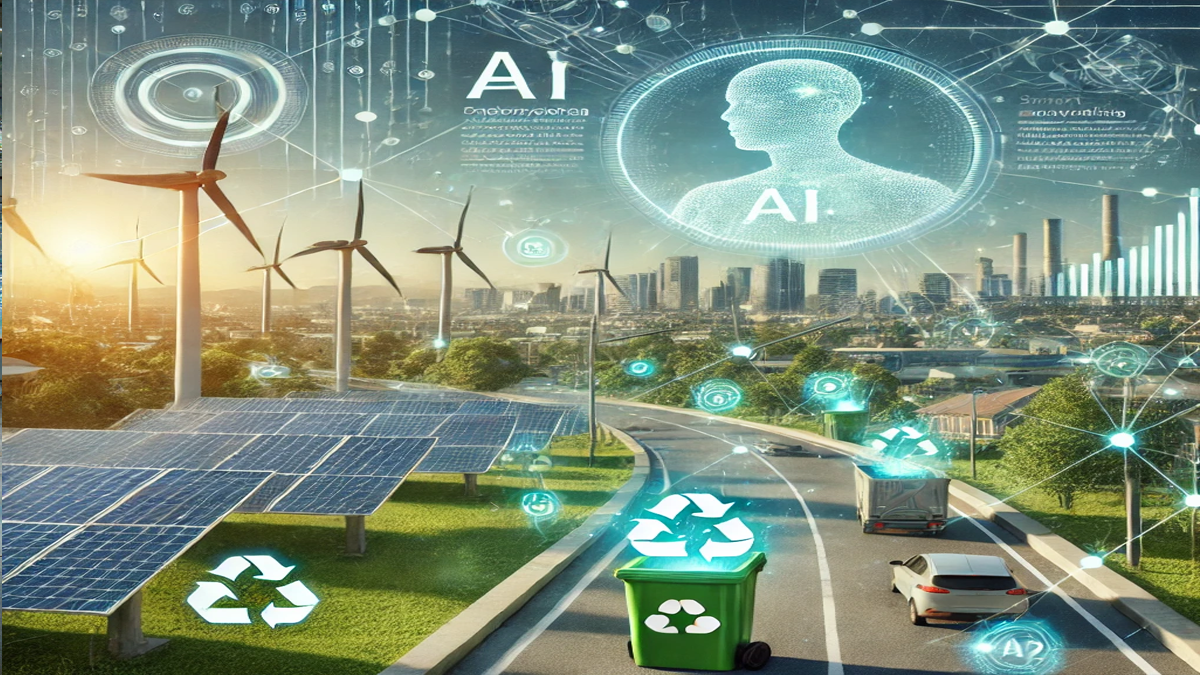
Explores how artificial intelligence shapes sustainability and green solutions, covering practical use cases, benefits, limitations, and risks.
#Infobox
AI-driven sustainability leverages artificial intelligence to optimize resource use, reduce waste, and enhance environmental monitoring, enabling smarter decision-making for a greener future.
AI and Sustainability: Green Solutions Field: Artificial Intelligence, Environmental Science Key Focus: Carbon footprint reduction, renewable energy optimization, waste management Major Applications: Smart grids, precision agriculture, climate modeling Notable Organizations: Google DeepMind, Microsoft AI for Earth, IBM Sustainability Accelerator First Developed: Early 2000s (with significant advancements post-2010)
#Overview
AI and sustainability represent a transformative intersection where artificial intelligence technologies are harnessed to address environmental challenges. This field integrates machine learning, data analytics, and automation to enhance efficiency in energy consumption, waste reduction, and natural resource management. By analyzing vast datasets, AI systems can predict environmental trends, optimize industrial processes, and support the transition to renewable energy sources. The goal is to create scalable, data-driven solutions that minimize ecological impact while fostering economic growth.
Key sectors benefiting from AI-driven sustainability include agriculture, energy, transportation, and urban planning. For instance, AI-powered smart grids balance energy supply and demand in real time, reducing reliance on fossil fuels. In agriculture, precision farming techniques use AI to optimize water and fertilizer use, cutting down on waste and pollution. Additionally, AI models assist in climate prediction, enabling policymakers to implement proactive measures against environmental degradation.
#History / Background
#Early Foundations
The conceptual roots of AI in sustainability trace back to the late 20th century, when early AI research focused on optimization and decision-making algorithms. However, practical applications were limited by computational power and data availability. The 1990s saw the emergence of environmental modeling tools that laid the groundwork for integrating AI with sustainability efforts.
#21st Century Advancements
The 2000s marked a turning point with the proliferation of big data and cloud computing, enabling AI systems to process and analyze environmental datasets at unprecedented scales. Projects like IBM’s “Smarter Planet” initiative (2008) demonstrated how AI could optimize urban infrastructure, including traffic management and energy distribution. The launch of open-source AI frameworks, such as TensorFlow (2015), further democratized access to AI tools for sustainability research.
#Modern Era
Since 2015, AI’s role in sustainability has expanded rapidly, driven by advancements in deep learning and reinforcement learning. Organizations like Google DeepMind have developed AI models to optimize data center cooling, reducing energy consumption by up to 40%. The COVID-19 pandemic (2020–2022) accelerated the adoption of AI in monitoring air quality and predicting environmental health risks. Today, AI is a cornerstone of global sustainability agendas, including the United Nations’ Sustainable Development Goals (SDGs).
#How It Works
#Core Technologies
AI-driven sustainability relies on several core technologies:
- Machine Learning (ML): Algorithms analyze historical and real-time data to identify patterns, such as energy consumption trends or deforestation rates. Supervised learning models predict outcomes (e.g., crop yields), while unsupervised learning detects anomalies (e.g., pollution spikes).
- Computer Vision: Used in satellite imagery and drones to monitor environmental changes, such as tracking deforestation or assessing water quality. Convolutional Neural Networks (CNNs) process visual data to classify land use or detect illegal mining activities.
- Natural Language Processing (NLP): Extracts insights from unstructured data, such as social media posts or scientific papers, to gauge public sentiment on environmental issues or identify emerging research trends.
- Reinforcement Learning (RL): Optimizes dynamic systems, such as traffic flow in smart cities or energy distribution in microgrids. RL agents learn from interactions with their environment to maximize efficiency and minimize waste.
#Key Applications
- **Energy Management:**AI systems optimize renewable energy integration by forecasting solar and wind power generation. For example, Google’s DeepMind reduced energy use in data centers by 40% using reinforcement learning to adjust cooling systems dynamically.
- **Waste Reduction:**AI-powered sorting robots in recycling facilities use computer vision to identify and separate materials, improving recycling rates by up to 30%. Startups like AMP Robotics employ AI to streamline waste management in municipalities.
- **Precision Agriculture:**AI analyzes soil health, weather patterns, and crop data to recommend optimal planting, irrigation, and harvesting schedules. Companies like John Deere use AI-driven tractors to reduce water and pesticide use by up to 20%.
- **Climate Modeling:**AI enhances climate prediction models by processing vast datasets from satellites, ocean buoys, and weather stations. NASA’s Earth Exchange (NEX) platform uses AI to simulate climate scenarios and assess the impact of policy decisions.
- **Smart Cities:**AI integrates with IoT sensors to manage urban resources, such as traffic lights that adapt to real-time congestion or water systems that detect leaks. Barcelona’s smart city initiatives reduced energy consumption by 25% using AI-driven urban planning.
#Important Facts
- Energy Savings: AI-driven data center optimization can reduce global data center energy consumption by 15%, equivalent to the annual electricity use of 1.5 million homes.
- Carbon Footprint Reduction: AI in logistics (e.g., route optimization for delivery trucks) can cut CO₂ emissions by up to 10% in supply chains.
- Biodiversity Monitoring: AI models analyze camera trap images to track endangered species, with accuracy rates exceeding 90% in some cases.
- Policy Impact: The European Union’s AI Act (2024) includes provisions for AI applications in sustainability, mandating transparency in high-risk environmental AI systems.
- Economic Growth: The global AI in sustainability market is projected to reach $15.5 billion by 2030, growing at a CAGR of 28.5% from 2023.
- Challenges: Despite progress, AI’s energy consumption remains a concern; training a single large language model can emit as much CO₂ as five cars over their lifetimes.
#Timeline
Year Event 1992 First use of AI in environmental modeling for predicting ozone depletion. 2008 IBM launches the "Smarter Planet" initiative, applying AI to urban sustainability. 2012 NASA’s Earth Exchange (NEX) platform debuts, using AI for climate data analysis. 2015 TensorFlow is open-sourced, enabling widespread AI adoption in sustainability research. 2018 Google DeepMind reduces data center energy use by 40% using reinforcement learning. 2020 AI tools are deployed globally to monitor air quality during the COVID-19 pandemic. 2022 Microsoft’s AI for Earth program expands to support 1,000+ sustainability projects. 2023 The EU proposes regulations for AI in sustainability, emphasizing ethical and low-carbon deployment. 2024 Global AI sustainability market surpasses $5 billion, with applications in 120+ countries.
#Related Terms
#FAQ
What does AI And Sustainability: Green Solutions cover?
Explores how artificial intelligence shapes sustainability and green solutions, covering practical use cases, benefits, limitations, and risks.
Why is AI And Sustainability: Green Solutions important?
It helps readers understand key concepts, compare practical use cases, and evaluate how Climate & Society decisions affect outcomes, risks, and implementation choices.
What should readers verify before applying this topic?
Readers should compare the benefits, limitations, data requirements, and related themes such as Sustainability, Green, Solution before using the ideas in real projects.
#References
- AI And Sustainability: Green Solutions terminology and background research
- AI And Sustainability: Green Solutions use cases, implementation examples, and limitations
- Climate & Society best practices, standards, and risk guidance
- Sustainability case studies, benchmarks, and current industry analysis


Comments
No comments yet. Start the discussion with a useful note.