

#Short Answer
Explores how artificial intelligence shapes sports and analytics and performance, covering practical use cases, benefits, limitations, and risks.
#Infobox
Artificial intelligence in sports analytics Field Sports Subfield Sports analytics Focus Performance analysis, Injury prevention, Tactical decision-making Key technologies Machine learning, computer vision, natural language processing, predictive modeling Notable applications Player tracking, game strategy optimization, fan engagement, sports medicine Major organizations NBA, NFL, FIFA, IOC, sports tech startups
#Overview
Artificial intelligence (AI) has become a transformative force in sports analytics, reshaping how teams, athletes, and organizations approach performance optimization, injury prevention, and fan engagement. By leveraging advanced algorithms and data-driven models, AI enables the extraction of meaningful patterns from complex datasets, including player biometrics, game footage, and opponent tendencies. This integration spans multiple domains within sports, from elite competitions to grassroots levels, and influences every aspect of the athletic ecosystem.
AI applications in sports analytics are categorized into four primary domains: performance analysis, tactical decision-making, injury prevention, and fan engagement. Performance analysis involves quantifying athlete output using metrics such as speed, acceleration, and endurance, often derived from wearable sensors and GPS tracking. Tactical decision-making utilizes AI to simulate game scenarios, predict opponent strategies, and recommend optimal plays. Injury prevention employs predictive models to identify risk factors and recommend load management strategies. Fan engagement leverages AI-powered platforms to deliver personalized content, predictive insights, and immersive experiences.
#History / Background
The roots of AI in sports trace back to the early adoption of statistical analysis in the late 20th century, often referred to as "Moneyball" after the 2003 book by Michael Lewis. This approach emphasized data-driven decision-making in baseball, using metrics like on-base percentage to evaluate player value. While not AI in the modern sense, these early efforts laid the foundation for quantitative sports analysis.
The transition to AI-driven analytics began in the 2010s with the proliferation of wearable technology and high-resolution video systems. The NBA pioneered the use of player tracking systems such as SportVU, which captured real-time motion data using multiple cameras. Concurrently, advancements in machine learning enabled the automatic detection of player actions, ball trajectories, and spatial formations from video footage.
By 2016, AI platforms like IBM Watson were deployed in tennis to analyze serve patterns and predict match outcomes. The FIFA introduced the FIFA Quality Programme for EPTS (Electronic Performance and Tracking Systems) in 2017, standardizing the use of AI-enabled tracking devices in football. Today, AI is embedded in training regimens, broadcast enhancements, and even referee decision support systems, such as the VAR in football.
#How it works
#Data collection
AI-powered sports analytics begins with comprehensive data collection. Multiple sources contribute to the dataset:
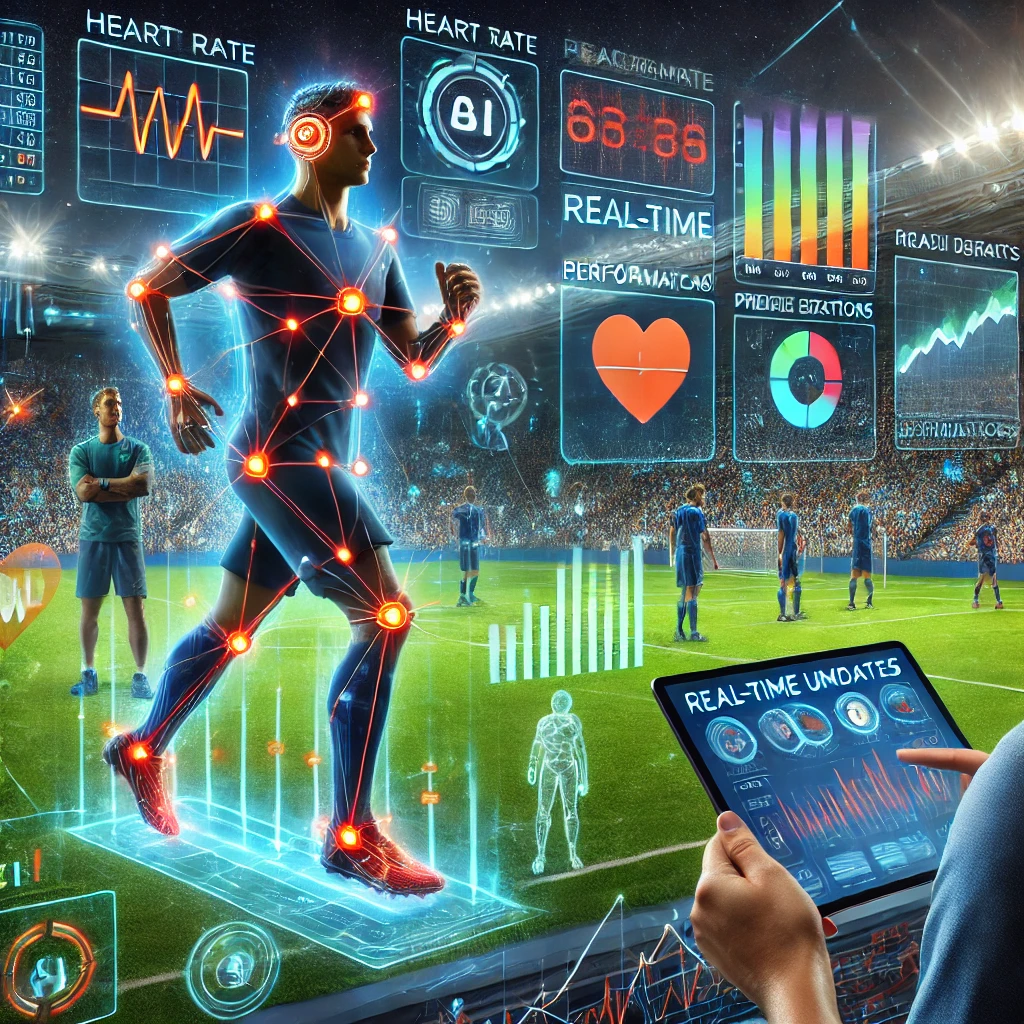
- Wearable sensors: Smart jerseys, GPS vests, and smartwatches collect biometric data such as heart rate, oxygen saturation, and muscle fatigue.
- Video tracking systems: High-definition cameras and depth sensors (e.g., Hawk-Eye, Second Spectrum) capture player movements, ball trajectories, and spatial positioning at up to 25 frames per second.
- Performance tracking devices: Devices like Catapult and STATSports monitor external load metrics such as distance covered, sprint counts, and accelerations.
- Biomechanical analysis tools: Force plates, motion capture systems, and 3D gait analysis provide insights into movement efficiency and injury risk.
- Historical and contextual data: Game statistics, weather conditions, opponent formations, and scouting reports are integrated to build predictive models.
#Data processing and analysis
Once collected, data is processed using AI algorithms:
- Computer vision: Convolutional neural networks (CNNs) and pose estimation models (e.g., OpenPose, MediaPipe) detect and track players, identify actions (e.g., passes, shots, tackles), and reconstruct 3D player positions.
- Machine learning models: Supervised learning models classify player actions, predict performance outcomes, and classify injury risks. Unsupervised learning clusters players based on playing styles or performance profiles.
- Predictive modeling: Time-series models (e.g., LSTM networks) forecast player fatigue, game outcomes, and injury likelihood based on historical and real-time data.
- Natural language processing (NLP): Analyzes coach-player interactions, fan sentiment on social media, and media coverage to assess psychological and public perception factors.
#Decision support and automation
AI systems provide actionable insights through:
- Real-time dashboards: Coaches and analysts receive live performance metrics, fatigue alerts, and tactical recommendations via mobile or desktop applications.
- Automated video tagging: AI systems tag game footage with key events (e.g., goals, fouls, substitutions), enabling rapid review and analysis.
- Simulation and scenario modeling: AI generates thousands of simulated game scenarios to evaluate optimal strategies under varying conditions.
- Personalized training programs: AI tailors drills and conditioning plans based on individual physiological profiles and performance goals.
#Important facts
- AI can reduce injury rates by up to 30% in elite football teams by identifying fatigue patterns and recommending load adjustments.
- The global sports analytics market is projected to reach $5.2 billion by 2028, growing at a CAGR of 21.4%.
- AI-powered VAR systems in football have increased the accuracy of offside decisions from 92% to 98.9%.
- In basketball, AI models predict the success rate of three-point shots based on shooter position, defender proximity, and historical performance, improving shot selection by 12–15%.
- Wearable AI devices like WHOOP and Catapult monitor over 100 biometric signals per second to optimize recovery and training load.
- AI is used in esports to analyze player behavior, detect cheating, and optimize team compositions in real time.
- Predictive models can forecast player market value with 85% accuracy up to 12 months in advance using performance, age, and transfer history data.
#Timeline
Year Milestone 1990s Early adoption of statistical analysis in baseball ("Moneyball" era begins) 2006 NBA deploys SportVU player tracking system 2013 IBM Watson analyzes tennis serve patterns at the US Open 2015 FIFA introduces EPTS standards for electronic performance tracking 2017 Second Spectrum deploys AI-powered analytics in the NBA 2019 VAR officially introduced in football at the FIFA Women's World Cup 2020 AI-driven injury prediction models adopted by Premier League clubs 2022 FIFA mandates semi-automated offside technology at the World Cup 2023 AI-generated personalized training apps for amateur athletes gain mainstream adoption
#Related Terms
#FAQ
What does AI And Sports: Analytics And Performance cover?
Explores how artificial intelligence shapes sports and analytics and performance, covering practical use cases, benefits, limitations, and risks.
Why is AI And Sports: Analytics And Performance important?
It helps readers understand key concepts, compare practical use cases, and evaluate how Sports decisions affect outcomes, risks, and implementation choices.
What should readers verify before applying this topic?
Readers should compare the benefits, limitations, data requirements, and related themes such as Sport, Analytic, Performance before using the ideas in real projects.
#References
- AI And Sports: Analytics And Performance terminology and background research
- AI And Sports: Analytics And Performance use cases, implementation examples, and limitations
- Sports best practices, standards, and risk guidance
- Sport case studies, benchmarks, and current industry analysis



Comments
No comments yet. Start the discussion with a useful note.