

#Short Answer
Explores how artificial intelligence shapes recommendations and smart suggestions, covering practical use cases, benefits, limitations, and risks.
#Infobox
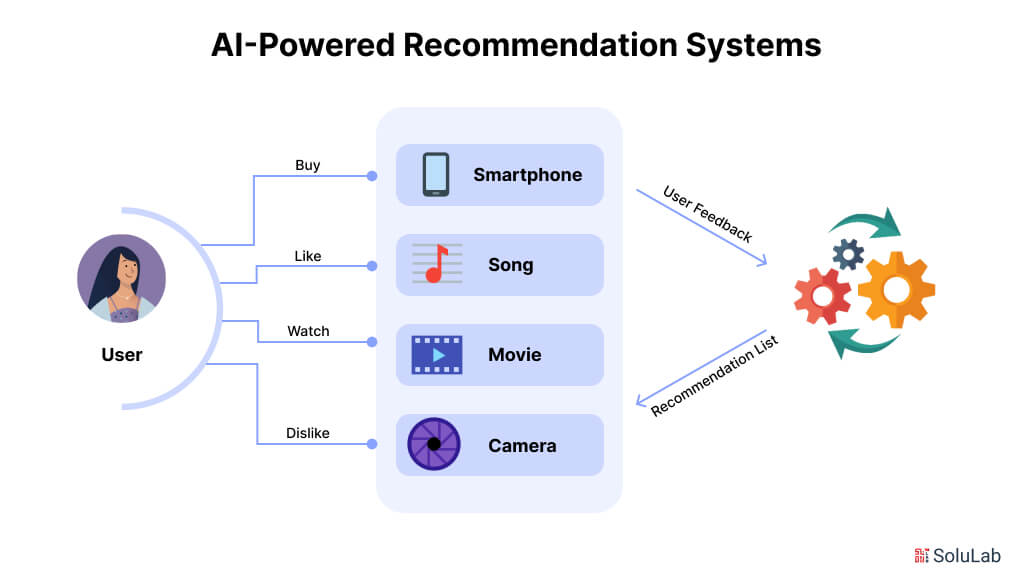
AI-powered recommendation systems are algorithms that predict user preferences by analyzing data patterns to suggest relevant content, products, or services.
Artificial Intelligence Recommendation Systems Type Machine Learning Algorithm Applications E-commerce, Streaming, Social Media Key Techniques Collaborative Filtering, Content-Based Filtering, Hybrid Models Developers Amazon, Netflix, Spotify, YouTube First Implementation 1990s (early digital platforms) Primary Goal Personalization & User Engagement
#Overview
AI recommendation systems are computational frameworks designed to analyze user behavior, preferences, and interactions to generate personalized suggestions. These systems leverage artificial intelligence, particularly machine learning and data analytics, to predict what a user might find useful or interesting. They are widely deployed across digital platforms such as e-commerce websites, streaming services, social media networks, and online content aggregators.
The core objective of these systems is to enhance user experience by reducing information overload and increasing engagement. By delivering tailored recommendations, they help users discover relevant products, videos, articles, or connections efficiently. The effectiveness of recommendation systems is often measured by metrics such as click-through rates, conversion rates, and user retention.
#History / Background
#Early Developments
The concept of automated recommendations traces back to the early 1990s with the rise of digital platforms. One of the earliest documented systems was the Tapestry system developed at Xerox PARC in 1992, which allowed users to annotate and filter documents based on collaborative feedback. This marked the beginning of collaborative filtering techniques.
In 1994, GroupLens, a research project at the University of Minnesota, introduced a collaborative filtering system for Usenet news articles. This innovation laid the groundwork for modern recommendation engines by demonstrating how user preferences could be aggregated to improve suggestions.
#Commercialization and Growth
The late 1990s and early 2000s saw the commercialization of recommendation systems. Amazon introduced its product recommendation engine in 1998, using item-to-item collaborative filtering to suggest books and other goods. This system became a benchmark for e-commerce personalization.
Netflix launched its recommendation algorithm in 2000, which evolved into a sophisticated machine learning model capable of predicting user preferences based on viewing history. The company's Cinematch system became a case study in the application of AI for content personalization.
By the 2010s, recommendation systems had become ubiquitous. Platforms like YouTube, Spotify, and Facebook integrated AI-driven suggestions to enhance user engagement and monetization through targeted advertising and content discovery.
#How It Works
#Data Collection
Recommendation systems rely on vast amounts of data, including:
- Explicit Feedback: User ratings, reviews, and direct preferences (e.g., thumbs up/down).
- Implicit Feedback: Browsing history, click patterns, purchase records, and time spent on content.
- Contextual Data: Time of day, device type, location, and demographic information.
- Item Metadata: Attributes such as genre, price, author, or technical specifications.
#Core Technologies
Several AI techniques underpin recommendation systems:
Collaborative Filtering
This method predicts user preferences by identifying patterns among users with similar behaviors. It operates on two main approaches:
- User-Based Collaborative Filtering: Recommends items liked by similar users.
- Item-Based Collaborative Filtering: Suggests items similar to those the user has previously liked.
Collaborative filtering is effective but suffers from the "cold start" problem—difficulty making recommendations for new users or items with insufficient interaction data.
Content-Based Filtering
This approach recommends items based on their attributes and the user's past preferences. It uses techniques such as:
- TF-IDF (Term Frequency-Inverse Document Frequency): Analyzes text-based content (e.g., articles, product descriptions).
- Feature Extraction: Identifies key characteristics of items (e.g., genre, price range).
Content-based filtering excels in domains with rich metadata but may struggle with diversity in recommendations.
Hybrid Models
To overcome the limitations of individual methods, hybrid systems combine collaborative and content-based filtering. Common strategies include:
- Weighted Hybrid: Combines scores from multiple models with weighted averaging.
- Feature Combination: Merges user and item features into a unified model.
- Cascade Hybrid: Uses one model to narrow down candidates, followed by another for ranking.
Hybrid models are widely adopted in industry due to their robustness and ability to handle diverse data types.
Deep Learning and Neural Networks
Modern recommendation systems increasingly utilize deep learning techniques, such as:
- Neural Collaborative Filtering (NCF): Uses neural networks to model user-item interactions.
- Autoencoders: Learns compressed representations of user preferences.
- Transformer Models: Leverages attention mechanisms to capture sequential patterns (e.g., in music or video recommendations).
These advanced models improve recommendation accuracy by capturing complex, non-linear relationships in data.
#Recommendation Pipeline
The process typically involves several stages:
- Data Preprocessing: Cleaning, normalization, and feature engineering.
- Model Training: Building and optimizing the recommendation algorithm.
- Candidate Generation: Retrieving a subset of potentially relevant items.
- Ranking: Ordering candidates based on predicted relevance.
- Presentation: Displaying recommendations to the user (e.g., "Recommended for You" sections).
#Important Facts
- Personalization Impact: Recommendation systems can increase conversion rates by up to 30% in e-commerce.
- Filter Bubbles: Over-reliance on recommendations may limit exposure to diverse content, creating echo chambers.
- Cold Start Problem: New users or items often receive poor recommendations due to lack of interaction data.
- Bias in Recommendations: Systems may perpetuate existing biases if trained on skewed datasets (e.g., favoring popular items).
- Real-Time Processing: Modern systems often use streaming data to update recommendations dynamically.
- Explainability: Transparent models (e.g., decision trees) are preferred in regulated industries like healthcare or finance.
#Timeline
Year Milestone 1992 Tapestry system developed at Xerox PARC (early collaborative filtering). 1994 GroupLens project introduces collaborative filtering for Usenet news. 1998 Amazon launches its product recommendation engine. 2000 Netflix introduces Cinematch, a rating-based recommendation system. 2006 Netflix Prize competition spurs advancements in collaborative filtering. 2010 YouTube and Spotify adopt AI-driven recommendation systems. 2016 Deep learning models (e.g., NCF) gain prominence in research. 2020 Transformer-based models (e.g., BERT4Rec) improve sequential recommendations.
#Related Terms
#FAQ
What does AI And Recommendations: Smart Suggestions cover?
Explores how artificial intelligence shapes recommendations and smart suggestions, covering practical use cases, benefits, limitations, and risks.
Why is AI And Recommendations: Smart Suggestions important?
It helps readers understand key concepts, compare practical use cases, and evaluate how Creative AI decisions affect outcomes, risks, and implementation choices.
What should readers verify before applying this topic?
Readers should compare the benefits, limitations, data requirements, and related themes such as Recommendation, Smart, Suggestion before using the ideas in real projects.
#References
- AI And Recommendations: Smart Suggestions terminology and background research
- AI And Recommendations: Smart Suggestions use cases, implementation examples, and limitations
- Creative AI best practices, standards, and risk guidance
- Recommendation case studies, benchmarks, and current industry analysis




Comments
No comments yet. Start the discussion with a useful note.