


#Short Answer
Explores how artificial intelligence shapes predictions and forecasting trends, covering practical use cases, benefits, limitations, and risks.
#Infobox
Artificial Intelligence in Market Trend Forecasting Field Artificial intelligence Subfield Predictive analytics, Demand forecasting Key Techniques Machine learning, deep learning, time-series analysis, neural networks Applications Retail, supply chain, finance, healthcare, manufacturing Notable Algorithms ARIMA, LSTM, Prophet, XGBoost, Random Forest Developed 2010s–Present Key Contributors Andrew Ng, Geoffrey Hinton, Yann LeCun, Jürgen Schmidhuber
#Overview
AI-driven demand forecasting leverages advanced computational techniques to analyze historical and real-time data, enabling businesses to anticipate market trends with greater precision. Unlike traditional statistical methods, AI models adapt to changing conditions, incorporate unstructured data (e.g., social media sentiment, weather patterns), and continuously improve through iterative learning. This approach minimizes overstocking and stockouts, enhances customer satisfaction, and drives operational efficiency.
The integration of AI in forecasting has expanded beyond traditional time-series analysis to include natural language processing (NLP) for sentiment analysis, computer vision for inventory tracking, and reinforcement learning for dynamic pricing strategies. Industries such as e-commerce, automotive, and pharmaceuticals increasingly rely on AI-powered tools to navigate volatile markets and consumer behavior shifts.
#History / Background
The foundations of AI-driven forecasting trace back to the 1950s with the advent of early machine learning concepts. However, practical applications emerged in the 1980s and 1990s with the development of statistical models like ARIMA (AutoRegressive Integrated Moving Average), which dominated demand forecasting until the 2010s.
The breakthrough came with the rise of deep learning and the availability of big data. In 2012, the ImageNet competition demonstrated the power of convolutional neural networks (CNNs), inspiring researchers to apply similar architectures to time-series forecasting. By 2016, companies like Amazon and Walmart began deploying AI-driven demand planning systems, marking a shift from rule-based to data-driven forecasting.
Key milestones include:
- 2014: Introduction of LSTM networks for sequential data prediction.
- 2017: Facebook open-sourced Prophet, a tool optimized for business forecasting.
- 2020: Widespread adoption of AI in supply chain management during the COVID-19 pandemic.
- 2023: Emergence of generative AI models (e.g., LLMs) for scenario planning and risk assessment.
#How It Works
#Data Collection and Preprocessing
AI forecasting systems ingest diverse data sources, including:
- Historical sales data
- Market trends and economic indicators
- Social media and web sentiment analysis
- Weather and geospatial data
- Supplier lead times and logistics data
Data is cleaned, normalized, and structured into time-series formats for model training. ### Model Training and Selection
Common AI models for forecasting include:
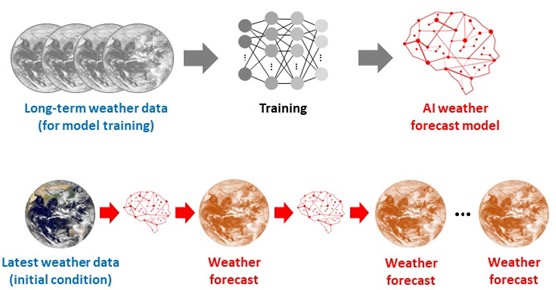
LSTM (Long Short-Term Memory) Specialized for sequential data, ideal for capturing long-term dependencies in sales trends. Prophet Developed by Facebook, optimized for business forecasting with built-in holiday effects and trend adjustments. XGBoost and Random Forest Ensemble methods that handle non-linear relationships and feature importance. Transformers Adapted from NLP, these models excel in capturing complex patterns in large datasets. Models are trained on historical data, validated using techniques like cross-validation, and fine-tuned for hyperparameters to minimize error metrics (e.g., MAE, RMSE).
#Deployment and Integration
Forecasting models are deployed via:
- Cloud platforms: AWS Forecast, Google Cloud AI, Azure Machine Learning.
- On-premise solutions: Custom-built pipelines using Python (e.g., TensorFlow, PyTorch).
- APIs: Real-time forecasting services integrated into enterprise resource planning (ERP) systems.
#Integration with IoT devices (e.g., RFID tags, smart shelves) enables dynamic updates based on real-time inventory levels. Important Facts
- Accuracy: AI models can reduce forecasting errors by up to 50% compared to traditional methods (McKinsey, 2022).
- Speed: Automated AI systems generate forecasts in minutes, whereas manual processes may take weeks.
- Cost Savings: Businesses using AI forecasting report a 10–40% reduction in inventory holding costs (Deloitte, 2023).
- Data Requirements: High-quality, diverse datasets are critical; poor data quality can lead to GIGO errors.
- Bias: AI models may inherit biases from training data, requiring regular audits and fairness checks.
- Explainability: Black-box models (e.g., deep neural networks) pose challenges for interpretability; techniques like SHAP values help address this.
#Timeline
Year Event 1950 Alan Turing proposes the Turing Test, laying groundwork for AI. 1960s Development of early statistical forecasting models (e.g., Box-Jenkins method). 1986 Backpropagation algorithm popularizes neural networks. 2006 Geoffrey Hinton introduces deep belief networks, reviving interest in deep learning. 2012 AlexNet wins ImageNet, proving the power of CNNs; applications in forecasting begin. 2016 Amazon and Walmart deploy AI-driven demand planning systems. 2017 Facebook releases Prophet, a tool for business forecasting. 2020 COVID-19 pandemic accelerates AI adoption in supply chain resilience. 2022 Generative AI models (e.g., LLMs) are explored for scenario planning. 2024 AI forecasting tools integrate with real-time data streams (e.g., IoT, satellite imagery).
#Related Terms
#FAQ
What does AI And Predictions: Forecasting Trends cover?
Explores how artificial intelligence shapes predictions and forecasting trends, covering practical use cases, benefits, limitations, and risks.
Why is AI And Predictions: Forecasting Trends important?
It helps readers understand key concepts, compare practical use cases, and evaluate how Artificial Intelligence decisions affect outcomes, risks, and implementation choices.
What should readers verify before applying this topic?
Readers should compare the benefits, limitations, data requirements, and related themes such as Prediction, Forecasting, Trend before using the ideas in real projects.
#References
- AI And Predictions: Forecasting Trends terminology and background research
- AI And Predictions: Forecasting Trends use cases, implementation examples, and limitations
- Artificial Intelligence best practices, standards, and risk guidance
- Prediction case studies, benchmarks, and current industry analysis



Comments
No comments yet. Start the discussion with a useful note.