

#Short Answer
Explores how artificial intelligence shapes no-code tools and democratizing AI, covering practical use cases, benefits, limitations, and risks.
#Infobox
AI and no-code tools are transforming software development by enabling non-experts to create applications without traditional programming. Artificial Intelligence and No-Code Tools Field Artificial intelligence, No-code development Key People Andrew Ng, Demis Hassabis, Satya Nadella Influential Figures Elon Musk, Fei-Fei Li, Yann LeCun Notable Companies Microsoft, Google, Salesforce, Zapier, Airtable First Developed 1950s (AI), 2010s (No-code AI tools) Current Status Rapidly evolving with increasing adoption
#Overview
Artificial Intelligence (AI) and no-code tools represent a paradigm shift in technology accessibility, enabling individuals without formal programming expertise to design, build, and deploy intelligent applications. AI refers to the simulation of human intelligence processes by machines, particularly computer systems, which includes learning, reasoning, and self-correction. No-code platforms, on the other hand, provide visual development environments where users can create software through drag-and-drop interfaces, pre-built templates, and automated workflows.
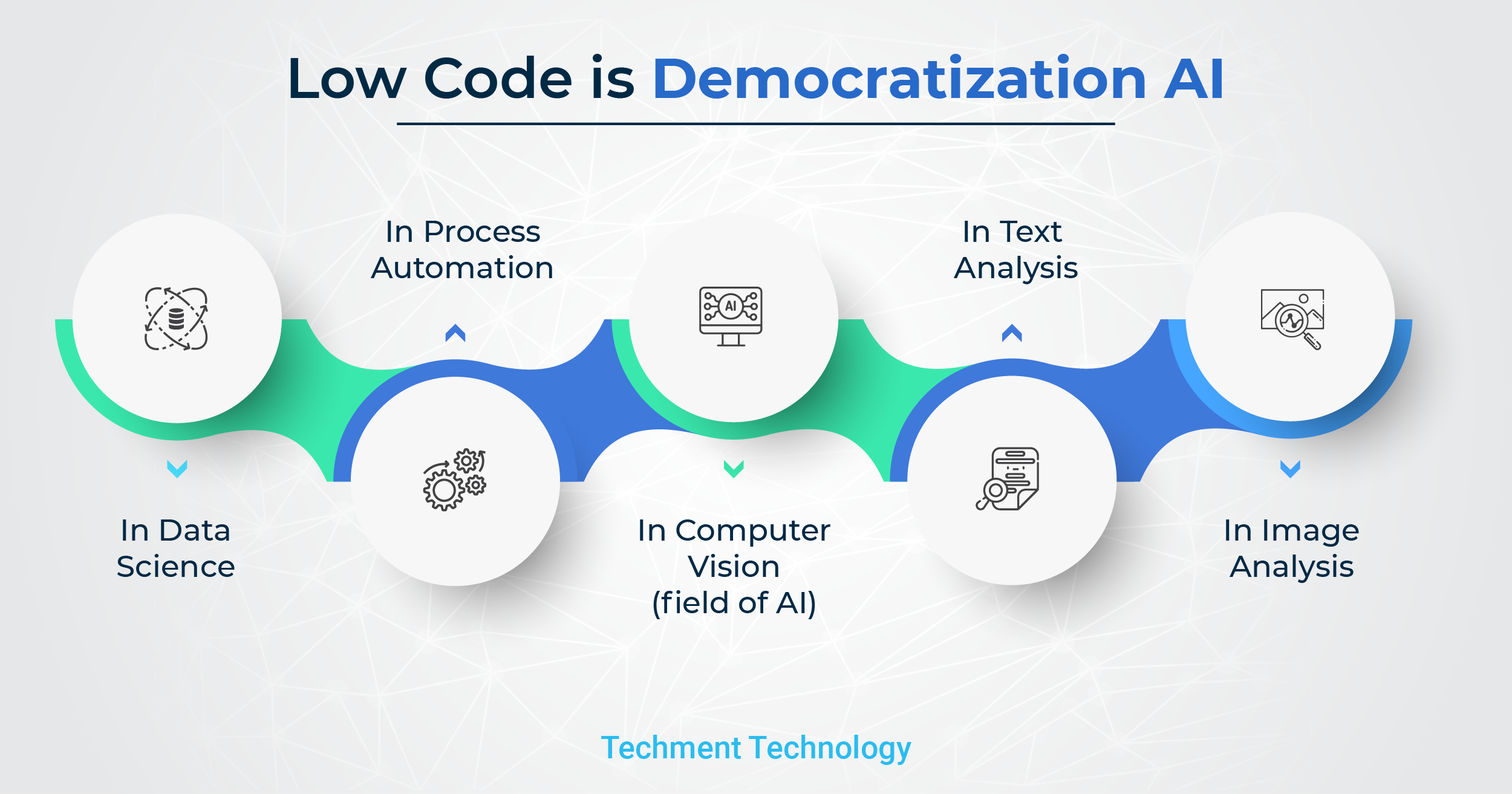
Together, these technologies democratize AI by lowering the barriers to entry, allowing businesses of all sizes, educators, and even hobbyists to harness the power of machine learning and automation without requiring deep technical knowledge. This fusion of AI and no-code development is accelerating digital transformation across industries, fostering innovation and operational efficiency.
#History / Background
#Evolution of AI
The concept of AI dates back to the mid-20th century. In 1950, Alan Turing proposed the Turing Test as a criterion for machine intelligence. The term "artificial intelligence" was coined in 1956 at the Dartmouth Conference, marking the official birth of AI as a field. Early AI systems, such as ELIZA (1966), demonstrated natural language processing capabilities, while expert systems like MYCIN (1970s) showcased rule-based reasoning.
Despite early enthusiasm, AI faced periods of reduced funding and interest known as "AI winters" in the 1970s and 1990s. However, breakthroughs in machine learning, particularly with the advent of neural networks and deep learning in the 2010s, revitalized the field. The availability of large datasets and powerful computing resources, especially GPUs, enabled models like AlexNet (2012) and AlphaGo (2016) to achieve superhuman performance in specific tasks.
#Rise of No-Code Development
No-code development emerged as a response to the growing complexity and cost of traditional software development. Early precursors include spreadsheet software like VisiCalc (1979) and database tools such as FileMaker (1980s), which allowed users to build applications without writing code. The modern no-code movement gained momentum in the 2010s with platforms like Webflow (2013), Zapier (2011), and Airtable (2012).
These platforms introduced visual interfaces, integrations with third-party services, and automation tools that eliminated the need for manual coding. The rise of cloud computing and API ecosystems further facilitated the growth of no-code solutions, enabling non-developers to connect services and build workflows with minimal technical overhead.
#How It Works
#AI in No-Code Platforms
No-code AI platforms integrate machine learning models into user-friendly interfaces, allowing users to train, deploy, and manage AI systems without writing code. These platforms typically offer the following features:
- Pre-trained Models: Ready-to-use models for tasks such as image recognition, natural language processing (NLP), and predictive analytics.
- Drag-and-Drop Interfaces: Visual tools for building AI pipelines, such as data preprocessing, model selection, and deployment.
- Automated Machine Learning (AutoML): Tools that automatically select algorithms, tune hyperparameters, and optimize model performance based on input data.
- Data Connectors: Integrations with databases, APIs, and cloud storage to facilitate data ingestion and processing.
- Deployment Wizards: One-click deployment options to web apps, mobile apps, or embedded systems.
#Common No-Code AI Tools
Several platforms have gained prominence for enabling AI democratization:
- Google Vertex AI: Provides AutoML capabilities for custom model training with minimal coding.
- Microsoft Power Platform: Combines Power Apps, Power Automate, and AI Builder to create AI-powered business applications.
- Salesforce Einstein: Embeds AI into CRM workflows for predictive analytics and automation.
- Zapier: Enables AI-driven automation across multiple apps without coding.
- Teachable Machine: Allows users to train simple image, sound, and pose recognition models in a browser.
#Important Facts
- Accessibility: No-code AI tools reduce the need for specialized skills, enabling small businesses and non-technical users to implement AI solutions.
- Cost Efficiency: By eliminating the need for hiring data scientists or developers, organizations can reduce development costs by up to 70%.
- Speed of Deployment: Applications that once took months to develop can now be built in days or weeks using no-code AI platforms.
- Customization: Many platforms support custom model training, allowing businesses to tailor AI solutions to their specific data and needs.
- Scalability: Cloud-based no-code AI solutions can scale with business growth, handling increased data volumes and user interactions.
- Regulatory Compliance: Some platforms include built-in tools for data governance and compliance with regulations like GDPR and CCPA.
#Timeline
Year Event 1950 Alan Turing publishes "Computing Machinery and Intelligence," introducing the Turing Test. 1956 Dartmouth Conference: Coining of the term "Artificial Intelligence." 1966 ELIZA, an early natural language processing program, is developed at MIT. 1980s Expert systems gain traction in industries like healthcare and finance. 2011 Zapier launches, pioneering no-code automation. 2012 AlexNet wins ImageNet competition, sparking deep learning revolution. 2013 Webflow is founded, enabling no-code website development. 2016 AlphaGo defeats world champion Lee Sedol in Go, demonstrating AI's potential. 2018 Google introduces AutoML, making machine learning accessible to non-experts. 2020 Microsoft Power Platform integrates AI Builder, expanding no-code AI capabilities. 2021 Teachable Machine enables browser-based AI model training for image, sound, and pose recognition. 2023 Generative AI tools like DALL-E and Stable Diffusion become available via no-code platforms.
#Related Terms
#FAQ
What does AI And No-Code Tools: Democratizing AI cover?
Explores how artificial intelligence shapes no-code tools and democratizing AI, covering practical use cases, benefits, limitations, and risks.
Why is AI And No-Code Tools: Democratizing AI important?
It helps readers understand key concepts, compare practical use cases, and evaluate how Technology decisions affect outcomes, risks, and implementation choices.
What should readers verify before applying this topic?
Readers should compare the benefits, limitations, data requirements, and related themes such as Nocode, Tool, Democratizing before using the ideas in real projects.
#References
- AI And No-Code Tools: Democratizing AI terminology and background research
- AI And No-Code Tools: Democratizing AI use cases, implementation examples, and limitations
- Technology best practices, standards, and risk guidance
- Nocode case studies, benchmarks, and current industry analysis


Comments
No comments yet. Start the discussion with a useful note.