

#Short Answer
Examines key questions about AI and job loss, including current uses, likely impacts, benefits, limitations, and risks.
#Infobox
#Overview
Artificial intelligence (AI) is reshaping the global labor market by automating repetitive, rule-based tasks and augmenting human capabilities in decision-making and creativity. By 2025, AI-driven automation is projected to affect approximately 300 million full-time jobs worldwide, according to McKinsey & Company. While this transformation threatens traditional employment in sectors like manufacturing and administrative services, it simultaneously generates new opportunities in AI development, data science, and human-AI collaboration roles.
The impact of AI on employment is not uniform; it varies by industry, geographic region, and skill level. High-income countries with advanced technological infrastructure face lower overall displacement risks due to higher adoption rates of AI tools and greater access to reskilling programs. Conversely, emerging economies with large manufacturing and service sectors are more vulnerable to job losses. Governments and organizations are increasingly focusing on policies that promote workforce adaptation, including upskilling initiatives and social safety nets to cushion the transition.
#History / Background
#Early developments
The concept of machines replacing human labor dates back to the Industrial Revolution, when mechanization transformed agriculture and manufacturing. However, the modern discussion around AI and job displacement began in the late 20th century with the advent of computer automation. Early AI systems, such as expert systems in the 1980s, demonstrated the potential to perform specialized tasks but were limited by computational constraints.
The 2010s marked a turning point with breakthroughs in machine learning, particularly deep learning, which enabled AI systems to process vast datasets and perform complex tasks like image recognition, natural language processing, and predictive analytics. Companies like Google, Amazon, and Tesla began integrating AI into their operations, leading to automation in logistics, customer service, and even autonomous driving.
#Modern impact
By 2020, AI-driven automation had expanded into white-collar professions, including legal research, financial analysis, and medical diagnostics. The COVID-19 pandemic accelerated this trend, as businesses sought to reduce human contact and improve efficiency through automation. Reports from the World Economic Forum (2023) indicated that AI could displace 85 million jobs globally by 2025 while creating 97 million new roles, reflecting a net positive shift in employment dynamics.
Governments and international bodies have responded with initiatives such as the European Union’s AI Act and the United States’ Infrastructure Investment and Jobs Act, which allocate funding for workforce development and AI ethics. These policies aim to balance innovation with social equity, ensuring that the benefits of AI are distributed across all segments of society.
#How it works
#Automation mechanisms
AI automates jobs through several mechanisms, primarily driven by advancements in machine learning (ML) and robotic process automation (RPA). ML algorithms analyze large datasets to identify patterns and make predictions, enabling AI systems to perform tasks such as fraud detection, customer service chatbots, and supply chain optimization. RPA, on the other hand, mimics human interactions with digital systems, automating repetitive tasks like data entry, invoice processing, and email filtering.
In manufacturing, robotics and computer vision systems are increasingly used for assembly, quality control, and inventory management. AI-powered cobots (collaborative robots) work alongside human workers, enhancing productivity while reducing the need for manual labor. In the service sector, AI-driven tools like virtual assistants and recommendation engines are replacing roles in telemarketing, basic accounting, and even radiology, where deep learning models analyze medical images with high accuracy.
#Human-AI collaboration
While AI excels at processing data and performing repetitive tasks, human workers remain essential for roles requiring creativity, emotional intelligence, and complex decision-making. The future of work lies in human-AI collaboration, where AI augments human capabilities rather than replacing them entirely. For example, AI tools assist doctors in diagnosing diseases by analyzing medical records and imaging data, while radiologists interpret the results and make final decisions. Similarly, in software development, AI-powered code generators streamline coding tasks, allowing developers to focus on innovation and problem-solving.
#Important facts
- Job displacement vs. job creation: While AI is expected to displace 300 million jobs by 2025, it is also projected to create 97 million new roles, particularly in AI ethics, cybersecurity, and AI system maintenance.
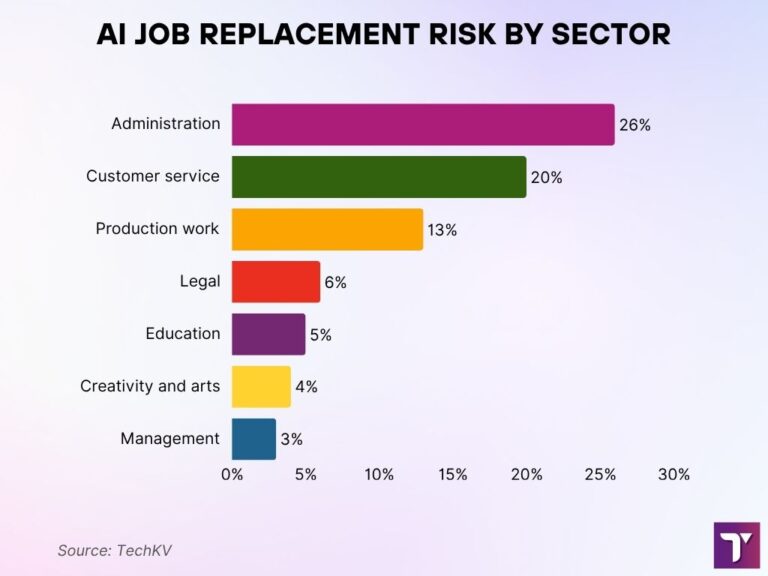
- Sector-specific risks: Manufacturing, customer service, and administrative roles face the highest automation risks, whereas healthcare, education, and creative industries are less susceptible to full replacement.
- Geographic disparities: Countries like China and India, with large manufacturing sectors, face higher automation risks compared to nations with advanced service economies, such as the United States and Germany.
- Reskilling challenges: The World Economic Forum estimates that by 2025, 50% of all employees will need reskilling, with an average investment of $6.5 trillion required globally to adapt workforces to AI-driven changes.
- AI bias and fairness: Automated hiring tools and AI-driven decision-making systems have faced criticism for perpetuating biases, highlighting the need for ethical AI frameworks and regulatory oversight.
- Economic impact: AI-driven productivity gains could add $15.7 trillion to the global economy by 2030, according to PwC, but this growth may exacerbate income inequality if not managed equitably.
#Timeline
Key milestones in AI and job displacementYearEventImpact1950sDevelopment of early AI concepts (e.g., Turing Test)Laying the foundation for machine intelligence and automation.1980sIntroduction of expert systems in industriesAutomation of specialized tasks in finance, healthcare, and manufacturing.2000sRise of machine learning and big data analyticsEnabling AI systems to process large datasets and perform complex tasks.2012Breakthrough in deep learning (AlexNet)Accelerating AI adoption in image recognition, speech processing, and autonomous systems.2016AlphaGo defeats world champion in GoDemonstrating AI’s ability to outperform humans in complex decision-making.2020COVID-19 pandemic accelerates AI adoptionBusinesses adopt automation to reduce human contact and improve efficiency.2023McKinsey estimates 300 million jobs at risk by 2025Highlighting the urgency of workforce adaptation and policy interventions.2024World Economic Forum predicts 97 million new AI-related jobs by 2025Emphasizing the need for reskilling and education reform.2025Implementation of AI ethics regulations (e.g., EU AI Act)Establishing frameworks for responsible AI deployment and workforce transition.
#Related Terms
#FAQ
What does AI And Job Loss: Should We Be Worried? cover?
Examines key questions about AI and job loss, including current uses, likely impacts, benefits, limitations, and risks.
Why is AI And Job Loss: Should We Be Worried? important?
It helps readers understand key concepts, compare practical use cases, and evaluate how Artificial Intelligence decisions affect outcomes, risks, and implementation choices.
What should readers verify before applying this topic?
Readers should compare the benefits, limitations, data requirements, and related themes such as Job, Loss, Should before using the ideas in real projects.
#References
- AI And Job Loss: Should We Be Worried? terminology and background research
- AI And Job Loss: Should We Be Worried? use cases, implementation examples, and limitations
- Artificial Intelligence best practices, standards, and risk guidance
- Job case studies, benchmarks, and current industry analysis


Comments
No comments yet. Start the discussion with a useful note.