

#Short Answer
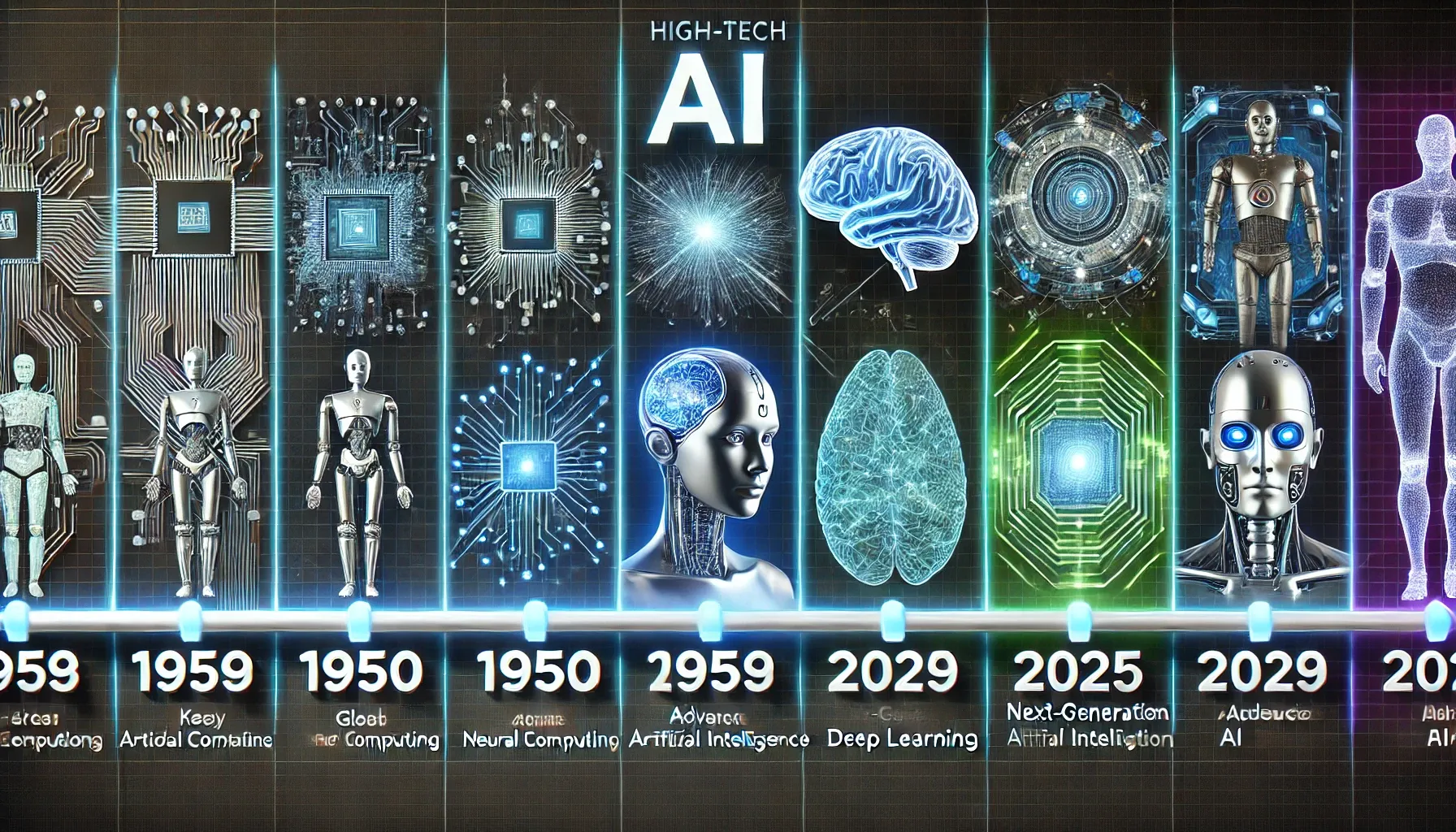
Explores how artificial intelligence shapes history and shaping the future, covering practical use cases, benefits, limitations, and risks.
#Infobox
Artificial Intelligence Field Computer science Subfields Machine learning, Natural language processing, Computer vision, Robotics Key Figures Alan Turing, John McCarthy, Marvin Minsky, Geoffrey Hinton Notable Achievements Deep Blue, AlphaGo, ChatGPT, DALL-E Applications Healthcare, finance, transportation, education, entertainment Ethical Concerns Bias, privacy, job displacement, autonomous weapons
#Overview
Artificial Intelligence is a transformative technology that mimics human cognitive functions, including reasoning, learning, and problem-solving. Unlike traditional software, AI systems improve over time through exposure to data, a process known as machine learning. The field has evolved from theoretical concepts to practical applications, driving innovation in automation, decision-making, and predictive analytics.
AI is categorized into two main types: narrow AI, designed for specific tasks (e.g., facial recognition), and general AI, which aims to replicate human-like intelligence across diverse domains. While narrow AI is prevalent today, general AI remains a long-term goal. The integration of AI into daily life has raised ethical and societal questions, including concerns about job displacement, algorithmic bias, and privacy.
#History / Background
#Early Concepts and Theoretical Foundations
The origins of AI trace back to ancient myths and philosophical debates about the nature of intelligence. In the 17th century, philosopher René Descartes pondered whether machines could ever achieve human-like thought. The 19th century saw the emergence of formal logic, with George Boole's Boolean algebra laying groundwork for computational reasoning.
The term "artificial intelligence" was coined in 1956 by John McCarthy during the Dartmouth Conference, marking the birth of AI as a formal discipline. Early pioneers like Alan Turing proposed the Turing Test in 1950, a benchmark for machine intelligence, while Marvin Minsky and others explored neural networks.
#AI Winters and Resurgence
The field experienced cycles of optimism and disillusionment, known as "AI winters," due to overpromised capabilities and limited computational power. The first AI winter (1974–1980) followed failed projects like machine translation and expert systems. A second winter (1987–1993) occurred after the collapse of the Lisp machine market and reduced funding.
The late 1990s and early 2000s saw a resurgence, fueled by advancements in computing power, big data, and algorithms. Key milestones included IBM's Deep Blue defeating chess champion Garry Kasparov in 1997 and the rise of machine learning techniques like support vector machines.
#Modern AI and Deep Learning
The 2010s marked a paradigm shift with the advent of deep learning, a subset of machine learning inspired by the structure of the human brain. Convolutional neural networks (CNNs) revolutionized computer vision, enabling breakthroughs in image recognition. Natural language processing (NLP) also advanced, culminating in models like BERT and GPT.
Companies like Google, Microsoft, and OpenAI have driven AI innovation, developing tools such as AlphaGo, which defeated a world champion Go player in 2016, and ChatGPT, a conversational AI model released in 2022.
#How It Works
#Machine Learning
Machine learning enables systems to learn from data without explicit programming. It relies on algorithms that identify patterns and make predictions. Key techniques include:
- Supervised Learning: Models are trained on labeled data (e.g., spam detection).
- Unsupervised Learning: Models find patterns in unlabeled data (e.g., customer segmentation).
- Reinforcement Learning: Agents learn by interacting with an environment to maximize rewards (e.g., robotics, gaming).
#Neural Networks
Inspired by biological neurons, neural networks consist of interconnected layers of nodes (neurons). Deep learning uses multiple layers to extract hierarchical features from data. Types include:
- Feedforward Neural Networks: Data flows in one direction (e.g., image classification).
- Recurrent Neural Networks (RNNs): Handle sequential data (e.g., time-series forecasting).
- Convolutional Neural Networks (CNNs): Optimized for grid-like data (e.g., photos).
#Natural Language Processing
NLP enables machines to understand, generate, and manipulate human language. Techniques include:
- Tokenization: Breaking text into words or phrases.
- Sentiment Analysis: Determining emotional tone in text.
- Machine Translation: Converting text between languages (e.g., Google Translate).
#Important Facts
- First AI Program: The Logic Theorist, developed by Allen Newell and Herbert A. Simon in 1956, proved mathematical theorems.
- Moore's Law Impact: The doubling of computing power every two years has accelerated AI development.
- AI in Healthcare: IBM Watson assists in diagnosing diseases, while AI models predict patient outcomes.
- Ethical AI: Initiatives like the Asilomar AI Principles aim to guide responsible AI development.
- AI Bias: Algorithms can perpetuate biases present in training data (e.g., facial recognition inaccuracies for certain demographics).
#Timeline
Year Event 1950 Alan Turing publishes "Computing Machinery and Intelligence," introducing the Turing Test. 1956 John McCarthy coins the term "artificial intelligence" at the Dartmouth Conference. 1966 ELIZA, an early NLP program, simulates conversation. 1997 IBM's Deep Blue defeats world chess champion Garry Kasparov. 2011 IBM Watson wins Jeopardy!, showcasing NLP capabilities. 2016 AlphaGo defeats Lee Sedol in the board game Go. 2020 OpenAI releases GPT-3, a language model with 175 billion parameters. 2022 ChatGPT is launched, sparking widespread interest in generative AI.
#Related Terms
#FAQ
What does AI And History: Shaping The Future cover?
Explores how artificial intelligence shapes history and shaping the future, covering practical use cases, benefits, limitations, and risks.
Why is AI And History: Shaping The Future important?
It helps readers understand key concepts, compare practical use cases, and evaluate how Artificial Intelligence decisions affect outcomes, risks, and implementation choices.
What should readers verify before applying this topic?
Readers should compare the benefits, limitations, data requirements, and related themes such as History, Shaping, Future before using the ideas in real projects.
#References
- AI And History: Shaping The Future terminology and background research
- AI And History: Shaping The Future use cases, implementation examples, and limitations
- Artificial Intelligence best practices, standards, and risk guidance
- History case studies, benchmarks, and current industry analysis


Comments
No comments yet. Start the discussion with a useful note.